70-764 Exam Details
-
Exam Code
:70-764 -
Exam Name
:Administering a SQL Database Infrastructure -
Certification
:Microsoft Certifications -
Vendor
:Microsoft -
Total Questions
:452 Q&As -
Last Updated
:Feb 07, 2022
Microsoft 70-764 Online Questions & Answers
-
Question 361:
DRAG DROP
You have a database named DB1 that contains the primary file group and two other file groups named CurrectData and HistoricalData. CurrentData contains 320 GB of active data that is updated frequently. HistoricalData is read-only and contains 1.7 TB of data.
You have a backup schedule configured as show in the following table.
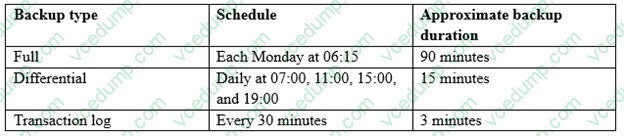
DB1 fails at 08:42 on Monday. You deploy a new server.
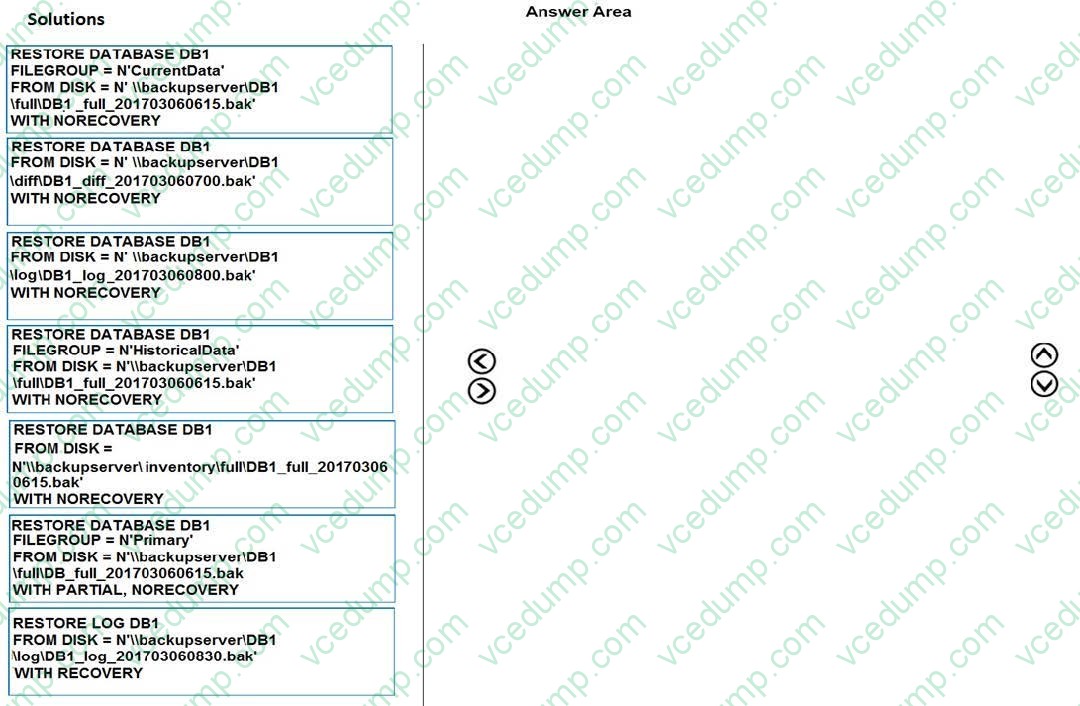
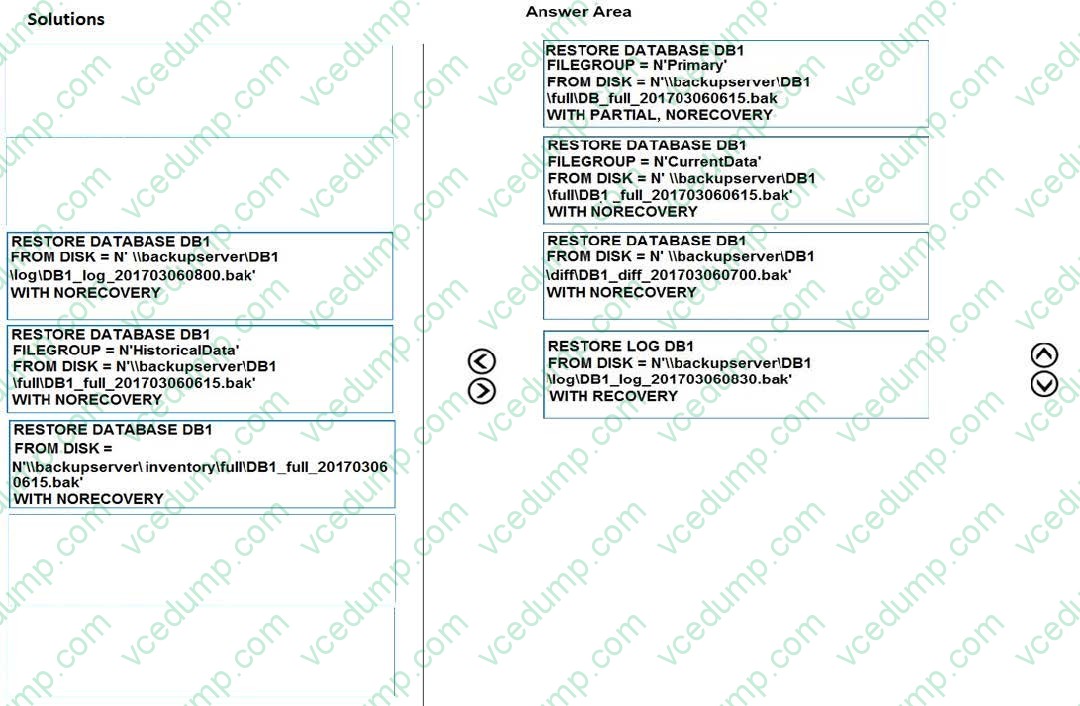
You need to recover CurrentData as quickly as possible on the new server. The solution must minimize the amount of data loss.
Which four statements should you execute in sequence? To answer, move the appropriate statements from the list of statements to the answer area and arrange them in the correct order.
Select and Place:
-
Question 362:
Note: This question is part of a series of questions that use the same or similar answer choices. An answer choice may be correct for more than one question in the series. Each question is independent of the other questions in this series.
Information and details provided in a question apply only to that question.
You collect performance metrics on multiple Microsoft SQL Server instances and store the data in a single repository.
You need to examine disk usage, query statistics, and server activity without building custom counters.
What should you use?
A. Activity Monitor
B. Sp_who3 stored procedure
C. Object Explorer in the Microsoft SQL Server Management Studio (SSMS)
D. SQL Server Data Collector
E. SQL Server Data Tools (SSDT)
F. SQL Server Configuration Manager -
Question 363:
You are creating a database that will store usernames and credit card numbers for an application. You need to recommend a solution to store and reuse the credit card numbers in the database. What should you recommend? More than one answer choice may achieve the goal. Select the BEST answer.
A. Data encryption
B. Transparent Data Encryption (TDE)
C. Encrypting File System (EFS)
D. Data hashing -
Question 364:
You administer a Microsoft SQL Server 2016 database that has Trustworthy set to On.
You create a stored procedure that returns database-level information from Dynamic Management Views. You grant User1 access to execute the stored procedure.
You need to ensure that the stored procedure returns the required information when User1 executes the stored procedure.
You need to achieve this goal by granting the minimum permissions required.
What should you do? (Each correct answer presents a complete solution. Choose all that apply.)
A. Create a SQL Server login that has VIEW SERVER STATE permissions. Create an application role and a secured password for the role.
B. Modify the stored procedure to include the EXECUTE AS OWNER statement. Grant VIEW SERVER STATE permissions to the owner of the stored procedure.
C. Create a SQL Server login that has VIEW SERVER STATE permissions. Modify the stored procedure to include the EXECUTE AS {newlogin} statement.
D. Grant the db_owner role on the database to User1.
E. Grant the sysadmin role on the database to User1. -
Question 365:
Note: This question is part of a series of questions that use the same scenario. For your convenience, the scenario is repeated in each question. Each question presents a different goal and answer choices, but the text of the scenario is
exactly the same in each question in this series.
Start of repeated scenario.
You have five servers that run Microsoft Windows 2012 R2. Each server hosts a Microsoft SQL Server instance. The topology for the environment is shown in the following diagram.
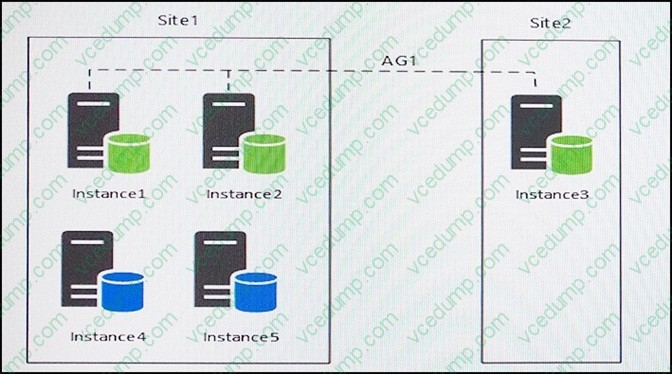
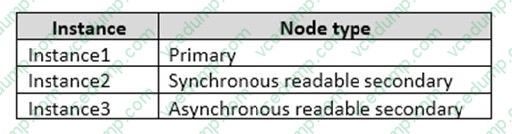
You have an Always On Availability group named AG1. The details for AG1 are shown in the following table.
Instance1 experiences heavy read-write traffic. The instance hosts a database named OperationsMain that is four terabytes (TB) in size. The database has multiple data files and filegroups. One of the filegroups is read_only and is half of the
total database size.
Instance4 and Instance5 are not part of AG1. Instance4 is engaged in heavy read-write I/O.
Instance5 hosts a database named StagedExternal. A nightly BULK INSERT process loads data into an empty table that has a rowstore clustered index and two nonclustered rowstore indexes.
You must minimize the growth of the StagedExternal database log file during the BULK INSERT operations and perform point-in-time recovery after the BULK INSERT transaction. Changes made must not interrupt the log backup chain.
You plan to add a new instance named Instance6 to a datacenter that is geographically distant from Site1 and Site2. You must minimize latency between the nodes in AG1.
All databases use the full recovery model. All backups are written to the network location \\SQLBackup\. A separate process copies backups to an offsite location. You should minimize both the time required to restore the databases and the
space required to store backups. The recovery point objective (RPO) for each instance is shown in the following table.
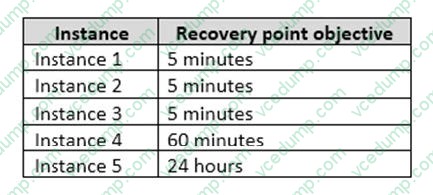
Full backups of OperationsMain take longer than six hours to complete. All SQL Server backups use the keyword COMPRESSION.
You plan to deploy the following solutions to the environment. The solutions will access a database named DB1 that is part of AG1.
Reporting system: This solution accesses data inDB1with a login that is mapped to a database user that is a member of the db_datareader role. The user has EXECUTE permissions on the database. Queries make no changes to the data.
The queries must be load balanced over variable read-only replicas.
Operations system: This solution accesses data inDB1with a login that is mapped to a database user that is a member of the db_datareader and db_datawriter roles. The user has EXECUTE permissions on the database. Queries from the
operations system will perform both DDL and DML operations.
The wait statistics monitoring requirements for the instances are described in the following table.

End of repeated scenario.
You need to create a backup plan for Instance4.
Which backup plan should you create?
A. Weekly full backups, nightly differential backups, transaction log backups every 30 minutes.
B. Weekly full backups, nightly differential. No transaction log backups are necessary.
C. Weekly full backups, nightly differential backups, transaction log backups every 12 hours.
D. Full backups every 60 minutes, transaction log backups every 30 minutes. -
Question 366:
Note: This question is part of a series of questions that use the same or similar answer choices. An answer choice may be correct for more than one question in the series. Each question is independent of the other questions in this series.
Information and details provided in a question apply only to that question.
You manage a Microsoft SQL Server environment. You implement Transparent Data Encryption (TDE).
A user will assist in managing TDE.
You need to ensure that the user can view the TDE metadata while following the principle of least privilege.
Which permission should you grant?
A. DDLAdmin
B. db_datawriter
C. dbcreator
D. dbo
E. View Database State
F. View Server State
G. View Definition
H. sysadmin -
Question 367:
Overview
Application Overview
Contoso, Ltd., is the developer of an enterprise resource planning (ERP) application.
Contoso is designing a new version of the ERP application. The previous version of the ERP application used SQL Server 2008 R2.
The new version will use SQL Server 2014.
The ERP application relies on an import process to load supplier data. The import process updates thousands of rows simultaneously, requires exclusive access to the database, and runs daily. You receive several support calls reporting
unexpected behavior in the ERP application. After analyzing the calls, you conclude that users made changes directly to the tables in the database.
Tables
The current database schema contains a table named OrderDetails.
The OrderDetails table contains information about the items sold for each purchase order. OrderDetails stores the product ID, quantities, and discounts applied to each product in a purchase order. The product price is stored in a table named
Products. The Products table was defined by using the SQL_Latin1_General_CP1_CI_AS collation.
A column named ProductName was created by using the varchar data type. The database contains a table named Orders.
Orders contains all of the purchase orders from the last 12 months. Purchase orders that are older than 12 months are stored in a table named OrdersOld.
The previous version of the ERP application relied on table-level security.
Stored Procedures
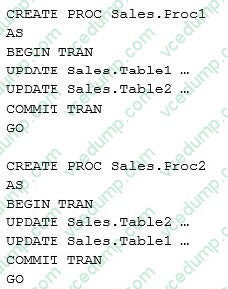
The current version of the database contains stored procedures that change two tables. The following shows the relevant portions of the two stored procedures:
Customer Problems
Installation Issues
The current version of the ERP application requires that several SQL Server logins be set up to function correctly. Most customers set up the ERP application in multiple locations and must create logins multiple times.
Index Fragmentation Issues
Customers discover that clustered indexes often are fragmented. To resolve this issue, the customers defragment the indexes more frequently. All of the tables affected by fragmentation have the following columns that are used as the
clustered index key:

Backup Issues
Customers who have large amounts of historical purchase order data report that backup time is unacceptable.
Search Issues
Users report that when they search product names, the search results exclude product names that contain accents, unless the search string includes the accent.
Missing Data Issues
Customers report that when they make a price change in the Products table, they cannot retrieve the price that the item was sold for in previous orders.
Query Performance Issues
Customers report that query performance degrades very quickly. Additionally, the customers report that users cannot run queries when SQL Server runs maintenance tasks. Import Issues During the monthly import process, database
administrators receive many supports call from users who report that they cannot access the supplier data. The database administrators want to reduce the amount of time required to import the data.
Design Requirements
File Storage Requirements
The ERP database stores scanned documents that are larger than 2 MB. These files must only be accessed through the ERP application. File access must have the best possible read and write performance.
Data Recovery Requirements
If the import process fails, the database must be returned to its prior state immediately.
Security Requirements
You must provide users with the ability to execute functions within the ERP application, without having direct access to the underlying tables.
Concurrency Requirements
You must reduce the likelihood of deadlocks occurring when Sales.Prod and Sales.Proc2 execute.
You need to recommend a solution that addresses the security requirement. What should you recommend?
A. Revoke user permissions on the tables. Create stored procedures that manipulate data. Grant the users the EXECUTE permission on the stored procedures.
B. Grant the users the SELECT permission on the tables. Create views that retrieve data from the tables. Grant the users the SELECT permission on the views.
C. Deny the users SELECT permission on the tables. Create views that retrieve data from the tables. Grant the users the SELECT permission on the views.
D. Deny the users the SELECT permission on the tables. Create stored procedures that manipulate data. Grant the users the EXECUTE permission on the stored procedures. -
Question 368:
You create a stored procedure that retrieves all of the rows from a table named Table1.
You need to recommend a solution to ensure that all of the statements in the stored procedure can be executed if another transaction is modifying rows in Table1 simultaneously.
What should you recommend?
A. Snapshot isolation
B. A database snapshot
C. Filegroups
D. Indexes -
Question 369:
You have an application that queries a database. Users report that the application is slower than expected.
You discover that several server process identifiers (SPIDs) have PAGELATCH_UP and PAGELATCH_EX waits. The resource descriptions of the SPIDs contains 2:1:1.
You need to resolve the issue.
What should you do?
A. Allocate additional processor cores to the server.
B. Add files to the file group of the application database.
C. Reduce the fill factor of all clustered indexes.
D. Add data files to tempdb. -
Question 370:
Overview
Application Overview
Contoso, Ltd., is the developer of an enterprise resource planning (ERP) application.
Contoso is designing a new version of the ERP application. The previous version of the ERP application used SQL Server 2008 R2.
The new version will use SQL Server 2014.
The ERP application relies on an import process to load supplier data. The import process updates thousands of rows simultaneously, requires exclusive access to the database, and runs daily. You receive several support calls reporting
unexpected behavior in the ERP application. After analyzing the calls, you conclude that users made changes directly to the tables in the database.
Tables
The current database schema contains a table named OrderDetails.
The OrderDetails table contains information about the items sold for each purchase order. OrderDetails stores the product ID, quantities, and discounts applied to each product in a purchase order. The product price is stored in a table named
Products. The Products table was defined by using the SQL_Latin1_General_CP1_CI_AS collation.
A column named ProductName was created by using the varchar data type. The database contains a table named Orders.
Orders contains all of the purchase orders from the last 12 months. Purchase orders that are older than 12 months are stored in a table named OrdersOld.
The previous version of the ERP application relied on table-level security.
Stored Procedures
The current version of the database contains stored procedures that change two tables. The following shows the relevant portions of the two stored procedures:
Customer Problems
Installation Issues
The current version of the ERP application requires that several SQL Server logins be set up to function correctly. Most customers set up the ERP application in multiple locations and must create logins multiple times.
Index Fragmentation Issues
Customers discover that clustered indexes often are fragmented. To resolve this issue, the customers defragment the indexes more frequently. All of the tables affected by fragmentation have the following columns that are used as the
clustered index key:
Backup Issues
Customers who have large amounts of historical purchase order data report that backup time is unacceptable.
Search Issues
Users report that when they search product names, the search results exclude product names that contain accents, unless the search string includes the accent.
Missing Data Issues
Customers report that when they make a price change in the Products table, they cannot retrieve the price that the item was sold for in previous orders.
Query Performance Issues
Customers report that query performance degrades very quickly. Additionally, the customers report that users cannot run queries when SQL Server runs maintenance tasks. Import Issues During the monthly import process, database
administrators receive many supports call from users who report that they cannot access the supplier data. The database administrators want to reduce the amount of time required to import the data.
Design Requirements
File Storage Requirements
The ERP database stores scanned documents that are larger than 2 MB. These files must only be accessed through the ERP application. File access must have the best possible read and write performance.
Data Recovery Requirements
If the import process fails, the database must be returned to its prior state immediately.
Security Requirements
You must provide users with the ability to execute functions within the ERP application, without having direct access to the underlying tables.
Concurrency Requirements
You must reduce the likelihood of deadlocks occurring when Sales.Prod and Sales.Proc2 execute.
You need to recommend a solution that addresses the installation issues.
What should you include in the recommendation?
A. Windows logins
B. Server roles
C. Contained users
D. Database roles
Related Exams:
-
62-193
Technology Literacy for Educators -
70-243
Administering and Deploying System Center 2012 Configuration Manager -
70-355
Universal Windows Platform – App Data, Services, and Coding Patterns -
77-420
Excel 2013 -
77-427
Excel 2013 Expert Part One -
77-725
Word 2016 Core Document Creation, Collaboration and Communication -
77-726
Word 2016 Expert Creating Documents for Effective Communication -
77-727
Excel 2016 Core Data Analysis, Manipulation, and Presentation -
77-728
Excel 2016 Expert: Interpreting Data for Insights -
77-731
Outlook 2016 Core Communication, Collaboration and Email Skills
Tips on How to Prepare for the Exams
Nowadays, the certification exams become more and more important and required by more and more enterprises when applying for a job. But how to prepare for the exam effectively? How to prepare for the exam in a short time with less efforts? How to get a ideal result and how to find the most reliable resources? Here on Vcedump.com, you will find all the answers. Vcedump.com provide not only Microsoft exam questions, answers and explanations but also complete assistance on your exam preparation and certification application. If you are confused on your 70-764 exam preparations and Microsoft certification application, do not hesitate to visit our Vcedump.com to find your solutions here.