70-762 Exam Details
-
Exam Code
:70-762 -
Exam Name
:Developing SQL Databases -
Certification
:Microsoft Certifications -
Vendor
:Microsoft -
Total Questions
:182 Q&As -
Last Updated
:Jan 29, 2022
Microsoft 70-762 Online Questions & Answers
-
Question 111:
Note: This question is part of a series of questions that use the same or similar answer choices. An Answer choice may be correct for more than one question in the series. Each question independent of the other questions in this series.
Information and details provided in a question apply only to that question.
You are a database developer for a company. The company has a server that has multiple physical disks. The disks are not part of a RAID array. The server hosts three SQL Server instances. There are many SQL jobs that run during off-
peak hours.
You must monitor the SQL Server instances in real time and optimize the server to maximize throughput, response time, and overall SQL performance.
You need to collect query performance data while minimizing the performance impact on the SQL Server.
What should you do?
A. A. Create a sys.dm_os_waiting_tasks query.
B. Create a sys.dm_exec_sessions query.
C. Create a Performance Monitor Data Collector Set.
D. Create a sys.dm_os_memory_objects query.
E. Create a sp_configure `max server memory' query.
F. Create a SQL Profiler trace.
G. Create a sys.dm_os_wait_stats query.
H. Create an Extended Event. -
Question 112:
You have several real-time applications that constantly update data in a database. The applications run more than 400 transactions per second that insert and update new metrics from sensors.
A new web dashboard is released to present the data from the sensors. Engineers report that the applications take longer than expected to commit updates.
You need to change the dashboard queries to improve concurrency and to support reading uncommitted data.
What should you do?
A. Use the NOLOCK option.
B. Execute the DBCC UPDATEUSAGE statement.
C. Use the max worker threads option.
D. Use a table-valued parameter.
E. Set SET ALLOW_SNAPSHOT_ISOLATION to ON.
F. Set SET XACT_ABORT to ON.
G. Execute the ALTER TABLE T1 SET (LOCK_ESCALATION = AUTO); statement.
H. Use the OUTPUT parameters. -
Question 113:
Note: This question is part of a series of questions that present the same scenario. Each question in the series contains a unique solution. Determine whether the solution meets the stated goals.
You have a database that contains a table named Employees. The table stores information about the employees of your company.
You need to implement and enforce the following business rules:
Limit the values that are accepted by the Salary column.
Prevent salaries less than $15,000 and greater than $300,000 from being entered.
Determine valid values by using logical expressions.
Do not validate data integrity when running DELETE statements.
Solution: You implement a check constraint on the table.
Does the solution meet the goal?
A. Yes
B. No -
Question 114:
Note: This question is part of a series of questions that use the same scenario. For your convenience, the scenario is repeated in each question. Each question presents a different goal and answer choices, but the text of the scenario is
exactly the same in each question in this series.
You have a database that contains the following tables: BlogCategory, BlogEntry, ProductReview, Product, and SalesPerson. The tables were created using the following Transact SQL statements:
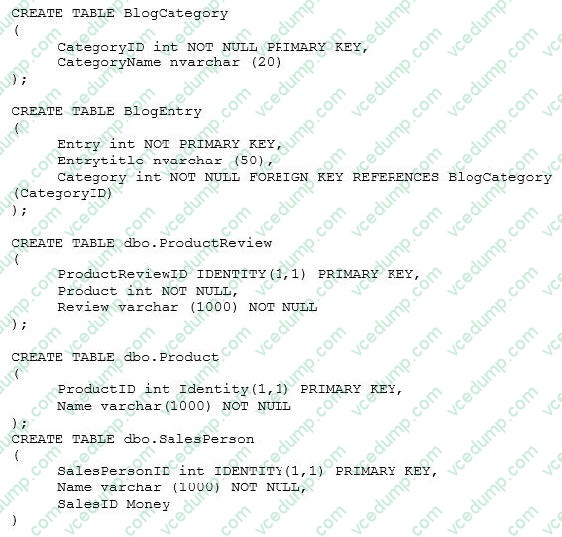
You must modify the ProductReview Table to meet the following requirements:
1. The table must reference the ProductID column in the Product table
2. Existing records in the ProductReview table must not be validated with the Product table.
3. Deleting records in the Product table must not be allowed if records are referenced by the ProductReview table.
4. Changes to records in the Product table must propagate to the ProductReview table.
You also have the following database tables: Order, ProductTypes, and SalesHistory, The transact-SQL statements for these tables are not available. You must modify the Orders table to meet the following requirements:
1. Create new rows in the table without granting INSERT permissions to the table.
2. Notify the sales person who places an order whether or not the order was completed.
You must add the following constraints to the SalesHistory table:
- a constraint on the SaleID column that allows the field to be used as a record identifier
- a constant that uses the ProductID column to reference the Product column of the ProductTypes table
- a constraint on the CategoryID column that allows one row with a null value in the column
- a constraint that limits the SalePrice column to values greater than four
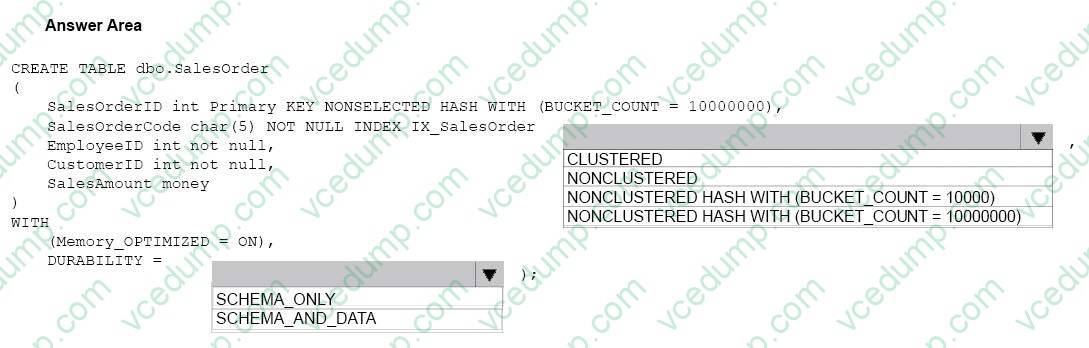
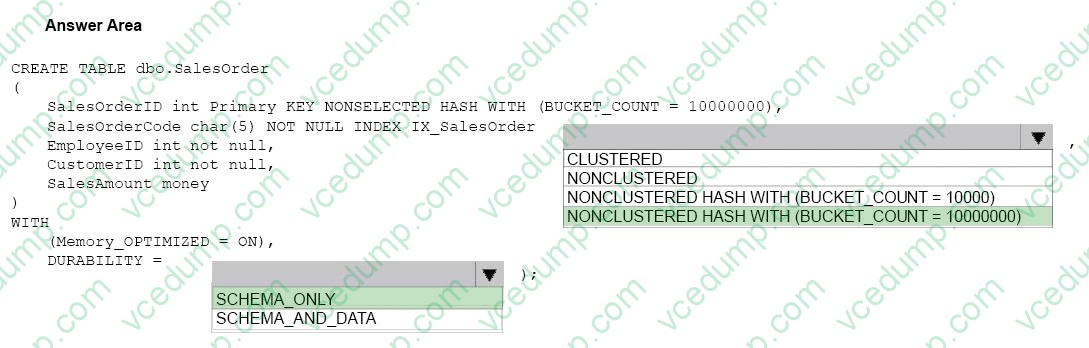
Finance department users must be able to retrieve data from the SalesHistory table for sales persons where the value of the SalesYTD column is above a certain threshold. You plan to create a memory-optimized table named SalesOrder. The table must meet the following requirements:
- The table must hold 10 million unique sales orders.
- The table must use checkpoints to minimize I/O operations and must not use transaction logging.
-Data loss is acceptable.
Performance for queries against the SalesOrder table that use Where clauses with exact equality operations must be optimized.
You need to create the Sales Order table
How should you complete the table definition? To answer? select the appropriate Transact-SQL segments in the answer area.
Hot Area:
-
Question 115:
Note: This question is part of a series of questions that present the same scenario. Each question in the series contains a unique solution that might meet the stated goals. Some questions sets might have more than onecorrect solution, while others might not have a correct solution.
After you answer a question in this section, you will NOT be able to return to it. As a result, these questions will not appear in the review screen.
You need to collect data from the following two sources:
1.
The performance counters of the operating system
2.
Microsoft SQL Server events
You must analyze the two datasets side-by side by using a single tool.
Solution: You use SQL Server Profiler and SQL Server Extended Events to collect performance data. You use SQL Server Profiler to analyze the data.
Does this meet the goal?
A. Yes
B. No -
Question 116:
DRAG DROP
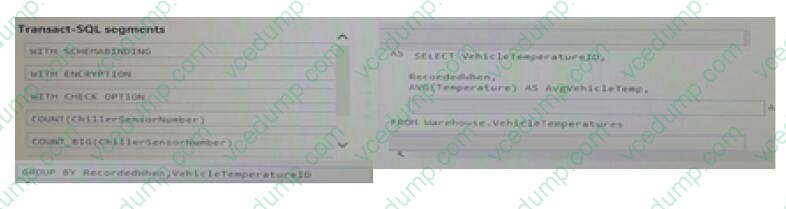
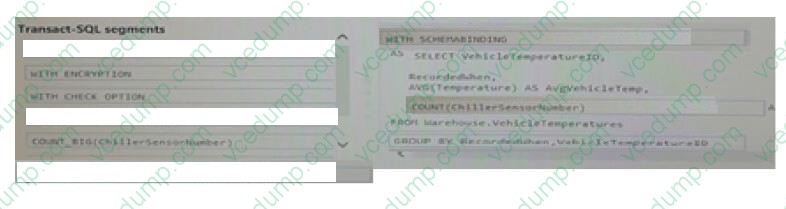
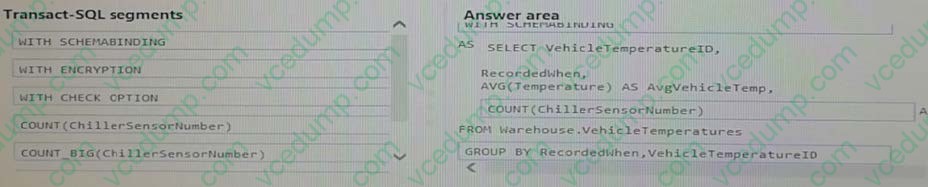
You are a database developer for a company that delivers produce and other refrigerated goods to grocery stores. You capture the food storage temperature for delivery vehicles by using Internet of Things (loT) devices. You store the
temperature data in a database table named vchicleTewperatures. The chillerSensorNumber column stores the identifier for the loT devices.
You need to create an indexed view that meets the following requirements:
Persists the data on disk to reduce the amount of I/O.
Provides the number of chillerSensorNumber items.
Creates only a set sof summary rows.
Select and Place:
-
Question 117:
Note: This question is part of a series of questions that present the same scenario. Each question in the series contains a unique solution that might meet the stated goals. Some questions sets might have more than onecorrect solution, while others might not have a correct solution.
After you answer a question in this section, you will NOT be able to return to it. As a result, these questions will not appear in the review screen.
You need to collect data from the following two sources:
1.
The performance counters of the operating system
2.
Microsoft SQL Server events
You must analyze the two datasets side-by side by using a single tool.
Solution: You use dynamic management views and SQL Server Profiler to collect performance data. You use SQL Server Management Studio (SSMS) to analyze the data.
Does this meet the goal?
A. Yes
B. No -
Question 118:
Background
You have a database named HR1 that includes a table named Employee.
You have several read-only, historical reports that contain regularly changing totals. The reports use multiple queries to estimate payroll expenses. The queries run concurrently.
Users report that the payroll estimate reports do not always run. You must monitor the database to identify issues that prevent the reports from running.
You plan to deploy the application to a database server that supports other applications.
You must minimize the amount of storage that the database requires.
Employee Table
You use the following Transact-SQL statements to create, configure, and populate the Employee table:
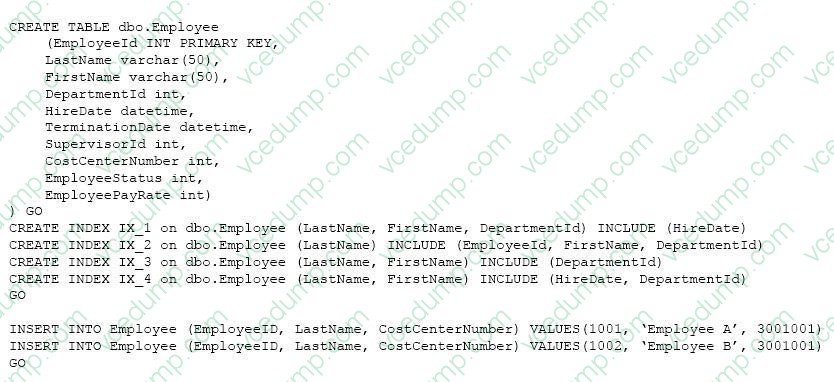
Application
You have an application that updates the Employees table. The application calls the following stored procedures simultaneously and asynchronously:
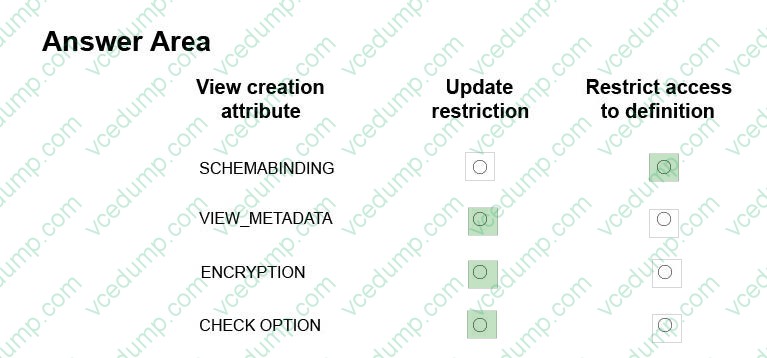
The application uses views to control access to data. Views must meet the following requirements:
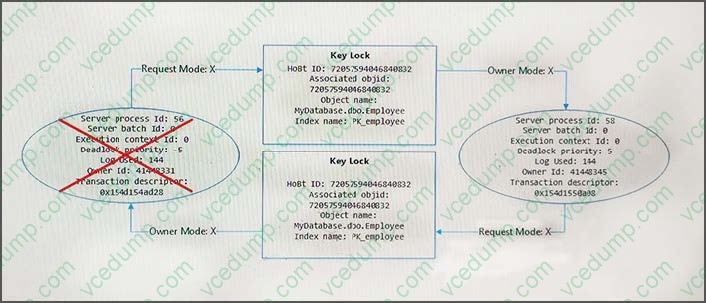
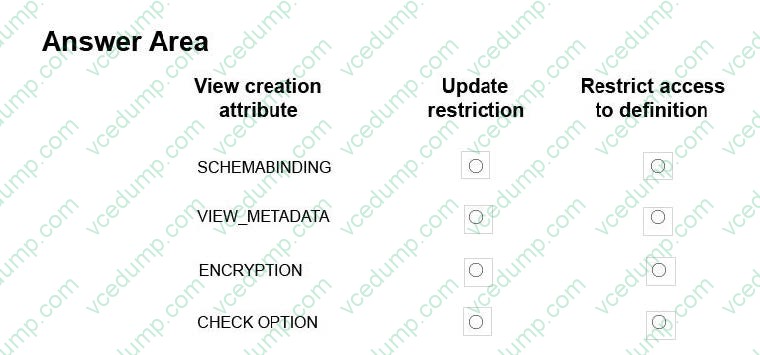
Users must only be able to modify data in the Employee table by using the vwEmployee view. You must prevent users from viewing the view definition in catalog views.
You need to identify the view attribute to use when creating vwEmployee.
In the table below, identify the attributes that you must use.
NOTE: Make only one selection in each column.
Hot Area:
-
Question 119:
Note: This question is part of a series of questions that use the same scenario. For your convenience, the scenario is repeated in each question. Each question presents a different goal and answer choices, but the text of the scenario is exactly the same in each question in this series.
You have a database that contains the following tables: BlogCategory, BlogEntry, ProductReview, Product, and SalesPerson. The tables were created using the following Transact SQL statements:
You must modify the ProductReview Table to meet the following requirements:
1. The table must reference the ProductID column in the Product table
2. Existing records in the ProductReview table must not be validated with the Product table.
3. Deleting records in the Product table must not be allowed if records are referenced by the ProductReview table.
4. Changes to records in the Product table must propagate to the ProductReview table.
You also have the following database tables: Order, ProductTypes, and SalesHistory. The transact-SQL statements for these tables are not available.
You must modify the Orders table to meet the following requirements:
1. Create new rows in the table without granting INSERT permissions to the table.
2. Notify the sales person who places an order whether or not the order was completed.
You must add the following constraints to the SalesHistory table:
- a constraint on the SaleID column that allows the field to be used as a record identifier - a constant that uses the ProductID column to reference the Product column of the ProductTypes table
- a constraint on the CategoryID column that allows one row with a null value in the column
- a constraint that limits the SalePrice column to values greater than four
Finance department users must be able to retrieve data from the SalesHistory table for sales persons where the value of the SalesYTD column is above a certain threshold.
You plan to create a memory-optimized table named SalesOrder. The table must meet the following requirements:
- The table must hold 10 million unique sales orders.
- The table must use checkpoints to minimize I/O operations and must not use transaction logging.
-Data loss is acceptable.
Performance for queries against the SalesOrder table that use Where clauses with exact equality operations must be optimized.
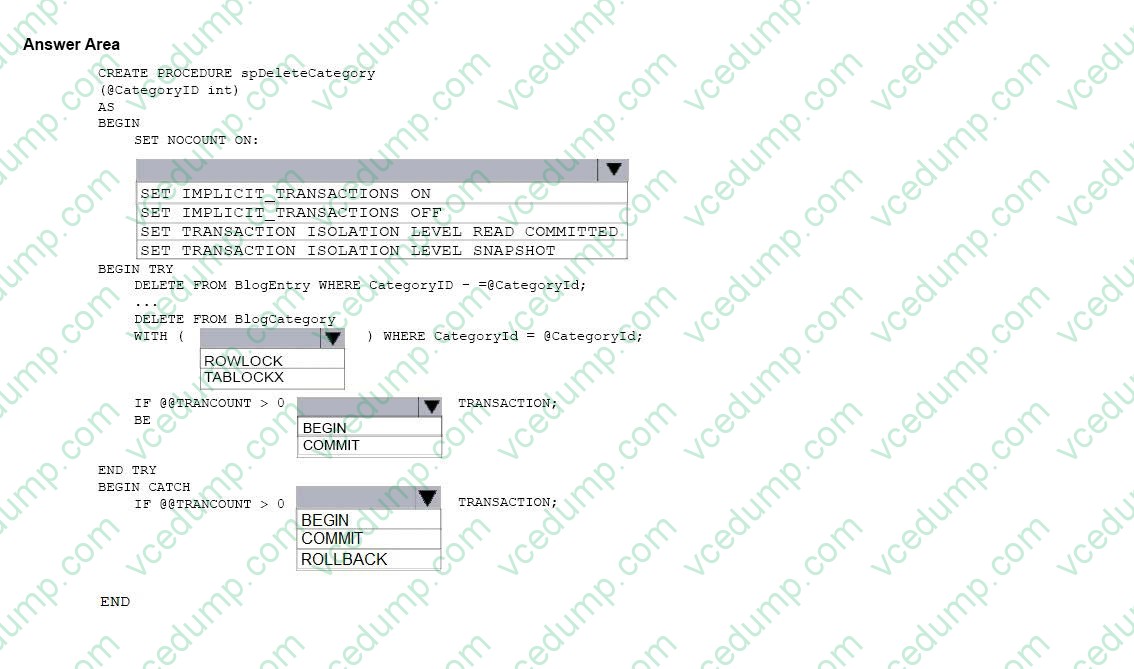
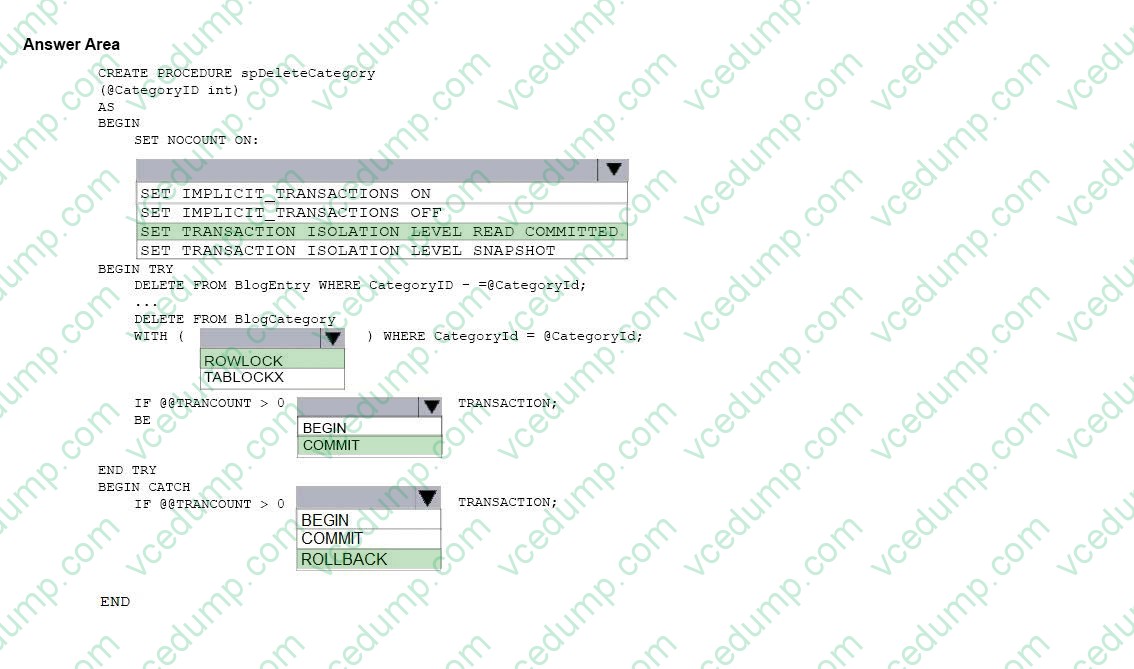
You need to create a stored procedure named spDeleteCategory to delete records in the database. The stored procedure must meet the following requirements:
1. Delete records in both the BlogEntry and BlogCategory tables where CategoryId equals parameter @CategoryId.
2. Avoid locking the entire table when deleting records from the BlogCategory table.
3. If an error occurs during a delete operation on either table, all changes must be rolled back, otherwise all changes should be committed.
How should you complete the procedure? To answer, select the appropriate Transact-SQL segments in the answer area.
Hot Area:
-
Question 120:
Note: This question is part of a series of questions that use the same or similar answer choices. An Answer choice may be correct for more than one question in the series. Each question independent of the other questions in this series.
Information and details provided in a question apply only to that question.
You are a database developer for a company. The company has a server that has multiple physical disks. The disks are not part of a RAID array. The server hosts three Microsoft SQL Server instances. There are many SQL jobs that run
during off-peak hours.
You must monitor the SQL Server instances in real time and optimize the server to maximize throughput, response time, and overall SQL performance.
You need to ensure that the performance of each instance is consistent for the same queried and query plans.
What should you do?
A. A. Create a sys.dm_os_waiting_tasks query.
B. Create a sys.dm_exec_sessions query.
C. Create a Performance Monitor Data Collector Set.
D. Create a sys.dm_os_memory_objects query.
E. Create a sp_configure `max server memory' query.
F. Create a SQL Profiler trace.
G. Create asys.dm_os_wait_stats query.
H. Create an Extended Event.
Related Exams:
-
62-193
Technology Literacy for Educators -
70-243
Administering and Deploying System Center 2012 Configuration Manager -
70-355
Universal Windows Platform – App Data, Services, and Coding Patterns -
77-420
Excel 2013 -
77-427
Excel 2013 Expert Part One -
77-725
Word 2016 Core Document Creation, Collaboration and Communication -
77-726
Word 2016 Expert Creating Documents for Effective Communication -
77-727
Excel 2016 Core Data Analysis, Manipulation, and Presentation -
77-728
Excel 2016 Expert: Interpreting Data for Insights -
77-731
Outlook 2016 Core Communication, Collaboration and Email Skills
Tips on How to Prepare for the Exams
Nowadays, the certification exams become more and more important and required by more and more enterprises when applying for a job. But how to prepare for the exam effectively? How to prepare for the exam in a short time with less efforts? How to get a ideal result and how to find the most reliable resources? Here on Vcedump.com, you will find all the answers. Vcedump.com provide not only Microsoft exam questions, answers and explanations but also complete assistance on your exam preparation and certification application. If you are confused on your 70-762 exam preparations and Microsoft certification application, do not hesitate to visit our Vcedump.com to find your solutions here.