70-762 Exam Details
-
Exam Code
:70-762 -
Exam Name
:Developing SQL Databases -
Certification
:Microsoft Certifications -
Vendor
:Microsoft -
Total Questions
:182 Q&As -
Last Updated
:Jan 29, 2022
Microsoft 70-762 Online Questions & Answers
-
Question 101:
Note: This question is part of a series of questions that present the same scenario. Each question in the series contains a unique solution that might meet the stated goals. Some questions sets might have more than one correct solution,
while others might not have a correct solution.
After you answer a question in this section, you will NOT be able to return to it. As a result, these questions will not appear in the review screen.
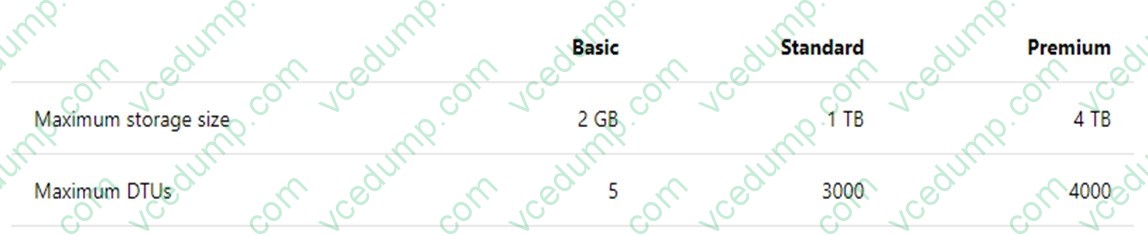
You have a 3-TB database. The database server has 64 CPU cores.
You plan to migrate the database to Microsoft Azure SQL Database.
You need to select the service tier for the Azure SQL database. The solution must meet or exceed the current processing capacity.
Solution: You select the Premium service tier.
Does this meet the goal?
A. Yes
B. No -
Question 102:
Case Study
Background
You have a database named HR1 that includes a table named Employee.
You have several read-only, historical reports that contain regularly changing totals. The reports use multiple queries to estimate payroll expenses. The queries run concurrently.
Users report that the payroll estimate reports do not always run. You must monitor the database to identify issues that prevent the reports from running.
You plan to deploy the application to a database server that supports other applications.
You must minimize the amount of storage that the database requires.
Employee Table
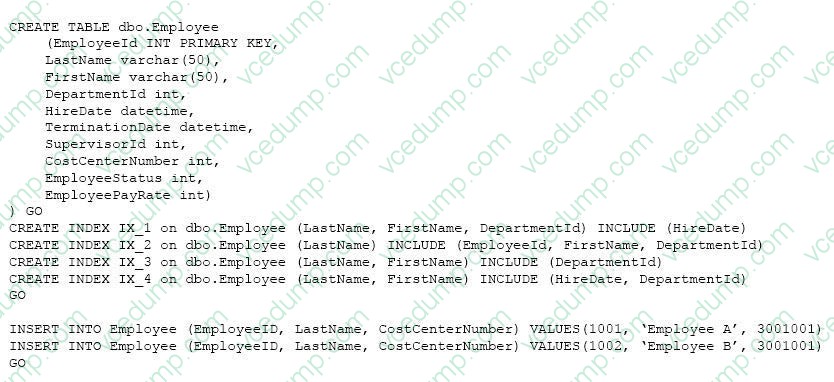
You use the following Transact-SQL statements to create, configure, and populate the Employee table:
Application
You have an application that updates the Employees table. The application calls the following stored procedures simultaneously and asynchronously:
The application uses views to control access to data. Views must meet the following requirements:
Exhibit
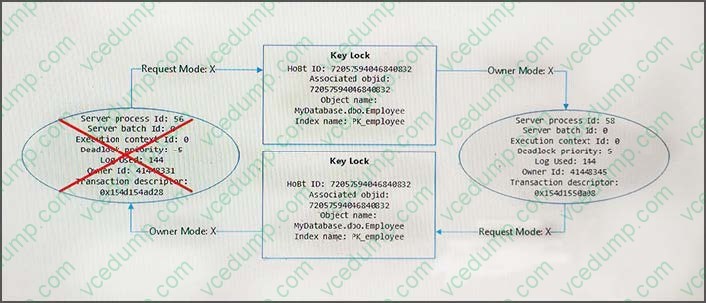
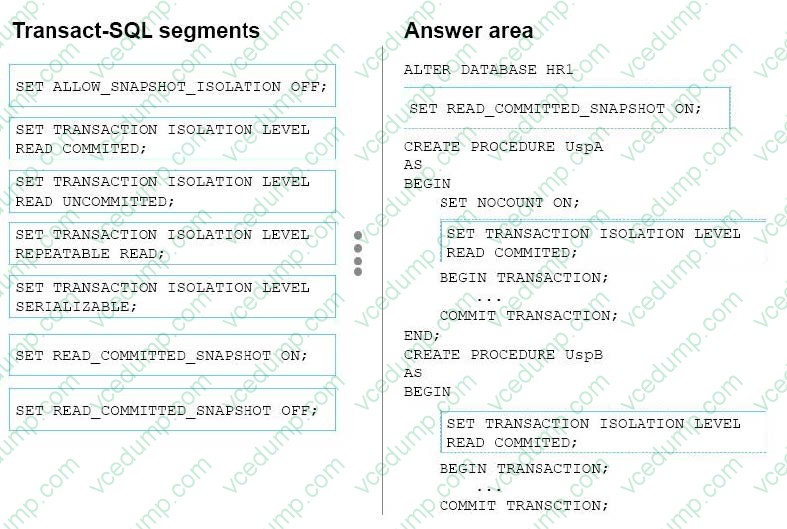
Both of the stored procedures experience blocking issues. UspB must not abort if UspA commits changes to a row before UspB commits changes to the same row. UspA must not abort if UspB commits changes to a row before UspA commits changes to the same row.
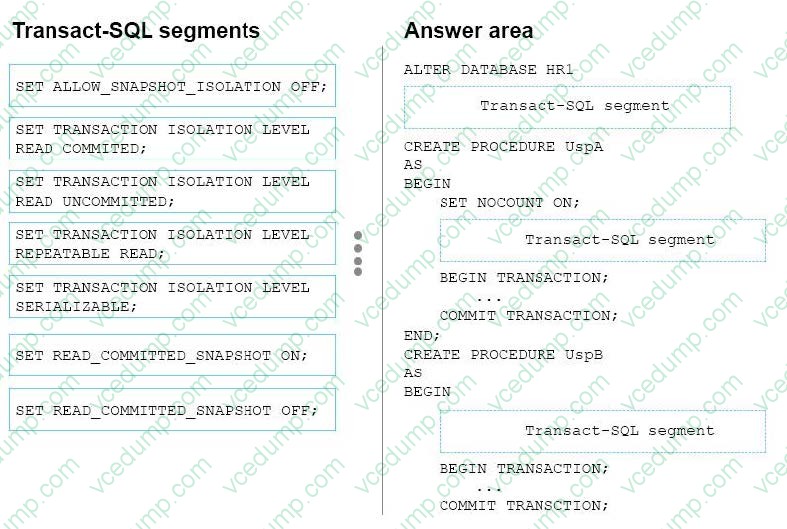
You need to specify the transaction isolation levels to enable row versioning.
How should you complete the Transact-SQL statements? To answer, drag the Transact-SQL segments to the correct locations. Each Transact-SQL segment may be used once, more than once, or not at all. You may need to drag the split bar between panes or scroll to view content.
Select and Place:
-
Question 103:
Note: this question is part of a series of questions that use the same or similar answer choices. An answer choice may be correct for more than one question in the series. Each question is independent of the other questions in the series.
Information and details provided in a question apply only to that question.
You are developing and application to track customer sales.
You need to return the sum of orders that have been finalized, given a specified order identifier. This value will be used in other Transact-SQL statements.
You need to create a database object.
What should you create?
A. extended procedure
B. CLR procedure
C. user-defined procedure
D. DML trigger
E. scalar-valued function
F. table-valued function -
Question 104:
You have a view that includes an aggregate.
You must be able to change the values of columns in the view. The changes must be reflected in the tables that the view uses.
You need to ensure that you can update the view.
What should you create?
A. a DML trigger
B. a schema-bound view
C. a stored procedure
D. a DDL trigger -
Question 105:
Background
You have a database named HR1 that includes a table named Employee.
You have several read-only, historical reports that contain regularly changing totals. The reports use multiple queries to estimate payroll expenses. The queries run concurrently.
Users report that the payroll estimate reports do not always run. You must monitor the database to identify issues that prevent the reports from running.
You plan to deploy the application to a database server that supports other applications.
You must minimize the amount of storage that the database requires.
Employee Table
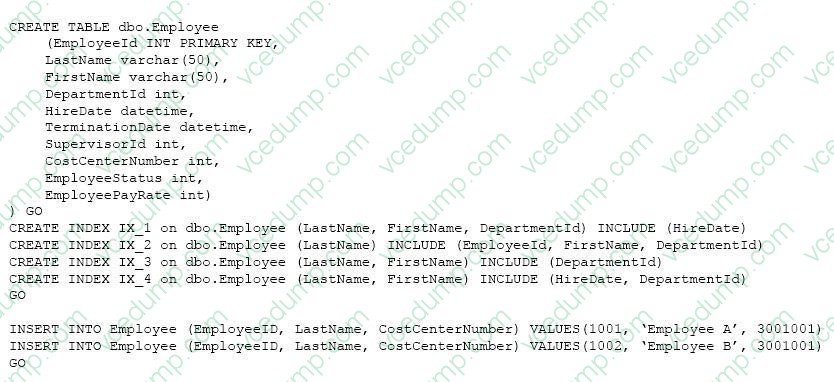
You use the following Transact-SQL statements to create, configure, and populate the Employee table:
Application
You have an application that updates the Employees table. The application calls the following stored procedures simultaneously and asynchronously:
The application uses views to control access to data. Views must meet the following requirements:
Exhibit
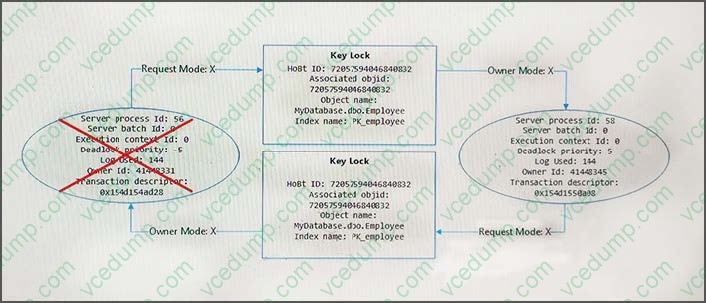
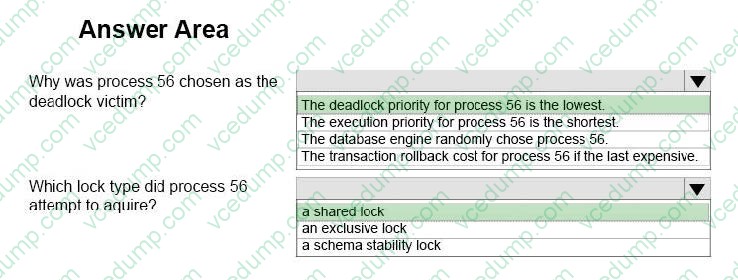
You view the Deadlock Graph as shown in the exhibit. (Click the Exhibit button.)
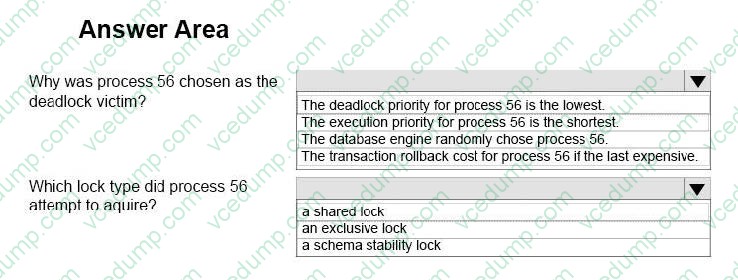
Use the drop-down menus to select the answer choice that answers each question based on the information presented in the graphic.
NOTE: Each correct selection is worth one point.
Hot Area:
-
Question 106:
Note: This question is part of a series of questions that present the same scenario. Each question in the series contains a unique solution. Determine whether the solution meets the stated goals.
You need to create a stored procedure that updates the Customer, CustomerInfo, OrderHeader, and OrderDetail tables in order.
You need to ensure that the stored procedure:
Runs within a single transaction.
Commits updates to the Customer and CustomerInfo tables regardless of the status of updates to the OrderHeader and OrderDetail tables.
Commits changes to all four tables when updates to all four tables are successful.
Solution: You create a stored procedure that includes the following Transact-SQL code:
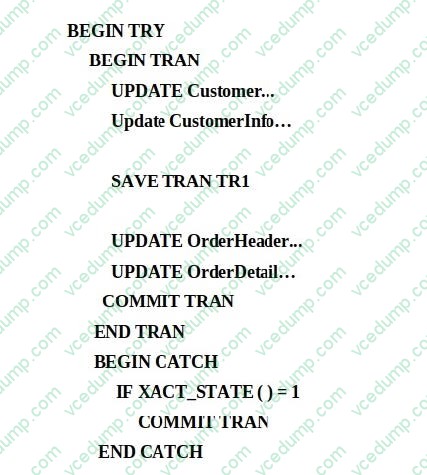
Does the solution meet the goal?
A. Yes
B. No -
Question 107:
Note: This question is part of a series of questions that use the same scenario. For your convenience, the scenario is repeated in each question. Each question presents a different goal and answer choices, but the text of the scenario is exactly the same in each question in this series.
You have a database named DB1 that contains the following tables: Customer, CustomerToAccountBridge, and CustomerDetails. The three tables are part of the Sales schema. The database also contains a schema named Website. You create the Customer table by running the following Transact-SQL statement:
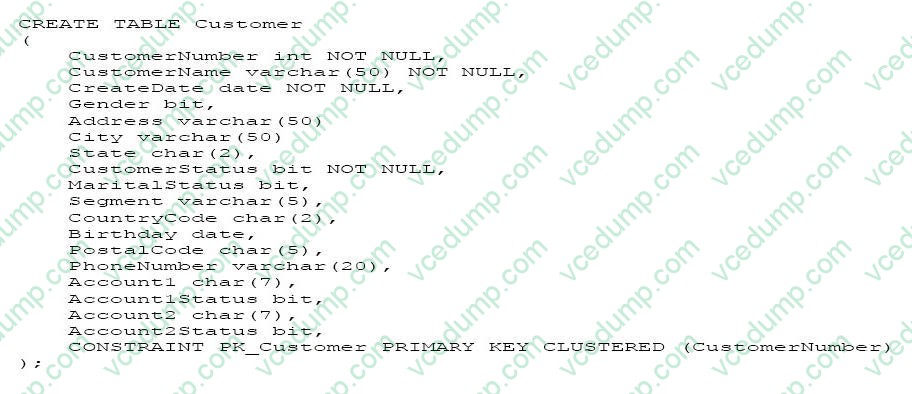
The value of the CustomerStatus column is equal to one for active customers. The value of the Account1Status and Account2Status columns are equal to one for active accounts. The following table displays selected columns and rows from the Customer table.

You plan to create a view named Website.Customer and a view named Sales.FemaleCustomers. Website.Customer must meet the following requirements:
1. Allow users access to the CustomerName and CustomerNumber columns for active customers.
2. Allow changes to the columns that the view references. Modified data must be visible through the view.
3. Prevent the view from being published as part of Microsoft SQL Server replication.
Sales.Female.Customers must meet the following requirements:
1. Allow users access to the CustomerName, Address, City, State and PostalCode columns.
2. Prevent changes to the columns that the view references.
3. Only allow updates through the views that adhere to the view filter.
You have the following stored procedures: spDeleteCustAcctRelationship and spUpdateCustomerSummary. The spUpdateCustomerSummary stored procedure was created by running the following Transacr-SQL statement:
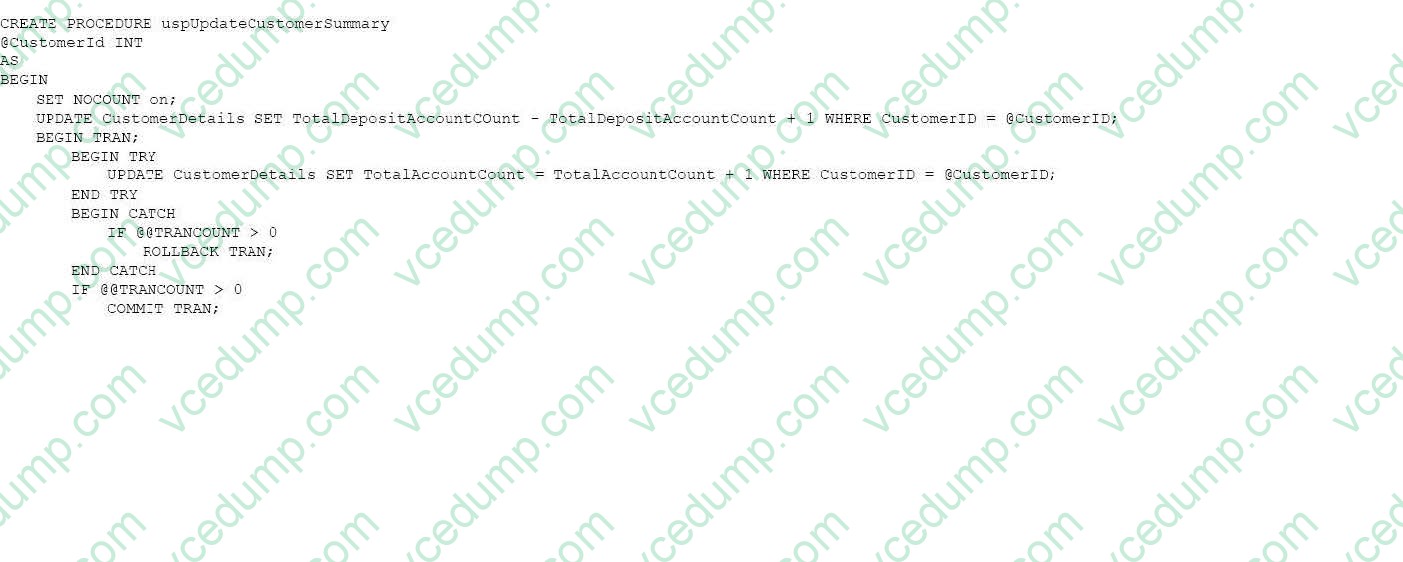
The following table displays a selected columns and rows from the Customer table. The value of the CustomerStatus column is equal to one for active customers. The value of the Account1Status and Account2Status columns are equal to one for active accounts.
You run the spUpdateCustomerSummary stored procedure to make changes to customer account summaries. Other stored procedures call the spDeleteCustAcctRelationship to delete records from the CustomerToAccountBridge table.
Users report that the following SELECT statement statement takes a long time to complete:
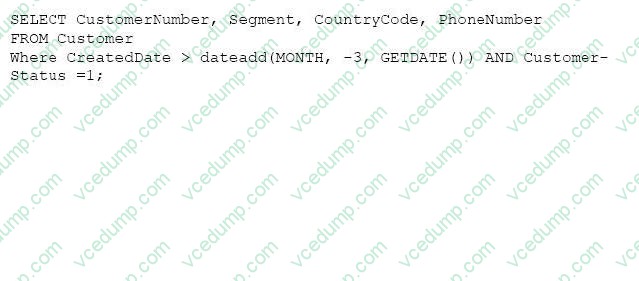
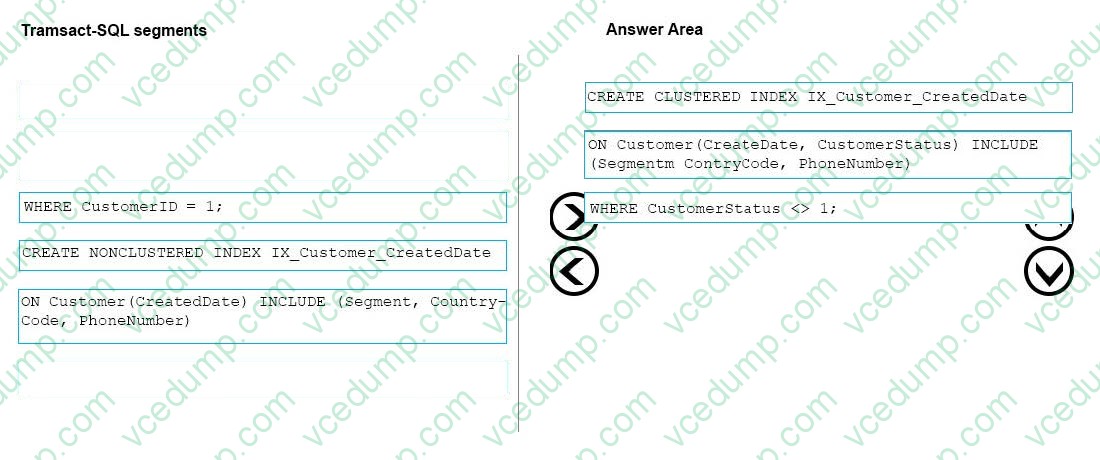
You need to create an index that meets the following requirements:
1. Improve the performance of the SELECT statement.
2. requires minimum index key size.
3. Only contains active customers.
4. Makes no change to the existing primary key.
5. Contains all of the columns required by the SELECT statement.
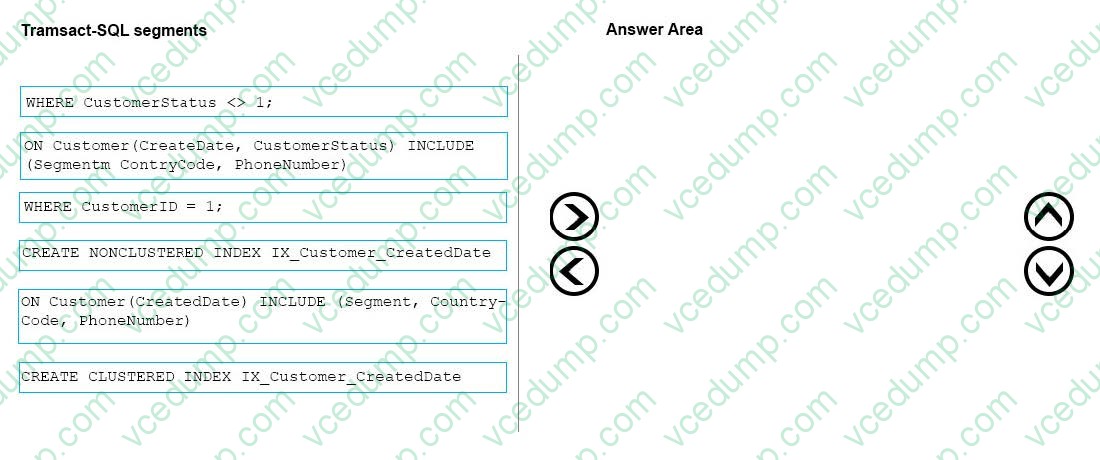
Which three Transact_SQL segments should you use to develop the solution?
To answer, move the appropriate code blocks from the list of code blocks to the answer area and arrange them in the correct order.
Select and Place:
-
Question 108:
Note: This question is part of a series of questions that use the same or similar answer choices. As answer choice may be correct for more than one question in the series. Each question is independent of the other questions in this series. Information and details provided in a question apply only to that question.
You have a Microsoft SQL Server database named DB1 that contains the following tables:
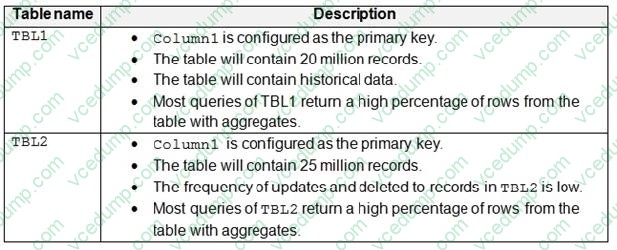
There are no foreign key relationships between TBL1 and TBL2.
You need to minimize the amount of time required for queries that use data from TBL1 and TBL2 to return data.
What should you do?
A. Create clustered indexes on TBL1 and TBL2.
B. Create a clustered index on TBL1.Create a nonclustered index on TBL2 and add the most frequently queried column as included columns.
C. Create a nonclustered index on TBL2 only.
D. Create UNIQUE constraints on both TBL1 and TBL2. Create a partitioned view that combines columns from TBL1 and TBL2.
E. Drop existing indexes on TBL1 and then create a clustered columnstore index. Create a nonclustered columnstore index on TBL1.Create a nonclustered index on TBL2.
F. Drop existing indexes on TBL1 and then create a clustered columnstore index. Create a nonclustered columnstore index on TBL1.Make no changes to TBL2.
G. Create CHECK constraints on both TBL1 and TBL2. Create a partitioned view that combines columns from TBL1 and TBL2.
H. Create an indexed view that combines columns from TBL1 and TBL2. -
Question 109:
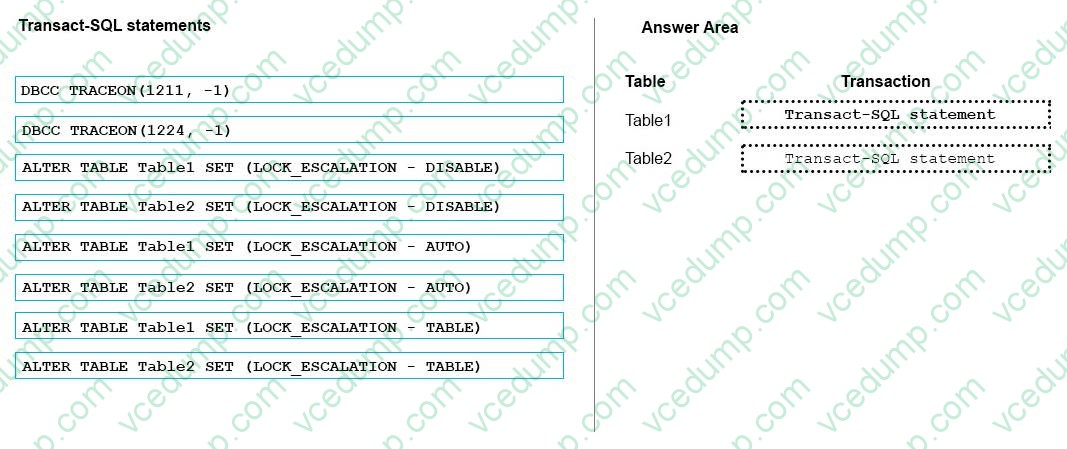
You have two database tables. Table1 is a partioned table and Table 2 is a nonpartioned table.
Users report that queries take a long time to complete. You monitor queries by using Microsoft SQL Server Profiler. You observe lock escalation for Table1 and Table 2.
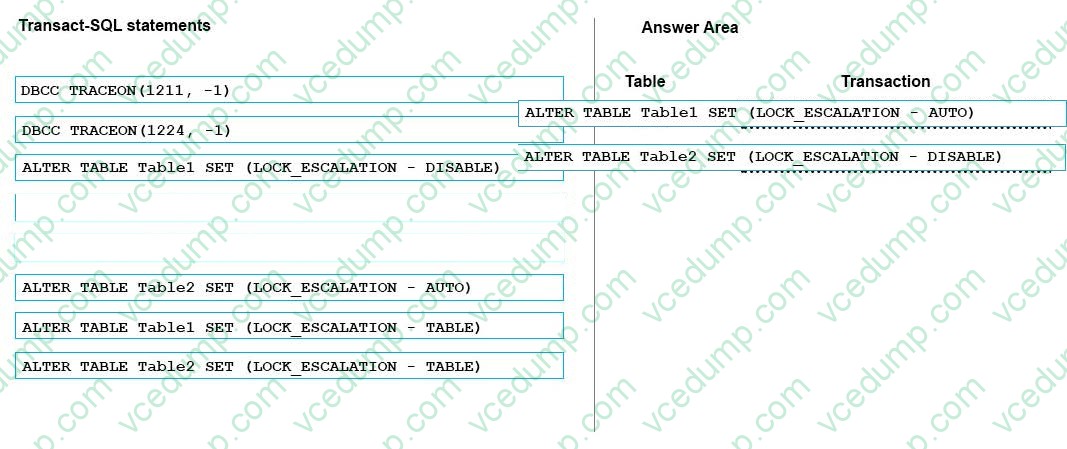
You need to allow escalation of Table1 locks to the partition level and prevent all lock escalation for Table2.
Which Transact-SQL statement should you run for each table? To answer, drag the appropriate Transact-SQL statements to the correct tables. Each command may be used once, more than once, or not at all. You may need to drag the split
bar between panes or scroll to view content.
Select and Place:
-
Question 110:
HOTSPOT
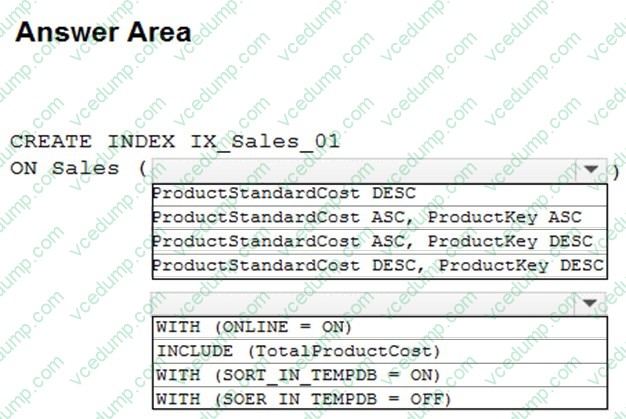
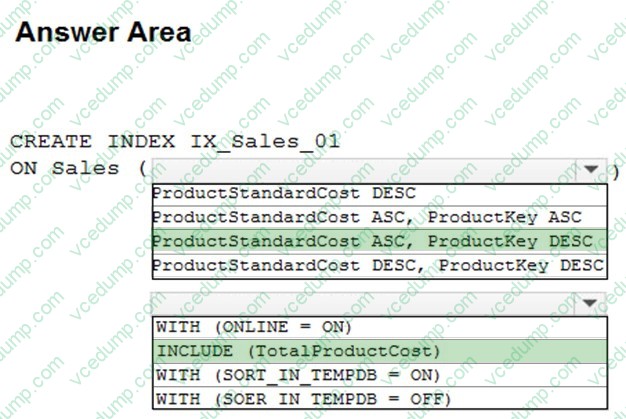
You have a Microsoft SQL Server database that has a table named Sales. The table is used for retrieving data and is updated during non-business hours.
You run the following Transact-SQL statement:

You analyze the execution plan for the statement. (Click the Exhibit button). Execution Plan

You need to add an index that optimizes performance.
Hot Area:
Related Exams:
-
62-193
Technology Literacy for Educators -
70-243
Administering and Deploying System Center 2012 Configuration Manager -
70-355
Universal Windows Platform – App Data, Services, and Coding Patterns -
77-420
Excel 2013 -
77-427
Excel 2013 Expert Part One -
77-725
Word 2016 Core Document Creation, Collaboration and Communication -
77-726
Word 2016 Expert Creating Documents for Effective Communication -
77-727
Excel 2016 Core Data Analysis, Manipulation, and Presentation -
77-728
Excel 2016 Expert: Interpreting Data for Insights -
77-731
Outlook 2016 Core Communication, Collaboration and Email Skills
Tips on How to Prepare for the Exams
Nowadays, the certification exams become more and more important and required by more and more enterprises when applying for a job. But how to prepare for the exam effectively? How to prepare for the exam in a short time with less efforts? How to get a ideal result and how to find the most reliable resources? Here on Vcedump.com, you will find all the answers. Vcedump.com provide not only Microsoft exam questions, answers and explanations but also complete assistance on your exam preparation and certification application. If you are confused on your 70-762 exam preparations and Microsoft certification application, do not hesitate to visit our Vcedump.com to find your solutions here.