70-762 Exam Details
-
Exam Code
:70-762 -
Exam Name
:Developing SQL Databases -
Certification
:Microsoft Certifications -
Vendor
:Microsoft -
Total Questions
:182 Q&As -
Last Updated
:Jan 29, 2022
Microsoft 70-762 Online Questions & Answers
-
Question 171:
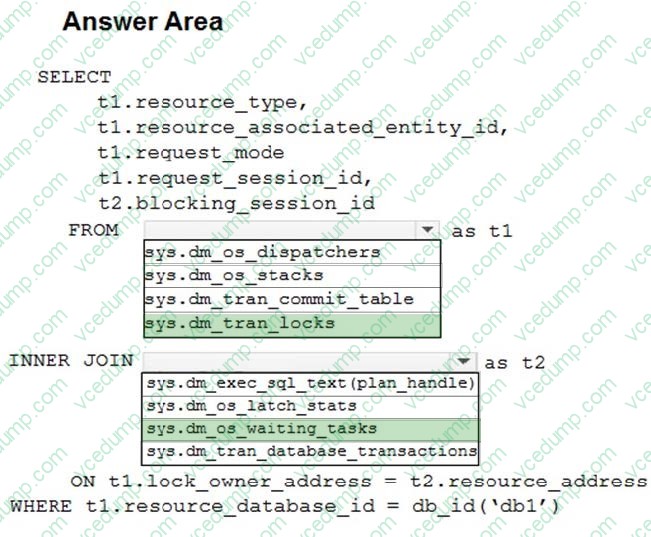
HOTSPOT
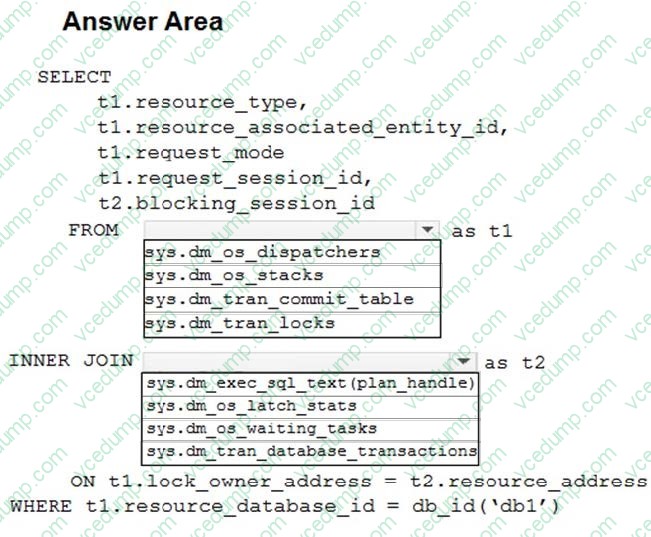
You have a Microsoft Azure SQL database.
Some queries take a long time to execute.
You need to identify whether any of the long-running queries prevent users from updating data in the database.
Which query should you execute? To answer, select the appropriate options in the answer area.
NOTE: Each correct selection is worth one point.
Hot Area:
-
Question 172:
You have a database with multiple tables. You must insert data into the tables by using views.
Which of the following two statements best describes an updatable view?
NOTE: Each correct selection is worth one point.
A. The view must not include the primary key of the table.
B. The view may include GROUP BY or HAVING statements.
C. The view may include a composite field.
D. Each view must reference columns from one table.
E. The view must not include subqueries. -
Question 173:
Note: This question is part of a series of questions that use the same scenario. For your convenience, the scenario is repeated in each question. Each question presents a different goal and answer choices, but the text of the scenario is exactly the same in each question in this series.
You have a database that contains the following tables: BlogCategory, BlogEntry, ProductReview, Product, and SalesPerson. The tables were created using the following Transact SQL statements:
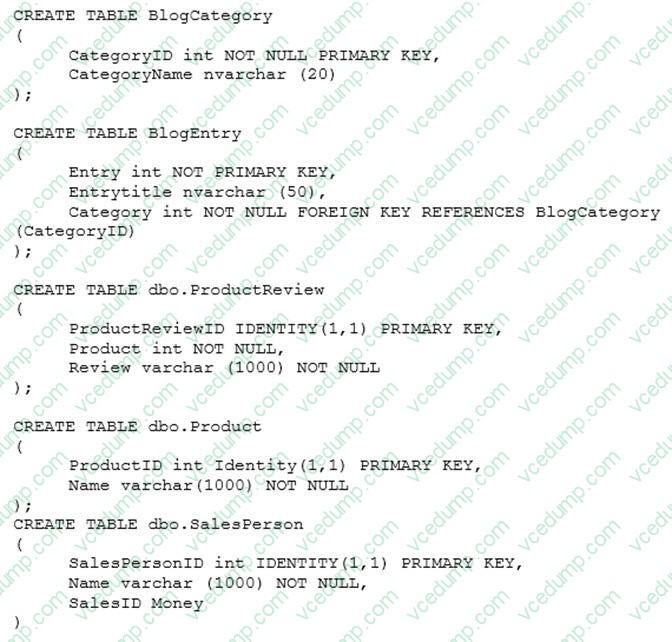
You must modify the ProductReview Table to meet the following requirements:
The table must reference the ProductID column in the Product table
Existing records in the ProductReview table must not be validated with the Product table.
Deleting records in the Product table must not be allowed if records are referenced by the ProductReview table.
Changes to records in the Product table must propagate to the ProductReview table.
You also have the following database tables: Order, ProductTypes, and SalesHistory. The transact-SQL statements for these tables are not available.
You must modify the Orders table to meet the following requirements:
Create new rows in the table without granting INSERT permissions to the table.
Notify the sales person who places an order whether or not the order was completed.
You must add the following constraints to the SalesHistory table:
a constraint on the SaleID column that allows the field to be used as a record identifier
a constant that uses the ProductID column to reference the Product column of the ProductTypes table
a constraint on the CategoryID column that allows one row with a null value in the column
a constraint that limits the SalePrice column to values greater than four
Finance department users must be able to retrieve data from the SalesHistory table for sales persons where the value of the SalesYTD column is above a certain threshold.
You plan to create a memory-optimized table named SalesOrder. The table must meet the following requirements:
The table must hold 10 million unique sales orders.
The table must use checkpoints to minimize I/O operations and must not use transaction logging.
Data loss is acceptable.
Performance for queries against the SalesOrder table that use WHERE clauses with exact equality operations must be optimized.
You need to modify the environment to meet the requirements for the Orders table.
What should you create?
A. an AFTER UPDATE trigger
B. a user-defined function
C. a stored procedure with output parameters
D. an INSTEAD OF INSERT trigger -
Question 174:
Note: This question is part of a series of questions that present the same scenario. Each question in the series contains a unique solution that might meet the stated goals. Some questions sets might have more than one correct solution,
while others might not have a correct solution.
After you answer a question in this section, you will NOT be able to return to it. As a result, these questions will not appear in the review screen.
You have a database that is 130 GB and contains 500 million rows of data.
Granular transactions and mass batch data imports change the database frequently throughout the day. Microsoft SQL Server Reporting Services (SSRS) uses the database to generate various reports by using several filters.
You discover that some reports time out before they complete.
You need to reduce the likelihood that the reports will time out.
Solution: You partition the largest tables.
Does this meet the goal?
A. Yes
B. No -
Question 175:
Note: This question is part of a series of questions that use the same or similar answer choices. An answer choice may be correct for more than one question in the series. Each question is independent of the other questions in this series.
Information and details provided in a question apply only to that question.
You have a Microsoft SQL Server database named DB1 that contains the following tables:
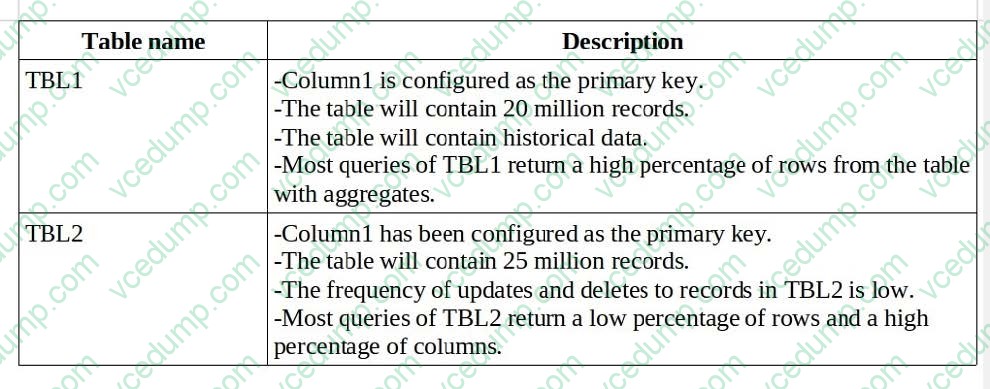
There are no foreign key relationships between TBL1 and TBL2.
You need to minimize the amount of time required for queries that use data from TB1 and TBL2 to return data.
What should you do?
A. Create clustered indexes on TBL1 and TBL2.
B. Create a clustered index on TBL1. Create a nonclustered index on TBL2 and add the most frequently queried column as included columns.
C. Create a nonclustered index on TBL2 only.
D. Create UNIQUE constraints on both TBL1 and TBL2. Create a partitioned view that combines columns from TBL1 and TBL2.
E. Drop existing indexes on TBL1 and then create a clustered columnstore index. Create a nonclustered columnstore index on TBL1. Create a nonclustered index on TBL2.
F. Drop existing indexes on TBL1 and then create a clustered columnstore index. Create a nonclustered columnstore index on TBL1.Make no changes to TBL2.
G. Create CHECK constraints on both TBL1 and TBL2. Create a partitioned view that combines columns from TBL1 and TBL2.
H. Create an indexed view that combines columns from TBL1 and TBL2. -
Question 176:
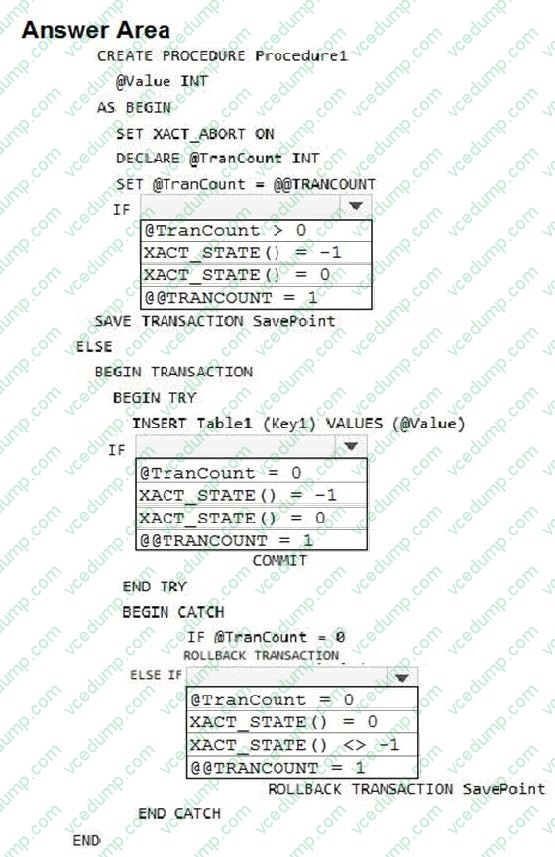
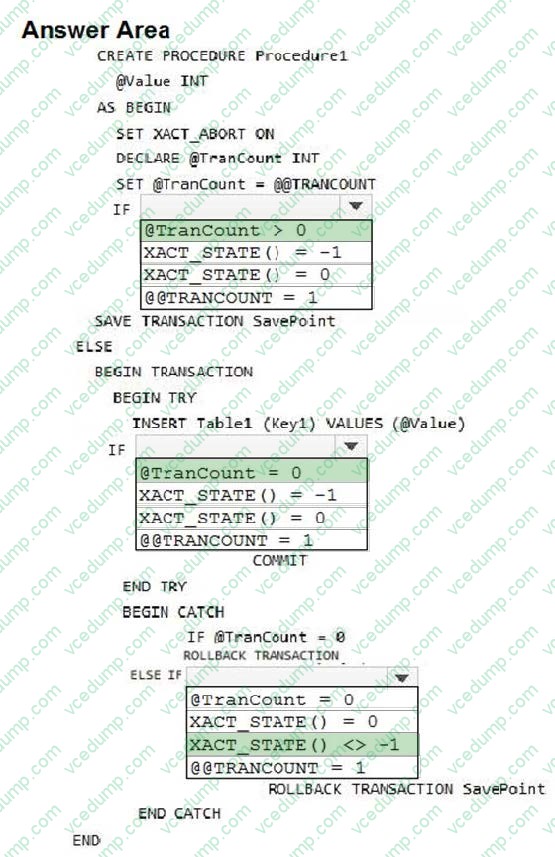
HOTSPOT You are developing a stored procedure with the following requirements: Accepts an integer as input and inserts the value into a table. Ensures new transactions are committed as part of the outer transactions. Preserves existing transactions if the transaction in the procedure fails.
If the transaction in the procedure fails, rollback the transaction. How should you complete the procedure? To answer, select the appropriate options in the answer area. NOTE: Each correct selection is worth one point.
Hot Area:
-
Question 177:
Note: This question is part of a series of questions that use the same or similar answer choices. An Answer choice may be correct for more than one question in the series. Each question independent of the other questions in this series.
Information and details provided in a question apply only to that question.
You are a database developer for a company. The company has a server that has multiple physical disks. The disks are not part of a RAID array. The server hosts three SQL Server instances. There are many SQL jobs that run during off-
peak hours.
You must monitor the SQL Server instances in real time and optimize the server to maximize throughput, response time, and overall SQL performance.
You need to create a baseline set of metrics to report how the computer running SQL Server operates under normal load. The baseline must include the resource usage associated with the server processes.
What should you do?
A. Create a sys.dm_os_waiting_tasks query.
B. Create a sys.dm_exec_sessions query.
C. Create a Performance Monitor Data Collector Set.
D. Create a sys.dm_os_memory_objects query.
E. Create a sp_configure `max server memory' query.
F. Create a SQL Profiler trace.
G. Create asys.dm_os_wait_stats query.
H. Create an Extended Event. -
Question 178:
You are experiencing performance issues with the database server.
You need to evaluate schema locking issues, plan cache memory pressure points, and backup I/O problems.
What should you create?
A. a System Monitor report
B. a sys.dm_tran_database_transaction dynamic management view query
C. an Extended Events session that uses Query Editor
D. a Microsoft SQL Profiler trace -
Question 179:
Note: This question is part of a series of questions that use the same scenario. For your convenience, the scenario is repeated in each question. Each question presents a different goal and answer choices, but the text of the scenario is
exactly the same in each question in this series.
You have a database named DB1 that contains the following tables: Customer, CustomerToAccountBridge, and CustomerDetails. The three tables are part of the Sales schema. The database also contains a schema named Website. You
create the Customer table by running the following Transact-SQL statement:
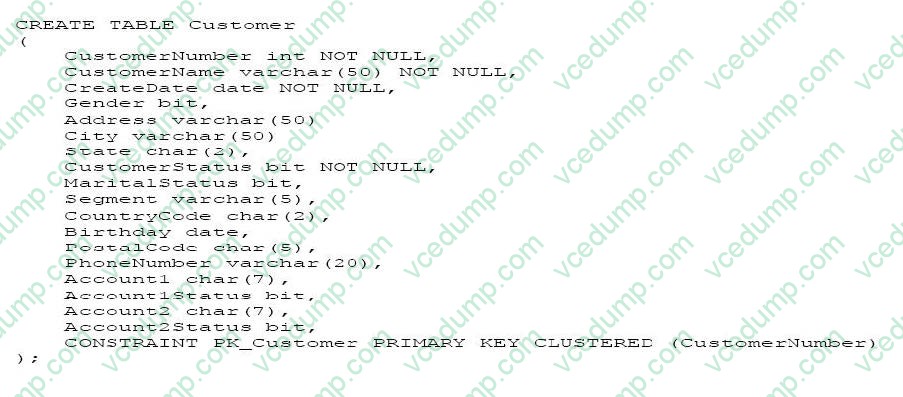
The value of the CustomerStatus column is equal to one for active customers. The value of the Account1Status and Account2Status columns are equal to one for active accounts. The following table displays selected columns and rows from the Customer table.

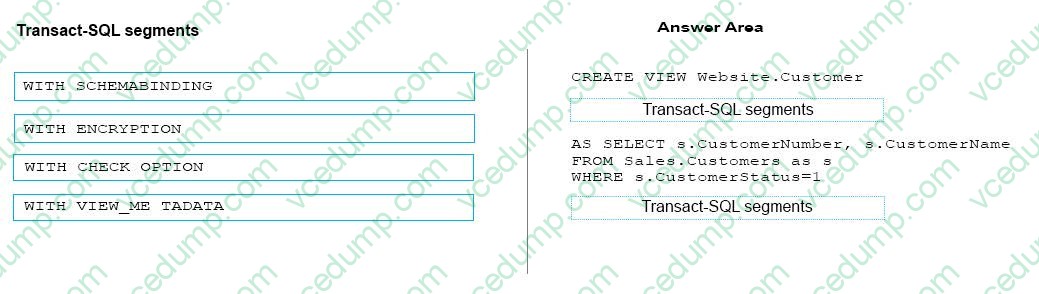
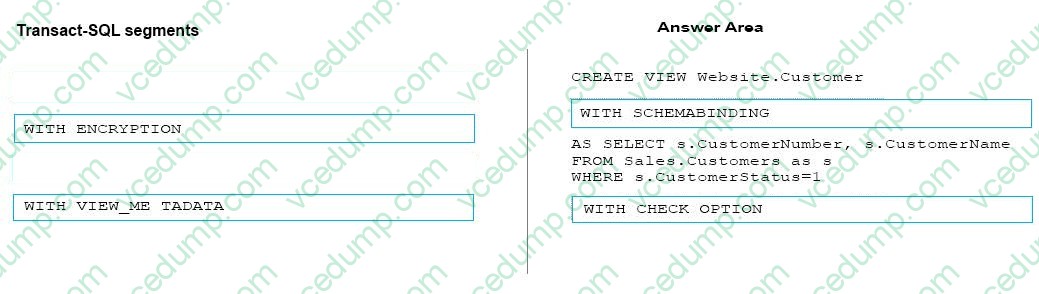
You plan to create a view named Website.Customer and a view named Sales.FemaleCustomers. Website.Customer must meet the following requirements:
1. Allow users access to the CustomerName and CustomerNumber columns for active customers.
2. Allow changes to the columns that the view references. Modified data must be visible through the view.
3. Prevent the view from being published as part of Microsoft SQL Server replication.
Sales.Female.Customers must meet the following requirements:
1. Allow users access to the CustomerName, Address, City, State and PostalCode columns.
2. Prevent changes to the columns that the view references.
3. Only allow updates through the views that adhere to the view filter.
You have the following stored procedures: spDeleteCustAcctRelationship and spUpdateCustomerSummary. The spUpdateCustomerSummary stored procedure was created by running the following Transacr-SQL statement:
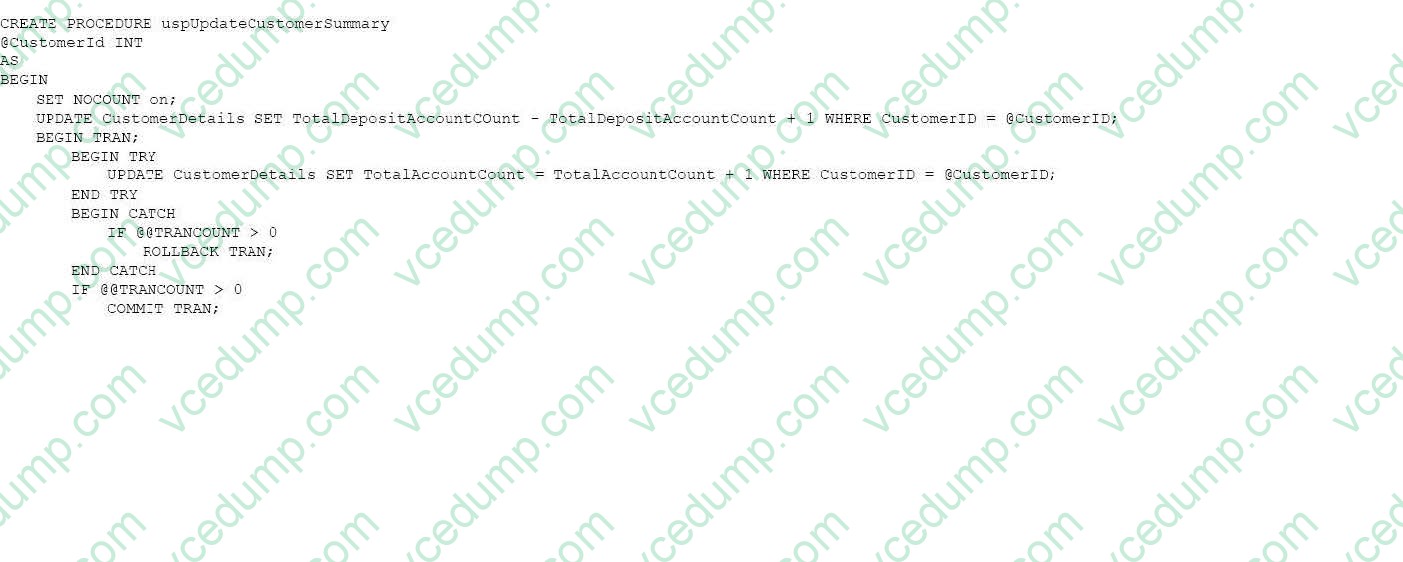
You run the spUpdateCustomerSummary stored procedure to make changes to customer account summaries. Other stored procedures call the spDeleteCustAcctRelationship to delete records from the CustomerToAccountBridge table.
You need to create Sales.FemaleCustomers.
How should you complete the view definition? To answer, drag the appropriate Transact-SQL segments to the correct locations. Each Transact_SQL segment may be used once, more than once or not at all. You may need to drag the split
bar between panes or scroll to view content.
Select and Place:
-
Question 180:
Note: This question is part of a series of questions that use the same or similar answer choices. As answer choice may be correct for more than one question in the series. Each question is independent of the other questions in this series. Information and details provided in a question apply only to that question.
You have a Microsoft SQL Server database named DB1 that contains the following tables:
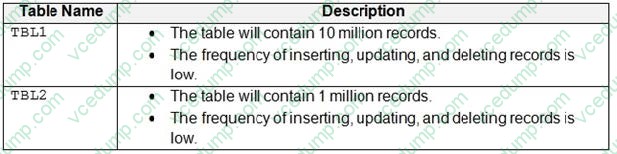
Users frequently run the following query:

Users report that the query takes a long time to return results.
You need to minimize the amount of time requires for the query to return data.
What should you do?
A. Create clustered indexes on TBL1 and TBL2.
B. Create a clustered index on TBL1.Create a nonclustered index on TBL2 and add the most frequently queried column as included columns.
C. Create a nonclustered index on TBL2 only.
D. Create UNIQUE constraints on both TBL1 and TBL2. Create a partitioned view that combines columns from TBL1 and TBL2.
E. Drop existing indexes on TBL1 and then create a clustered columnstore index. Create a nonclustered columnstore index on TBL1.Create a nonclustered index on TBL2.
F. Drop existing indexes on TBL1 and then create a clustered columnstore index. Create a nonclustered columnstore index on TBL1.Make no changes to TBL2.
G. Create CHECK constraints on both TBL1 and TBL2. Create a partitioned view that combines columns from TBL1 and TBL2.
H. Create an indexed view that combines columns from TBL1 and TBL2.
Related Exams:
-
62-193
Technology Literacy for Educators -
70-243
Administering and Deploying System Center 2012 Configuration Manager -
70-355
Universal Windows Platform – App Data, Services, and Coding Patterns -
77-420
Excel 2013 -
77-427
Excel 2013 Expert Part One -
77-725
Word 2016 Core Document Creation, Collaboration and Communication -
77-726
Word 2016 Expert Creating Documents for Effective Communication -
77-727
Excel 2016 Core Data Analysis, Manipulation, and Presentation -
77-728
Excel 2016 Expert: Interpreting Data for Insights -
77-731
Outlook 2016 Core Communication, Collaboration and Email Skills
Tips on How to Prepare for the Exams
Nowadays, the certification exams become more and more important and required by more and more enterprises when applying for a job. But how to prepare for the exam effectively? How to prepare for the exam in a short time with less efforts? How to get a ideal result and how to find the most reliable resources? Here on Vcedump.com, you will find all the answers. Vcedump.com provide not only Microsoft exam questions, answers and explanations but also complete assistance on your exam preparation and certification application. If you are confused on your 70-762 exam preparations and Microsoft certification application, do not hesitate to visit our Vcedump.com to find your solutions here.