70-743 Exam Details
-
Exam Code
:70-743 -
Exam Name
:Upgrading Your Skills to MCSA Windows Server 2016 -
Certification
:Microsoft Certifications -
Vendor
:Microsoft -
Total Questions
:296 Q&As -
Last Updated
:Feb 02, 2022
Microsoft 70-743 Online Questions & Answers
-
Question 181:
DRAG DROP
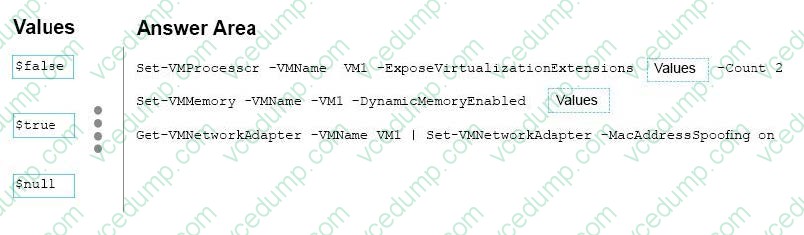
You have a physical server named Server1 that runs Windows Server 2016. Server1 is a Hyper-V host.
On Server1, you create a virtual machine named VM1 that runs Windows Server 2016.
You plan to install the Hyper-V server role on VM1.
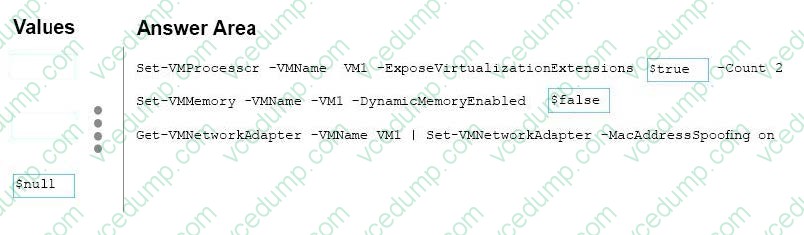
You need to ensure that you can configure VM1 to host virtual machines.
How should you compete the Windows PowerShell script? To answer, drag the appropriate values to the correct targets. Each value may be used once, more than once, or not at all. You may need to drag the split bar between panes or scroll
to view content.
Select and Place:
-
Question 182:
You have a server that runs Windows Server 2016.
The server contains a storage pool named Pool1. Pool1 contains five physical disks named Disk1, Disk2, Disk3, Disk4, and Disk5.
A virtual disk named VirtualDisk1 is stored in Pool1. VirtualDisk1 uses the parity storage layout.
Disk3 fails.
You need to remove Disk3 from Pool1.
Which two commands should you run? Each correct answer presents part of the solution.
A. Update-StoragePool -FriendlyName Pool1
B. Set-ResiliencySetting -StoragePool Pool1 璓hysicalDiskRedundancyDefault 4
C. Reset-PhysicalDisk -FriendlyName Disk3
D. Remove-PhysicalDisk -FriendlyName Disk3
E. Set-PhysicalDisk -FriendlyName Disk3 璘sage Retired -
Question 183:
Note: This question is part of a series of questions that use the same or similar answer choices. An answer choice may be correct for more than one question in the series. Each question is independent of the other questions in this series.
Information and details provided in a question apply only to that question.
You have two servers named Server1 and Server2 that run Windows Server 2016. Server1 and Server2 have the Hyper-V server role installed and are nodes in a failover cluster.
On Server1, an administrator creates a virtual machine named VM1.
You need to configure VM1 for high availability.
Which tool should you use?
A. the clussvc.exe command
B. the cluster.exe command
C. the Computer Management snap-in
D. the configurehyperv.exe command
E. the Disk Management snap-in
F. the Failover Cluster Manager snap-in
G. the Hyper-V Manager snap-in
H. the Server Manager app -
Question 184:
Your network contains an Active Directory forest named contoso.com. The forest contains a member server named Server1 that runs Windows Server 2016. Server1 is located in the perimeter network.
You install the Active Directory Federation Services server role on Server1. You create an Active Directory Federation Services (AD FS) farm by using a certificate that has a subject name of sts.contoso.com.
You need to enable certificate authentication from the Internet on Server1.
Which two inbound TCP ports should you open on the firewall? Each correct answer presents part of the solution.
A. 389
B. 443
C. 3389
D. 8531
E. 49443 -
Question 185:
Note: This question is part of a series of questions that present the same scenario. Each question in the series contains a unique solution that might meet the stated goals. Some questions sets might have more than onecorrect solution, while others might not have a correct solution.
After you answer a question in this section, you will NOT be able to return to it. As a result, these questions will not appear in the review screen.
You have a Hyper-V host named Server1 that hosts a virtual machine named VM1. Server1 and VM1 run Windows Server 2016. The settings for VM1 are configured as shown in the exhibit below:
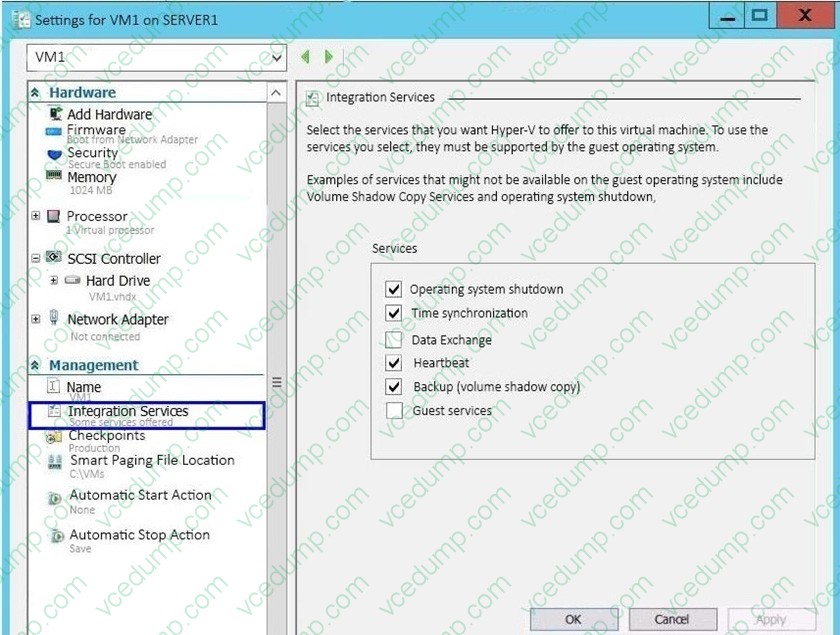
You need to ensure that you can use the Copy-VMFile cmdlet on Server1 to copy files from VM1.
Solution: You need to enable the Guest services integration service for VM1.
Does this meet the goal?
A. Yes
B. No -
Question 186:
Note: This question is part of a series of questions that use the same or similar answer choices. An answer choice may be correct for more than one question in the series. Each question is independent of the other questions in this series.
Information and details provided in a question apply only to that question.
You have a Hyper-V host named Server1 that runs Windows Server 2016. Server1 contains a virtual machine named VM1.
You need to ensure that you can use nested virtualization on VM1.
What should you run on Server1?
A. the Mount-VHD cmdlet
B. the Diskpart command
C. the Set-VHD cmdlet
D. the Set-VM cmdlet
E. the Set-VMHost cmdlet
F. the Set-VMProcessor cmdlet
G. the Install-WindowsFeature cmdlet
H. the Optimize-VHD cmdlet -
Question 187:
Note: This question is part of a series of questions that use the same or similar answer choices. An answer choice may be correct for more than one question in the series. Each question is independent of the other questions in this series.
Information and details provided in a question apply only to that question.
You have two servers named Server1 and Server2 that run Windows Server 2016. Server1 and Server2 have the Hyper-V server role installed.
An iSCSI SAN connects to the network.
You create a LUN on the SAN and configure both servers to connect to the iSCSI target.
You create a failover cluster and add Server1 and Server2 to the cluster. You connect both servers to the iSCSI target and format the shared storage.
You need to add the shared storage to the cluster. The solution must ensure that virtual machines running on both nodes can access the shared storage simultaneously.
Which tool should you use?
A. the clussvc.exe command
B. the cluster.exe command
C. the Computer Management snap-in
D. the configurehyperv.exe command
E. the Disk Management snap-in
F. the Failover Cluster Manager snap-in
G. the Hyper-V Manager snap-in
H. the Server Manager app -
Question 188:
This question is part of a series of questions that present the same scenario. Each question in the series contains a unique solution that might meet the stated goals. Some question sets might have more than one correct solution, while others
might not have a correct solution.
After your answer a question in this section, you will NOT be able to return to it. As a result, these questions will not appear in the review screen.
Your network contains an Active Directory forest named contoso.com.
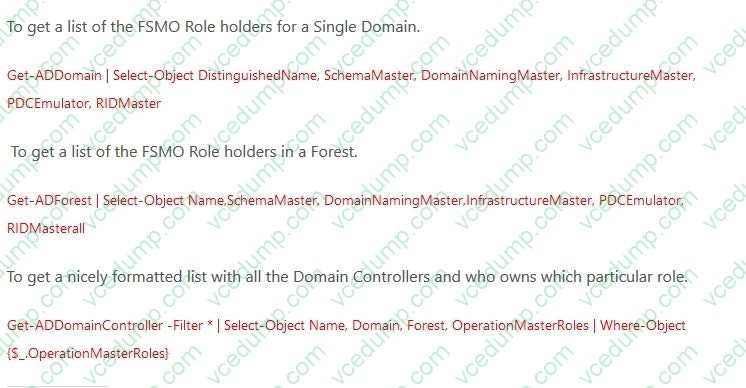
You need to identify which server is the schema master.
Solution: From Windows PowerShell, you run Get-ADDomainController -Discover -Service 2.
Does this meet the goal?
A. Yes
B. No -
Question 189:
You have a server named Server1 that runs Windows Server 2016. Server1 is an IP Address Management (IPAM) server that collects DHCP and DNS logs and events for your entire network.
You need to get the IP addresses that were assigned to a client computer named Computer1 during the last week.
What should you do on Server1?
A. Open Event Viewer and click Windows Logs. Filter the Forwarded Events log for Computer1.
B. From the IPAM node in Server Manager, click Event Catalog, and then review the IP Address Tracking.
C. Run the Get-IpamAddress cmdlet.
D. From the IPAM node in Server Manager, click IP Address Space, and then review the IP Address Inventory.
E. Run the Get-IpamDhcpConfigurationEvent cmdlet.
F. Run the Export-IpamAddress cmdlet.
G. Open Event Viewer and click Windows Logs. Filter the Security log for Computer1. -
Question 190:
You have a Windows Server 2016 failover cluster named Cluster1 that contains four nodes named Server1, Server2, Server3, and Server4.
You need to configure Cluster1 to use directly attached storage to host several virtual machines.
You run the Enable-ClusterStorageSpacesDirect cmdlet on Server1.
What should you do next?
A. Run the Enable-ClusterStorageSpacesDirect cmdlet on the other three nodes.
B. Create volumes.
C. Create a storage pool.
D. Run the Add-ClusterResource cmdlet on all of the nodes.

Related Exams:
-
62-193
Technology Literacy for Educators -
70-243
Administering and Deploying System Center 2012 Configuration Manager -
70-355
Universal Windows Platform – App Data, Services, and Coding Patterns -
77-420
Excel 2013 -
77-427
Excel 2013 Expert Part One -
77-725
Word 2016 Core Document Creation, Collaboration and Communication -
77-726
Word 2016 Expert Creating Documents for Effective Communication -
77-727
Excel 2016 Core Data Analysis, Manipulation, and Presentation -
77-728
Excel 2016 Expert: Interpreting Data for Insights -
77-731
Outlook 2016 Core Communication, Collaboration and Email Skills
Tips on How to Prepare for the Exams
Nowadays, the certification exams become more and more important and required by more and more enterprises when applying for a job. But how to prepare for the exam effectively? How to prepare for the exam in a short time with less efforts? How to get a ideal result and how to find the most reliable resources? Here on Vcedump.com, you will find all the answers. Vcedump.com provide not only Microsoft exam questions, answers and explanations but also complete assistance on your exam preparation and certification application. If you are confused on your 70-743 exam preparations and Microsoft certification application, do not hesitate to visit our Vcedump.com to find your solutions here.