70-417 Exam Details
-
Exam Code
:70-417 -
Exam Name
:Upgrading Your Skills to MCSA Windows Server 2012 -
Certification
:Microsoft Certifications -
Vendor
:Microsoft -
Total Questions
:711 Q&As -
Last Updated
:Feb 03, 2022
Microsoft 70-417 Online Questions & Answers
-
Question 501:
Your network contains 25 Web servers that run Windows Server 2012 R2.
You need to configure auditing policies that meet the following requirements:
Generate an event each time a new process is created.
Generate an event each time a user attempts to access a file share.
Which two auditing policies should you configure? To answer, select the appropriate two auditing policies in the answer area.
A. Audit access management (Not Defined)
B. Audit directory service access (Not Defined)
C. Audit logon events (Not Defined)
D. Audit object access(Not Defined)
E. Audit policy change(Not Defined)
F. Audit privilege use (Not Defined)
G. Audit process tracking (Not Defined)
H. Audit system events(Not Defined) -
Question 502:
Your role of Network Administrator at ABC.com includes the management of the Active Directory Domain Services (AD DS) domain named ABC.com. The network includes servers that run Windows Server 2012. The client computers run Windows 7 Professional or Windows 8 Pro. A Windows Server 2012 server named ABC-WSUS1 runs Windows Server Updates Services. All client computers in the network download updates from ABC-WSUS1. You need to configure ABCWSUS1 to download express installation files from Microsoft to provide faster download and installation on the client computers.
How should you configure ABC-WSUS1?
A. In the WSUS console, modify the Update Files settings under Update Files and Languages options.
B. In the WSUS console, modify the Update Languages settings under Update Files and Languages options.
C. In the WSUS console, modify the Classifications settings under Products and Classifications options.
D. In the WSUS console, modify the Products settings under Products and Classifications options. -
Question 503:
You work for a company named ABC.com. Your role of Network Administrator includes the management of the company's physical and virtual infrastructure. The network includes servers running Windows Server 2008 R2 Service Pack 1
(SP1) and Windows Server 2012.
Virtual machines (VMs) are hosted on Windows Server 2012 servers running the Hyper-V role. One Windows Server 2012 Hyper-V host server is named ABC-HVDev1. ABC-HVDev1 has four quad-core processors, 48GB RAM and six
physical network adapters configured as three network adapter teams. ABC-HVDev1 also has two Host Bus Adapters (HBAs) and connects to a Fiber Channel SAN.
You have installed five VMs named DevVM1 through DevVM5 on ABC-HVDev1. Company developers use the VMs to test applications during the development of the applications. The developers regularly take snapshots of the VMs and
often restore the VMs back to earlier snapshots.
You need to ensure successful time synchronization in the event that significant time has passed since a VM last synched time.
What should you do?
A. You should configure Automatic Start Action.
B. You should configure Startup Order.
C. You should configure NUMA topology.
D. You should configure Resource Control
E. You should configure SR-IOV.
F. You should configure Integration Services. -
Question 504:
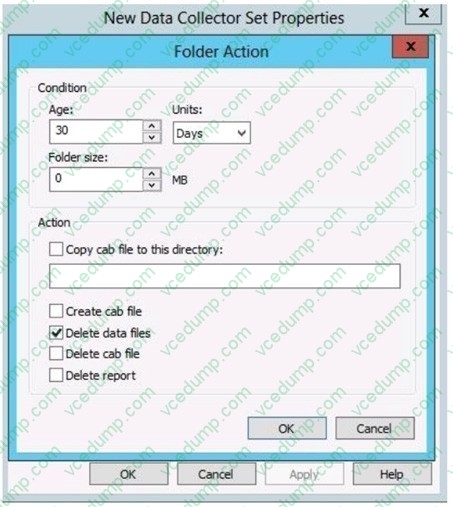
You have a server named Server1 that runs Windows Server 2012 R2. On Server1, you configure a custom Data Collector Set (DCS) named DCS1. You need to ensure that all performance log data that is older than 30 days is deleted automatically.
What should you configure?
A. A File Server Resource Manager (FSRM) file screen on the %Systemdrive%\PerfLogs folder
B. The Data Manager settings of DCS1
C. A schedule for DCS1
D. A File Server Resource Manager (FSRM) quota on the %Systemdrive%\PerfLogs folder -
Question 505:
Your role of Network Administrator at ABC.com includes the management of the Active Directory Domain Services (AD DS) domain named ABC.com. The network includes servers that run Windows Server 2012.
A server named ABC-SRV10 runs Windows Server 2012 and is configured as a file server, DHCP server and DNS server.
The company has recently opened a branch office. You plan to move ABC-SRV10 to the branch office.
To improve security, you want to remove the graphical user interface (GUI) from ABC-SRV10. What is the easiest way to remove the GUI from ABC-SRV10?
A. Run the Remove-WindowsFeature Desktop-Experience cmdlet.
B. Run the Disable-ServerManagerStandardUserRemoting cmdlet.
C. Reinstall Windows Server 2012.
D. Uninstall the User Interfaces and Infrastructure feature. -
Question 506:
Your network contains an Active Directory domain named contoso.com. The domain contains a server named Server1 that has the Remote Access server role installed.
DirectAccess is implemented on Server1 by using the default configuration.
You discover that DirectAccess clients do not use DirectAccess when accessing websites on the Internet.
You need to ensure that DirectAccess clients access all Internet websites by using their DirectAccess connection.
What should you do?
A. Configure a DNS suffix search list on the DirectAccess clients.
B. Enable the Route all traffic through the internal network policy setting in the DirectAccess Server Settings Group Policy object (GPO).
C. Configure DirectAccess to enable force tunneling.
D. Disable the DirectAccess Passive Mode policy setting in the DirectAccess Client Settings Group Policy object (GPO). -
Question 507:
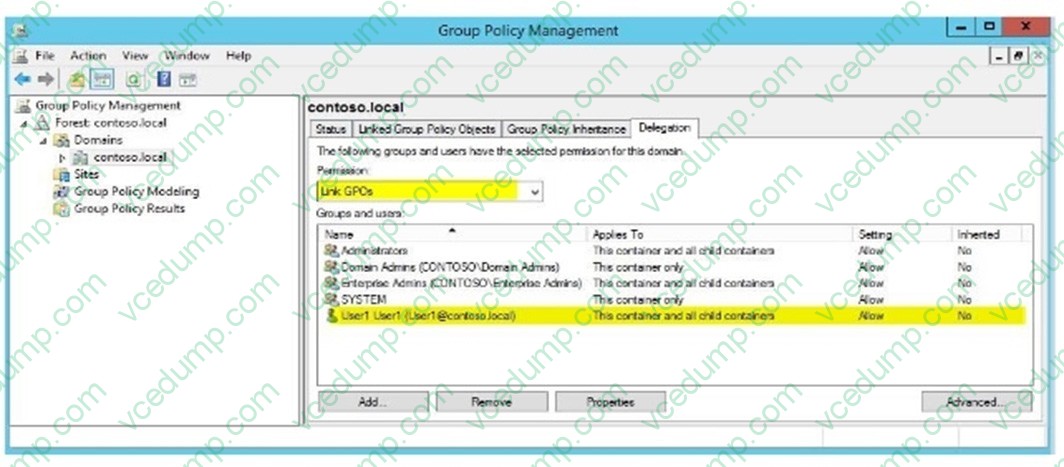
Your network contains an Active Directory domain named contoso.com. The domain contains 30 organizational units (OUs). You need to ensure that a user named User1 can link Group Policy Objects (GPOs) in the domain.
What should you do?
A. From the Active Directory Users and Computers, add User1 to the Network Configuration Operators group.
B. From the Group Policies Management, click the contoso.com node and modify the Delegation settings.
C. From the Group Policies Management, click the Group Policy Objects node and modify the Delegation settings.
D. From the Active Directory Users and Computers, add User1 to the Group Policy Creator Owners group. -
Question 508:
Your network contains an Active Directory forest named contoso.com. All servers run Windows Server 2012 R2.
You need to create a custom Active Directory application partition.
Which tool should you use?
A. Eseutil
B. Dsadd
C. Dsmod
D. Ntdsutil -
Question 509:
Your network contains a server named Server1 that runs Windows Server 2012. Server1 has the Hyper-V server role installed.
Server1 hosts four virtual machines named VM1, VM2, VM3, and VM4.
Server1 is configured as shown in the following table.
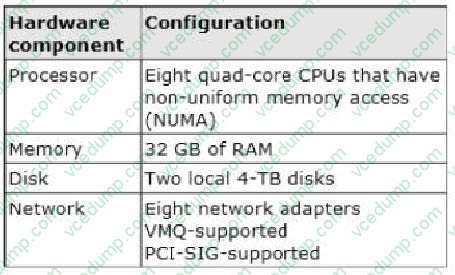
You plan to schedule a complete backup of Server1 by using Windows Server Backup.
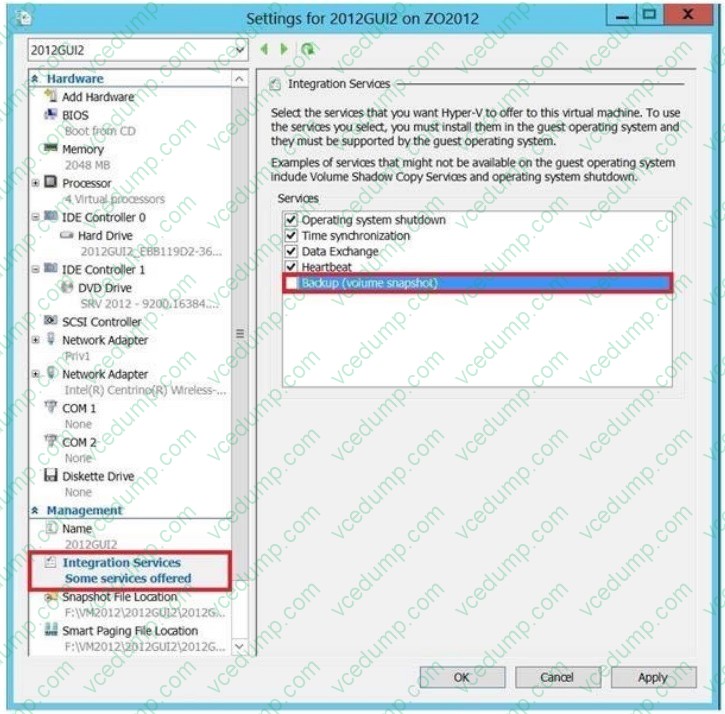
You need to ensure that the state of VM1 is saved before the backup starts.
What should you configure?
A. NUMA topology
B. Resource control
C. Resource metering
D. Virtual Machine Chimney
E. The VLAN ID
F. Processor Compatibility
G. The startup order
H. Automatic Start Action
I. Integration Services
J. Port mirroring -
Question 510:
Your network contains two servers named HV1 and HV2. Both servers run Windows Server 2012 R2 and have the Hyper-V server role installed.
HV1 hosts 25 virtual machines. The virtual machine configuration files and the virtual hard disks are stored in D:\VM.
You shut down all of the virtual machines on HV1.
You copy D:\VM to D:\VM on HV2.
You need to start all of the virtual machines on HV2. You want to achieve this goal by using the minimum amount of administrative effort.
What should you do?
A. From HV1, export all virtual machines to D:\VM. Copy D:\VM to D:\VM on HV2 and overwrite the existing files. On HV2, run the New Virtual Machine wizard.
B. From HV1, export all virtual machines to D:\VM. Copy D:\VM to D:\VM on HV2 and overwrite the existing files. On HV2, run the Import Virtual Machine wizard.
C. Run the Import-VM InitialReplication cmdlet.
D. Run the Import-VM cmdlet.
Related Exams:
-
62-193
Technology Literacy for Educators -
70-243
Administering and Deploying System Center 2012 Configuration Manager -
70-355
Universal Windows Platform – App Data, Services, and Coding Patterns -
77-420
Excel 2013 -
77-427
Excel 2013 Expert Part One -
77-725
Word 2016 Core Document Creation, Collaboration and Communication -
77-726
Word 2016 Expert Creating Documents for Effective Communication -
77-727
Excel 2016 Core Data Analysis, Manipulation, and Presentation -
77-728
Excel 2016 Expert: Interpreting Data for Insights -
77-731
Outlook 2016 Core Communication, Collaboration and Email Skills
Tips on How to Prepare for the Exams
Nowadays, the certification exams become more and more important and required by more and more enterprises when applying for a job. But how to prepare for the exam effectively? How to prepare for the exam in a short time with less efforts? How to get a ideal result and how to find the most reliable resources? Here on Vcedump.com, you will find all the answers. Vcedump.com provide not only Microsoft exam questions, answers and explanations but also complete assistance on your exam preparation and certification application. If you are confused on your 70-417 exam preparations and Microsoft certification application, do not hesitate to visit our Vcedump.com to find your solutions here.