642-885 Exam Details
-
Exam Code
:642-885 -
Exam Name
:Deploying Cisco Service Provider Advanced Routing -
Certification
:Cisco Certifications -
Vendor
:Cisco -
Total Questions
:131 Q&As -
Last Updated
:Jun 15, 2024
Cisco 642-885 Online Questions & Answers
-
Question 51:
Which command configures a Source Specific Multicast on a Cisco IOS XR router?
A. configure multicast-routing address-family ipv4 interface all enable exit router igmp version 3 commit
B. configure multicast-routing address-family ipv4 interface all enable exit router igmp version 2 commit
C. configure multicast-routing address-family ipv4 interface all enable exit router igmp version 1 commit
D. configure interface all enable exit router igmp version 3 commit -
Question 52:
Which Cisco IOS XR command sets successfully configure a value of 20 for the advertisement- interval?
A. RP/0/RSP0/CPU0:routerconfig)# router bgp 65512 RP/0/RSP0/CPU0:router(config-bgp)# session-group test RP/0/RSP0/CPU0:router(config-bgp-sngrp)# advertisement-interval 20 RP/0/RSP0/CPU0:router (config-bgp-sngrp)# exit RP/0/RSP0/CPU0:router(config-bgp)# neighbor-group test RP/0/RSP0/CPU0:router(config-bgp-nbrgrp)# advertisement-interval 25 RP/0/RSP0/CPU0:router (config-bgp-nbrgrp)# exit RP/0/RSP0/CPU0:router(config-bgp)# exit RP/0/RSP0/CPU0:router(config-bgp)# neighbor 192.168.1.1 RP/0/RSP0/CPU0:router(config-bgp-nbr)# remote-as 65513 RP/0/RSP0/CPU0:router(config-bgpnbr)# use session-group test RP/0/RSP0/CPU0:router(config-bgp-nbr)# use neighbor-group test
B. RP/0/RSP0/CPU0:routerconfig)# router bgp 65512 RP/0/RSP0/CPU0:router(config-bgp)# session-group test RP/0/RSP0/CPU0:router(config-bgp-sngrp)# ebgp-multihop 2 RP/0/RSP0/CPU0:router(config-bgpsngrp)# exit RP/0/RSP0/CPU0:router(config-bgp)# neighbor-group test RP/0/RSP0/CPU0:router(config-bgp-nbrgrp)# advertisement-interval 20 RP/0/RSP0/CPU0:router (config-bgp-nbrgrp)# exit RP/0/RSP0/CPU0:router(config-bgp)# exit RP/0/RSP0/CPU0:router(config-bgp)# neighbor 192.168.1.1 RP/0/RSP0/CPU0:router(config-bgp-nbr)# remote-as 65513 RP/0/RSP0/CPU0:router(config-bgpnbr)# use session-group test RP/0/RSP0/CPU0:router(config-bgp-nbr)# use neighbor-group test
C. RP/0/RSP0/CPU0:routerconfig)# router bgp 65512 RP/0/RSP0/CPU0:router(config-bgp)# session-group test RP/0/RSP0/CPU0:router(config-bgp-sngrp)# exit RP/0/RSP0/CPU0:router(config-bgp)# neighbor-group test RP/0/RSP0/CPU0:router(config-bgp-nbrgrp)# exit RP/0/RSP0/CPU0:router(config-bgp)# exit RP/0/RSP0/CPU0:router(config-bgp)# neighbor 192.168.1.1 RP/0/RSP0/CPU0:router(config-bgp-nbr)# remote-as 65513 RP/0/RSP0/CPU0:router(config-bgpnbr)# use session-group test RP/0/RSP0/CPU0:router(config-bgp-nbr)# use neighbor-group test
D. RP/0/RSP0/CPU0:routerconfig)# router bgp 65512 RP/0/RSP0/CPU0:router(config-bgp)# session-group test RP/0/RSP0/CPU0:router(config-bgp-sngrp)# advertisement-interval 25 RP/0/RSP0/CPU0:router (config-bgp-sngrp)# exit RP/0/RSP0/CPU0:router(config-bgp)# neighbor-group test RP/0/RSP0/CPU0:router(config-bgp-nbrgrp)# advertisement-interval 20 RP/0/RSP0/CPU0:router (config-bgp-nbrgrp)# exit RP/0/RSP0/CPU0:router(config-bgp)# exit RP/0/RSP0/CPU0:router(config-bgp)# neighbor 192.168.1.1 RP/0/RSP0/CPU0:router(config-bgp-nbr)# remote-as 65513 RP/0/RSP0/CPU0:router(config-bgpnbr)# use session-group test RP/0/RSP0/CPU0:router(config-bgp-nbr)# use neighbor-group test -
Question 53:
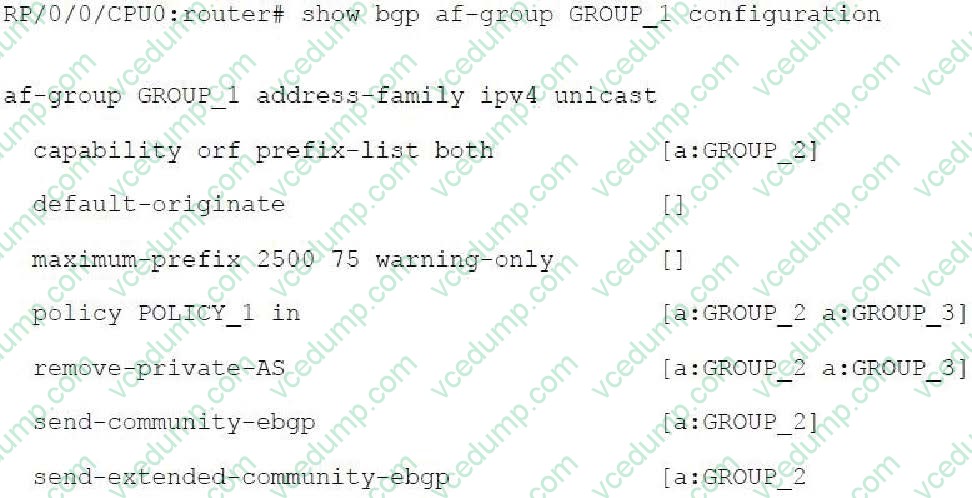
Refer to the Cisco IOS-XR show output exhibit.
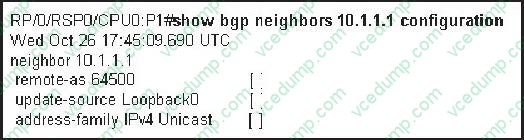
Which statement is correct?
A. The [ ] indicates the configuration has a problem
B. The [ ] indicates the 10.1.1.1 neighbor peering session has not been established
C. The [ ] indicates the configuration was not inherited from a group
D. The [ ] indicates the configuration has not been committed
E. The [ ] indicates the corresponding BGP peer configuration has a mismatch configuration -
Question 54:
Which command set implements BGP support for NSF/SSO on Cisco IOS XE between a PE and a route reflector?
A. On RR: router bgp 300 no synchronization bgp log-neighbor-changes bgp graceful-restart restart-time 120 bgp graceful-restart stalepath-time 360 bgp graceful-restart neighbor 10.20.20.2 remote-as 200 neighbor 10.20.20.2 update-source Loopback0 no auto-summary ! address-family vpnv4 neighbor 10.20.20.2 activate neighbor 10.20.20.2 send-community both neighbor 10.20.20.2 route-reflector-client exit-address-family On PE: router bgp 300 no synchronization bgp log-neighbor-changes bgp graceful-restart restart-time 120 bgp graceful-restart stalepath-time 360 bgp graceful-restart neighbor 10.20.20.1 remote-as 300 neighbor 10.20.20.1 update-source Loopback0 no auto-summary ! address-family vpnv4 neighbor 10.20.20.1 activate neighbor 10.20.20.1 send-community both exit-address-family !
B. On RR: router bgp 300 no synchronization bgp log-neighbor-changes bgp graceful-restart restart-time 120 bgp graceful-restart stalepath-time 360 bgp graceful-restart neighbor 10.20.20.2 remote-as 200 neighbor 10.20.20.2 update-source Loopback0 no auto-summary ! address-family vpnv4 neighbor 10.20.20.2 activate neighbor 10.20.20.2 send-community both neighbor 10.20.20.2 route-reflector-client exit-address-family On PE: router bgp 300 no synchronization bgp log-neighbor-changes neighbor 10.20.02.1 remote-as 300 neighbor 10.20.20.1 update-source Loopback0 no auto-summary ! address-family vpnv4 neighbor 10.20.20.1 activate neighbor 10.20.20.1 send-community both exit-address-family !
C. On RR: router bgp 300 no synchronization bgp log-neighbor-changes bgp graceful-restart restart-time 120 bgp graceful-restart stalepath-time 360 bgp graceful-restart neighbor 10.20.20.2 remote-as 200 neighbor 10.20.20.2 update-source Loopback0 no auto-summary ! address-family vpnv4 neighbor 10.20.20.2 activate neighbor 10.20.20.2 send-community both neighbor 10.20.20.2 route-reflector-client exit-address-family On PE: router bgp 300 no synchronization bgp log-neighbor-changes neighbor 10.20.20.1 remote-as 300 neighbor 10.20.20.1 update-source Loopback0 neighbor 10.20.20.1 ha-mode sso no auto-summary ! address-family vpnv4 neighbor 10.20.20.1 activate neighbor 10.20.20.1 send-community both exit-address-family !
D. On RR: router bgp 300 no synchronization bgp log-neighbor-changes neighbor 10.20.20.2 remote-as 200 neighbor 10.20.20.2 update-source Loopback0 neighbor 10.20.20.2 ha-mode sso no auto-summary ! address-family vpnv4 neighbor 10.20.20.2 activate neighbor 10.20.20.2 send-community both neighbor 10.20.20.2 route-reflector-client exit-address-family On PE: router bgp 300 no synchronization bgp log-neighbor-changes neighbor 10.20.20.1 remote-as 300 neighbor 10.20.20.1 update-source Loopback0 neighbor 10.20.20.1 ha-mode sso no auto-summary ! address-family vpnv4 neighbor 10.20.20.1 activate neighbor 10.20.20.1 send-community both exit-address-family !
E. On RR: router bgp 300 no synchronization bgp log-neighbor-changes neighbor 10.20.20.2 remote-as 200 neighbor 10.20.20.2 update-source Loopback0 no auto-summary ! address-family vpnv4 neighbor 10.20.20.2 activate neighbor 10.20.20.2 send-community both neighbor 10.20.20.2 route-reflector-client exit-address-family On PE: router bgp 300 no synchronization bgp log-neighbor-changes bgp graceful-restart restart-time 120 bgp graceful-restart stalepath-time 360 bgp graceful-restart neighbor 10.20.20.1 remote-as 300 neighbor 10.20.20.1 update-source Loopback0 no auto-summary ! address-family vpnv4 neighbor 10.20.20.1 activate neighbor 10.20.20.1 send-community both exit-address-family ! -
Question 55:
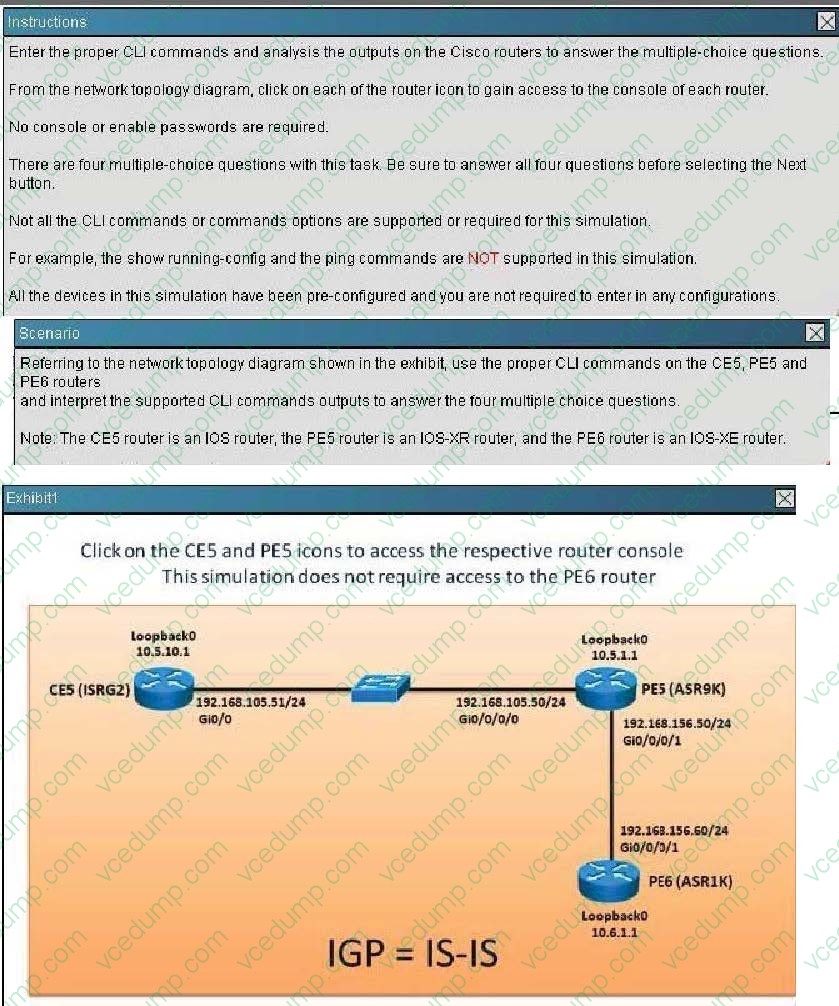
Which router Is configured as the RPforthe 234.1.1.1 multicast group and which Is the multicast source that is currently sending traffic to the 234.1.1.1 multicast group? (Choose two.)
A. CE5
B. PE5
C. PE6
D. 10.5.10.1
E. 10.5.1.1
F. 192.168.156.60 -
Question 56:
Which three statements regarding NAT64 operations are correct? (Choose three.)
A. With stateful NAT64, many IPv6 address can be translated into one IPv4 address, thus IPv4 address conservation is achieved
B. Stateful NAT64 requires the use of static translation slots so IPv6 hosts and initiate connections to IPv4 hosts.
C. With stateless NAT64, the source and destination IPv4 addresses are embedded in the IPv6 addresses
D. NAT64 works in conjunction with DNS64
E. Both the stateful and stateless NAT64 methods will conserve IPv4 address usage -
Question 57:
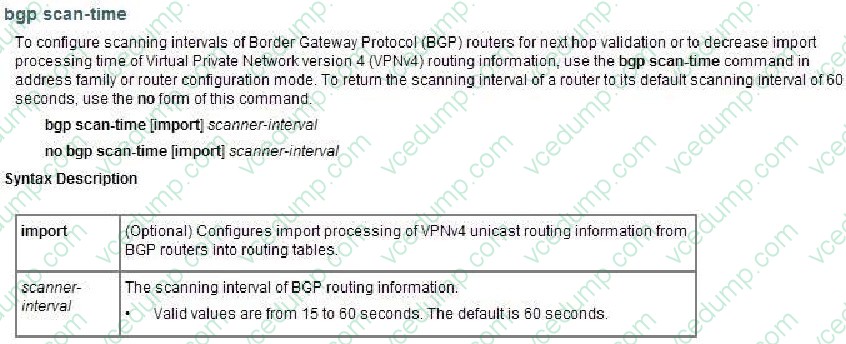
You noticed a recent change to the BGP configuration on a PE router, the bgp scan time has been changed from the default value to 30s. Which three effects will this change have? (Choose three.)
A. The BGP table will be examined and verified more frequently
B. The BGP keepalive messages will be sent to the BGP peers at a faster rate
C. The BGP table will be modified more quickly in the event that a next-hop address becomes unreachable
D. The CPU load of the router will increase
E. The minimum time interval between sending EBGP and IBGP routing updates will decrease
F. The BGP convergence time will increase -
Question 58:
Which two methods represent IPv6 tunneling implementations? (Choose two.)
A. IPv6 over GRE tunneling
B. manually configured tunnels
C. automatic tunnels
D. 6to4 tunneling
E. IPv6 over an IPv4 tunnel over MPLS -
Question 59:
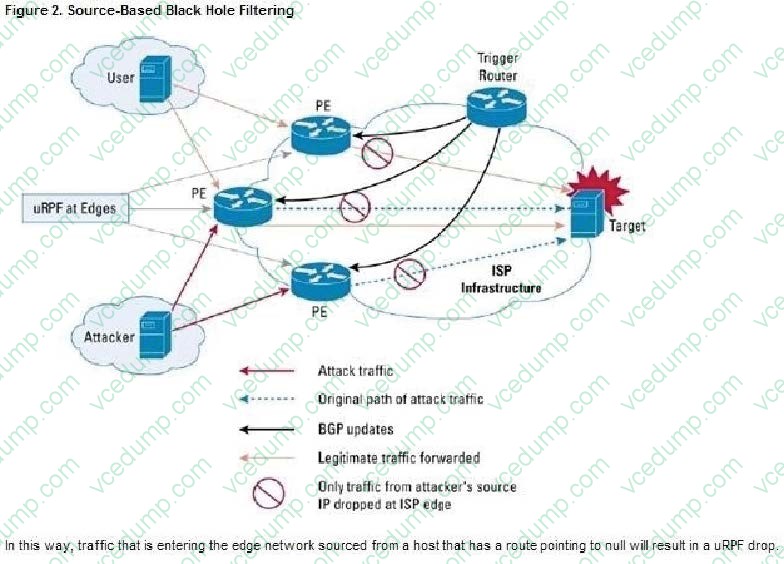
When implementing source-based remote-triggered black hole filtering, which two configurations are required on the edge routers that are not the signaling router? (Choose two.)
A. A static route to a prefix that is not used in the network with a next hop set to the Null0 interface
B. A static route pointing to the IP address of the attacker
C. uRPF on all external facing interfaces at the edge routers
D. Redistribution into BGP of the static route that points to the IP address of the attacker
E. A route policy to set the redistributed static routes with the no-export BGP community -
Question 60:
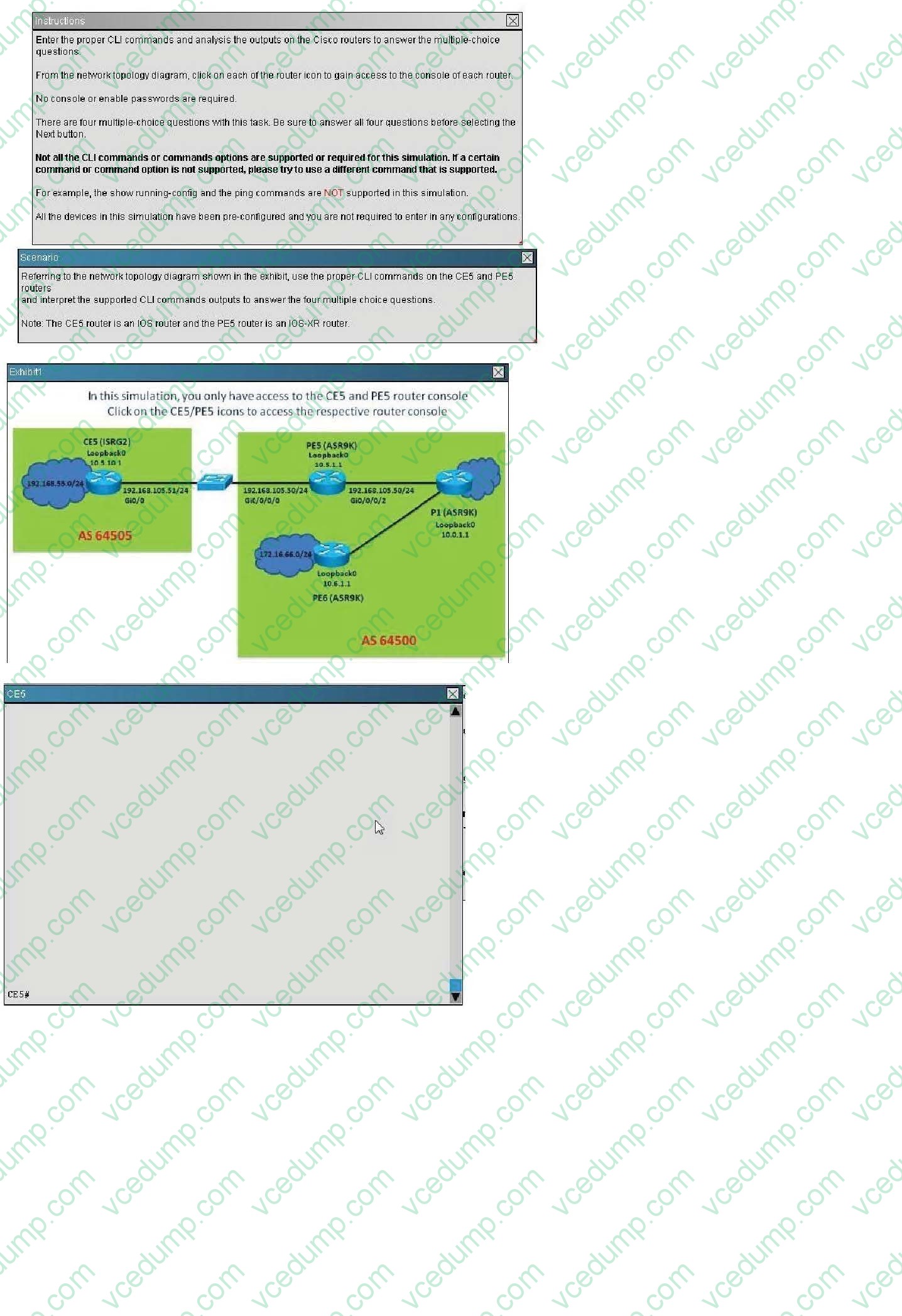
On the PE5 router, which statement Is correct regarding the learned BGP prefixes?
A. The 209.165.201.0/27 prefix is received from the 10.0.1.1 IBGP peer which is a route reflector
B. The 172.16.66.0/24 prefix BGP next-hop points to the route reflector
C. All prefixes learned on PE5 has the default local prefernce value
D. The 209.165.202.128/27 prefix is originated by the 10.0.1.1 IBGP peer
Related Exams:
-
300-745
Designing Cisco Security Infrastructure (300-745 SDSI) v1.0 -
350-101
Implementing and Operating Cisco Wireless Core Technologies (350-101 WLCOR)v1.0 -
352-011
Cisco Certified Design Expert Practical -
500-052
Cisco Unified Contact Center Express -
500-173
Designing the FlexPod Solution (FPDESIGN) -
500-201
Deploying Cisco Service Provider Mobile Backhaul Solutions -
500-210
SP Optical Technology Field Engineer Representative -
500-220
Engineering Cisco Meraki Solutions (ECMS) v2.2 -
500-230
Cisco Service Provider Routing Field Engineer -
500-240
Cisco Mobile Backhaul for Field Engineers
Tips on How to Prepare for the Exams
Nowadays, the certification exams become more and more important and required by more and more enterprises when applying for a job. But how to prepare for the exam effectively? How to prepare for the exam in a short time with less efforts? How to get a ideal result and how to find the most reliable resources? Here on Vcedump.com, you will find all the answers. Vcedump.com provide not only Cisco exam questions, answers and explanations but also complete assistance on your exam preparation and certification application. If you are confused on your 642-885 exam preparations and Cisco certification application, do not hesitate to visit our Vcedump.com to find your solutions here.