642-885 Exam Details
-
Exam Code
:642-885 -
Exam Name
:Deploying Cisco Service Provider Advanced Routing -
Certification
:Cisco Certifications -
Vendor
:Cisco -
Total Questions
:131 Q&As -
Last Updated
:Jun 15, 2024
Cisco 642-885 Online Questions & Answers
-
Question 11:
With IPv6 multicast, which feature can be used as a replacement method for static RP configuration?
A. PIM Snooping
B. MLD
C. MLD Snooping
D. Embedded RP
E. DHCPv6 -
Question 12:
Which two statements correctly describe the RPF check when a multicast packet arrives at a router? (Choose two.)
A. The router looks up the source address in the unicast routing table to determine if the packet has arrived on the interface that is on the reverse path back to the source
B. The router looks up the destination address in the unicast routing table to determine if the packet has arrived on the interface that is on the reverse path back to the destination
C. If the packet has arrived on the interface leading back to the destination, the RPF check passes and the packet is forwarded. If the RPF check fails, the packet is dropped
D. If the packet has arrived on the interface leading back to the source, the RPF check passes and the packet is forwarded. If the RPF check fails, the packet is dropped -
Question 13:
What is determined by running the same hash algorithm on all PIMv2 routers?
A. The SPT from the RP to the multicast source
B. The SPT from the last hop router to the multicast source
C. Auto RP election
D. Which BSR to use for a particular multicast group
E. Which RP to use from a set of candidate RPs in the RP set -
Question 14:
In which three cases is a dual-stack IPv6/IPv4 router required? (Choose three.)
A. tunnel endpoint routers in the case of IPv6 over GRE
B. transit routers in case of an IPv6 over GRE implementation
C. 6to4 implementation border routers
D. 6to4 implementation border and neighboring routers
E. PE routers in case of an IPv6 over IPv4 tunnel over MPLS implementation
F. PE and P routers in case of an IPv6 over IPv4 tunnel over MPLS implementation -
Question 15:
Refer to the exhibit.
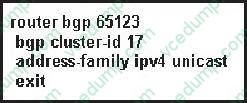
Given the partial BGP configuration, which configuration correctly completes the Cisco IOS-XR route reflector configuration where both the 1.1.1.1 and 2.2.2.2 routers are the clients and the 3.3.3.3 router is a non-client IBGP peer?
A. neighbor 1.1.1.1 remote-as 65123 route-reflector-client neighbor 2.2.2.2 remote-as 65123 route-reflector-client neighbor 3.3.3.3 remote-as 65123
B. neighbor 1.1.1.1 address-family ipv4 unicast remote-as 65123 route-reflector-client neighbor 2.2.2.2 address-family ipv4 unicast remote-as 65123 route-reflector-client neighbor 3.3.3.3 address-family ipv4 unicast remote-as 65123
C. neighbor 1.1.1.1 remote-as 65123 address-family ipv4 unicast route-reflector-client neighbor 2.2.2.2 remote-as 65123 address-family ipv4 unicast route-reflector-client neighbor 3.3.3.3 remote-as 65123
D. neighbor 1.1.1.1 remote-as 65123 neighbor 1.1.1.1 route-reflector-client neighbor 2.2.2.2 remote-as 65123 neighbor 2.2.2.2 route-reflector-client neighbor 3.3.3.3 remote-as 65123 -
Question 16:
Which command set should be used for a 6to4 tunnel in a Cisco IOS XE router, considering the border interface with IPv4 address of 209.165.201.2?
A. interface Tunnel2002 ipv6 enable ipv6 address 2002:D1A5:C902::1/128 tunnel source Ethernet0/0 tunnel mode ipv6ip 6to4
B. interface Tunnel2002 ipv6 enable ipv6 address 2002:D1A5:D902::1/128 tunnel source Ethernet0/0 tunnel mode ipv6ip 6to4
C. interface Tunnel2002 ipv6 enable ipv6 address 2002:D1A5:D902::1/128 tunnel source Ethernet0/0 tunnel mode ipv6ip
D. interface Tunnel2002 ipv6 enable ipv6 address 2002:D1A5:C902::1/128 tunnel source Ethernet0/0 tunnel mode ipv6ip auto-tunnel
E. interface Tunnel2002 ipv6 enableipv6 address 2002:D1A5:D902::1/128 tunnel source Ethernet0/0 tunnel mode ipv6ip auto-tunnel -
Question 17:
Refer to the exhibit for the outputs from an ASR9K router.
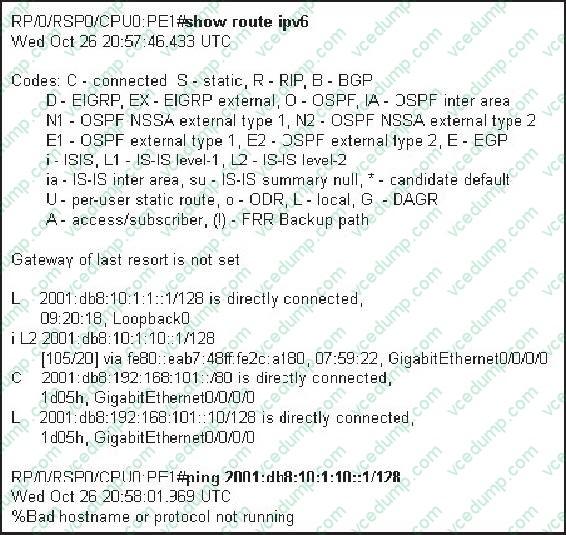
Why did the ping fail?
A. The ping command is missing the ipv6 option: ping ipv6 2001:db8:10:1:10::1/128
B. There is a problem with the IS-IS configurations
C. The fe80::eab7:48ff:fe2c:a180 next-hop is not reachable
D. The prefix length should be removed from the IPv6 address in the ping command: ping ipv6 2001:db8:10:1:10::1
E. IPv6 is not enabled on the Gi0/0/0/0 interface
F. The IPv6 neighbor discovery protocol is not enabled on the Gi0/0/0/0 interface -
Question 18:
Refer to the exhibit.
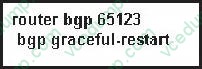
Which statement correctly explains the bgp graceful-restart command?
A. This command is used to enable NSR and is entered on the NSR-capable router, and also on any NSR-aware peer
B. This command is used to enable NSF and is entered on the NSF-capable router, and also on any NSF-aware peer
C. This command is only required on the NSF-capable routers to enable BGP graceful restart with the BGP peers
D. This command is only required on the NSF-aware routers to enable BGP graceful restart with the BGP peers
E. This command is only required on the NSR-capable routers to enable BGP graceful restart with the BGP peers -
Question 19:
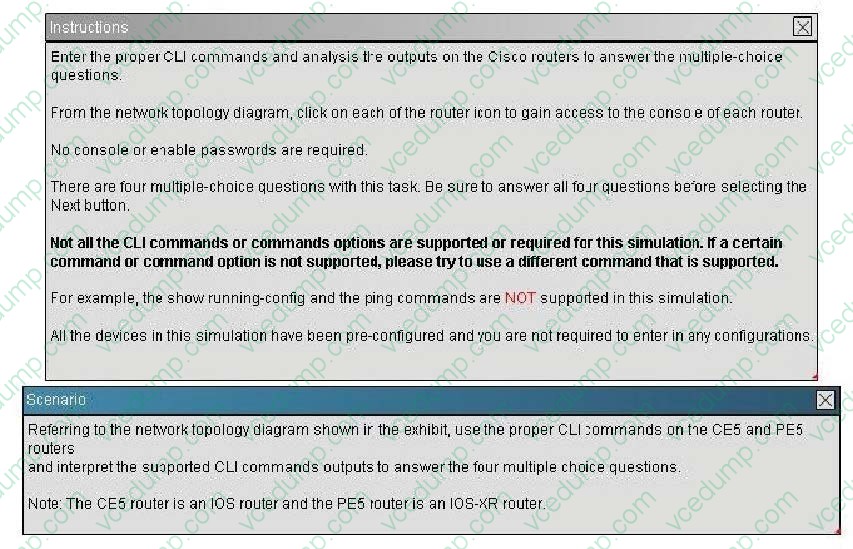
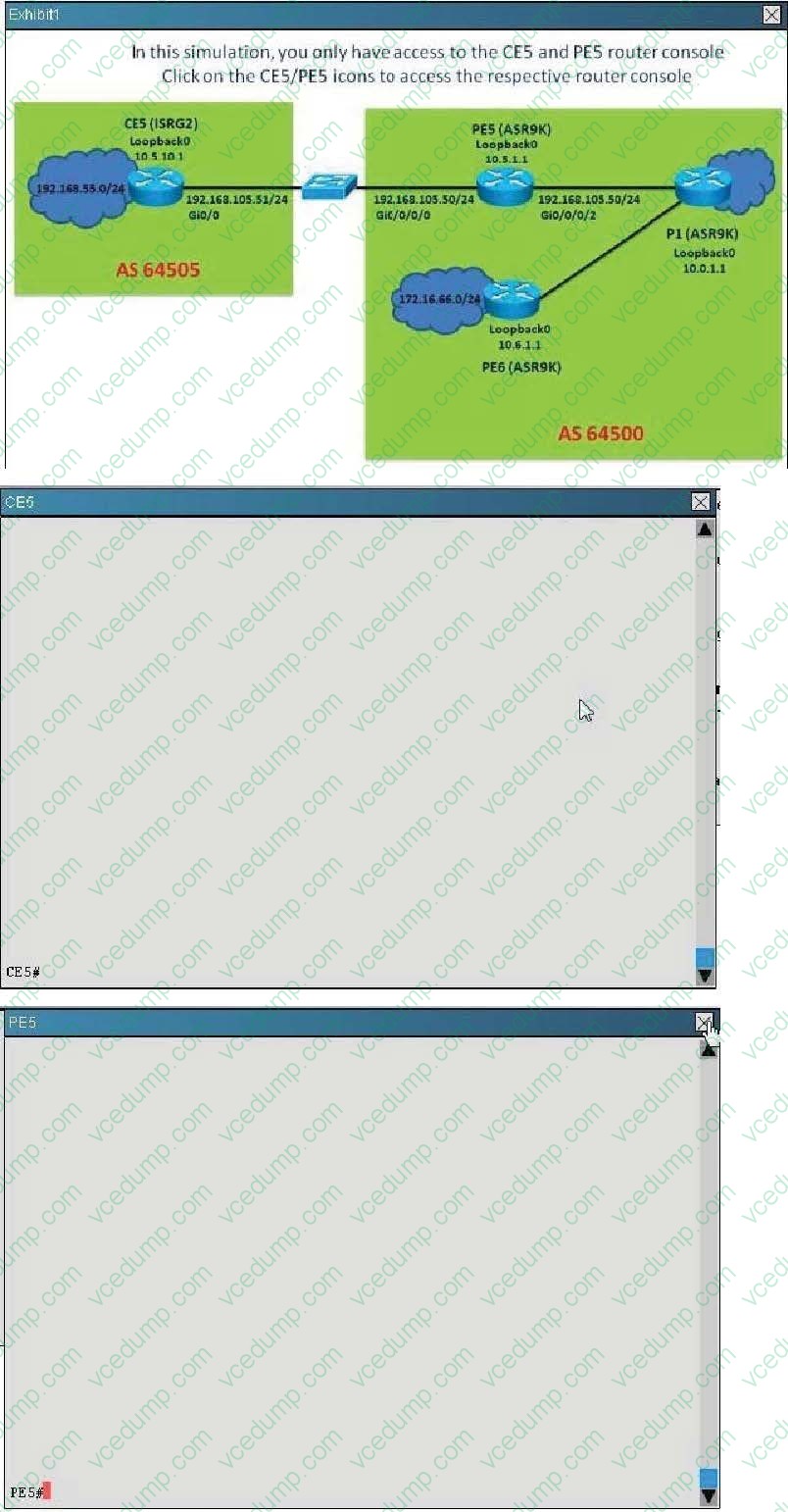
Which three statements regarding the BGP operations are correct? (Choose three)
A. PE5 will set the local preferences 200 on all the prefixes sent to CE5
B. PE5 will set the local preference to 200 on all the prefixes learned from CE5
C. CE5 has received 5 prefixes from the PE5 EBGP peer
D. CE5 has the BGP scan interval set to 30 seconds
E. CE5 is announcing the 192.168.55.0/24 prefix via EBGP to the PE5 EBGP peer
F. The AS-Path to reach the 209.165.202.128/27 prefix from CE5 is: 64500 64497 64498 -
Question 20:
Which four statements are correct regarding MSDP configurations and operations? (Choose four.)
A. The MSDP peers are also typically the RPs in respective routing domains.
B. SA messages are flooded to all other MSDP peers without any restrictions
C. On Cisco IOS, IOS-XE, and IOS-XR, the router can be configured to cache the SA messages to reduce the join latency
D. SA messages are used to advertise active sources in a domain
E. MSDP establishes neighbor relationships with other MSDP peers using TCP port 639
F. MSDP peerings on Cisco IOS, IOS-XE, and IOS-XR support MD5 or SHA1 authentication
Related Exams:
-
300-745
Designing Cisco Security Infrastructure (300-745 SDSI) v1.0 -
350-101
Implementing and Operating Cisco Wireless Core Technologies (350-101 WLCOR)v1.0 -
352-011
Cisco Certified Design Expert Practical -
500-052
Cisco Unified Contact Center Express -
500-173
Designing the FlexPod Solution (FPDESIGN) -
500-201
Deploying Cisco Service Provider Mobile Backhaul Solutions -
500-210
SP Optical Technology Field Engineer Representative -
500-220
Engineering Cisco Meraki Solutions (ECMS) v2.2 -
500-230
Cisco Service Provider Routing Field Engineer -
500-240
Cisco Mobile Backhaul for Field Engineers
Tips on How to Prepare for the Exams
Nowadays, the certification exams become more and more important and required by more and more enterprises when applying for a job. But how to prepare for the exam effectively? How to prepare for the exam in a short time with less efforts? How to get a ideal result and how to find the most reliable resources? Here on Vcedump.com, you will find all the answers. Vcedump.com provide not only Cisco exam questions, answers and explanations but also complete assistance on your exam preparation and certification application. If you are confused on your 642-885 exam preparations and Cisco certification application, do not hesitate to visit our Vcedump.com to find your solutions here.