642-883 Exam Details
-
Exam Code
:642-883 -
Exam Name
:Deploying Cisco Service Provider Network Routing -
Certification
:Cisco Certifications -
Vendor
:Cisco -
Total Questions
:174 Q&As -
Last Updated
:Dec 08, 2021
Cisco 642-883 Online Questions & Answers
-
Question 31:
BGP peerings can be secured using which protection mechanism?
A. SHA authentication
B. MD5 authentication
C. SSH
D. SSL
E. AAA
F. digital certificates -
Question 32:
Refer to the topology diagram in the exhibit.
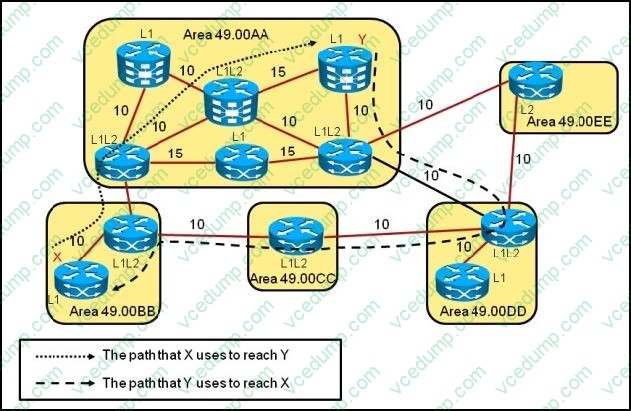
Which IS-IS feature could be implemented so that the return path for the packets from router Y in area 49.00AA to router X in area 49.00BB will use the more optimal path?
A. Enable route leaking to pass Level 2 information into the Level 1 routers.
B. Change the area 49.00AA type from a stub area to a regular area.
C. Change the IS-IS administrative distance on router Y in area 49.00AA.
D. Change the IS-IS metric type from narrow to wide on all IS-IS routers. -
Question 33:
Refer to the PE1 router routing table output exhibit.
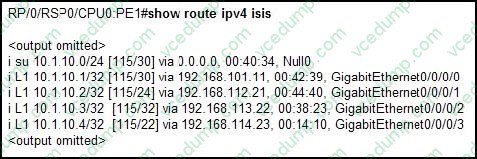
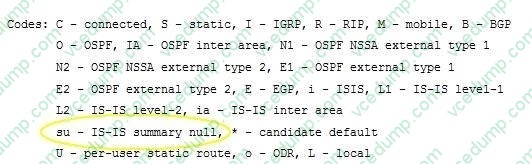
What is causing the i su 10.1.10.0/24 [115/30] via 0.0.0.0, 00:40:34, Null0 entry on the PE1 router routing table?
A. The PE1 router is receiving the 10.1.10.0/24 summary route from the upstream L1/L2 IS-IS router.
B. The PE1 router has been configured to summarize the 10.1.10.x/32 IS-IS routes to 10.1.10.0/24.
C. The 10.1.10.0/24 has been suppressed because IS-IS auto-summary has been disabled on the PE1 router.
D. The 10.1.10.0/24 has been suppressed because of a route policy configuration on the PE1 router.
E. The 10.1.10.0/24 has been suppressed because the more specific 10.1.10.x/32 IS-IS routes have been configured to leak into the IS-IS non-backbone area. -
Question 34:
When monitoring the OSPF operations in the network, you notice that the OSPF process is not load balancing traffic across multiple OSPF links. Which configuration adjustment could be made to enable the OSPF process to load balance traffic across multiple OSPF links?
A. Enable BFD on the OSPF interfaces and on the OSPF routing process.
B. Enable NSR on the OSPF routing process.
C. Enable NSF on the OSPF routing process.
D. Adjust the OSPF cost on the OSPF interfaces.
E. Adjust the OSPF variance parameter.
F. Use the wide-style OSPF metric instead of the narrow-style OSPF metric. -
Question 35:
Refer to the network diagram in the exhibit.
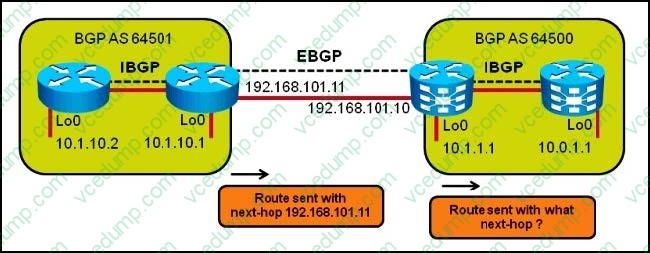
Assuming the IBGP session within AS 64500 was established using the loopback 0 interface between the two routers, by default, what will be the next hop of the routes from AS 64501 when the routes appear on the router running IBGP only in AS 64500?
A. 192.168.101.11
B. 192.168.101.10
C. 10.1.1.1
D. 10.0.1.1
E. 10.1.10.1 -
Question 36:
An engineer has two routers multihomed to the Internet via BGP. The first should be the primary path for all outbound traffic and the second should automatically become active in the event the primary goes offline. Which method to configure the routers is the most simple?
A. Set the local-preference to be higher on the primary router.
B. Set the local-preference to be lower on the primary router.
C. Set the MED to be higher on the primary router than the backup.
D. Set the primary router to have a higher weight than the backup. -
Question 37:
When implementing LDP, what is liberal label retention mode?
A. To reduce the convergence time, the LSR will retain all the received labels in its LIB even if all the neighbor LSRs go down temporary
B. The LSR can assign it's own label for each destination network even though it has not been assigned a next hop label from the neighbor LSR
C. The LSR will store the label received from the downstream LSRs in its LIB even if the downstream LSRs are not the next hop for the destination
D. The LSR will not perform PHP if it is operating in liberal label retention mode -
Question 38:
Which configuration is used when matching a prefix-list
A. match ip address prefix-list mylistin a route map?
B. match ip address mylist
C. match ip next-hop mylist
D. ip local-policy route-map mylist
E. ip-policy route-map mylist -
Question 39:
Which of the following is a characteristic of dual-multihomed connectivity between an enterprise network and the service provider network or networks?
A. An enterprise network that is connected to two or more different service providers with two or more links per service provider and using BGP to exchange routing updates with the service providers.
B. Each service provider announces a default route on each of the links that connect to the customer with a different metric.
C. An enterprise network announces a default route to each service provider.
D. Load balancing can be achieved using the maximum-paths command. -
Question 40:
An engineer wants to use an address family to configure internal BGP peer 10.1.1.1 as a route reflector client for unicast and multicast prefixes. Which option accomplishes this configuration?
A. router bgp 140 address-family ipv4 unicast neighbor 10.1.1.1 remote-as 140 address-family ipv4 unicast route-reflector-client exit address-family ipv4 multicast route-reflector-client
B. router bgp 140 neighbor 10.1.1.1 address-family ipv4 unicast address-family ipv4 multicast remote-as 150 route-reflector-client exit
C. router bgp 140 address-family ipv4 unicast route-reflector-client address-family ipv4 multicast remote-as 140 neighbor 10.1.1.1
D. router bgp 140 address-family ipv4 unicast neighbor 10.1.1.1 remote-as 150 address-family ipv4 unicast route-reflector-client exit address-family ipv4 multicast route-reflector-client
Related Exams:
-
300-745
Designing Cisco Security Infrastructure (300-745 SDSI) v1.0 -
350-101
Implementing and Operating Cisco Wireless Core Technologies (350-101 WLCOR)v1.0 -
352-011
Cisco Certified Design Expert Practical -
500-052
Cisco Unified Contact Center Express -
500-173
Designing the FlexPod Solution (FPDESIGN) -
500-201
Deploying Cisco Service Provider Mobile Backhaul Solutions -
500-210
SP Optical Technology Field Engineer Representative -
500-220
Engineering Cisco Meraki Solutions (ECMS) v2.2 -
500-230
Cisco Service Provider Routing Field Engineer -
500-240
Cisco Mobile Backhaul for Field Engineers
Tips on How to Prepare for the Exams
Nowadays, the certification exams become more and more important and required by more and more enterprises when applying for a job. But how to prepare for the exam effectively? How to prepare for the exam in a short time with less efforts? How to get a ideal result and how to find the most reliable resources? Here on Vcedump.com, you will find all the answers. Vcedump.com provide not only Cisco exam questions, answers and explanations but also complete assistance on your exam preparation and certification application. If you are confused on your 642-883 exam preparations and Cisco certification application, do not hesitate to visit our Vcedump.com to find your solutions here.