642-883 Exam Details
-
Exam Code
:642-883 -
Exam Name
:Deploying Cisco Service Provider Network Routing -
Certification
:Cisco Certifications -
Vendor
:Cisco -
Total Questions
:174 Q&As -
Last Updated
:Dec 08, 2021
Cisco 642-883 Online Questions & Answers
-
Question 21:
When configuring Cisco IOS XR route policy nesting, which command is used within a route policy to call another route policy?
A. Apply
B. Continue
C. Jump
D. Go to
E. Call -
Question 22:
Refer to the Cisco IOS XR route policy exhibit.
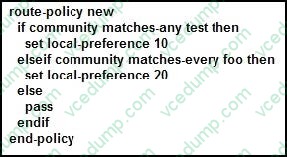
Which two statements are correct? (Choose two.)
A. "test" and "foo" are references to the community sets.
B. The "match-any" option indicates matching either the standard community or extended community.
C. Routes that match both the "test" and "foo" conditions will have their local preference set to 20.
D. All non-matching routes will be permitted. -
Question 23:
Refer to the exhibit.
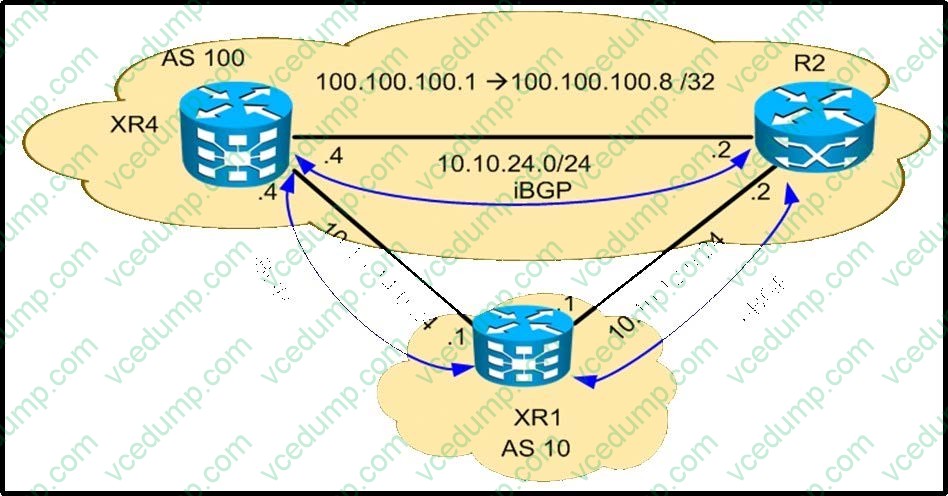
XR1 must have XR4 as the primary exit point for only the first three subnets received from AS 100 and may not impact the rest of the subnets. Which configuration on XR1 is correct?
A. prefix-set PREFER 100.100.100.0/30 le 32 route-policy LP if destination in PREFER then set local-preference 200 endif
B. route-policy LP if destination in (100.100.100.0/30 le 32) then set local- preference 200 else pass endif
C. prefix-set PREFER 100.100.100.0/29 le 32 route-policy LP if destination in PREFER then set local-preference 200 else pass endif
D. route-policy LP if destination in (100.100.100.0/29 le 32) then set local preference 200 else set local-preference 100 endif -
Question 24:
A service provider is deploying route redistributions for a large enterprise that wants to unify a few IGP routing domains into one to condense administration as well as common network and security policies. Which technique should be used to safely assume that the new routing domain is loop free?
A. Enable filtering based on route-tagging on the redistribution points to avoid route- feedback.
B. Define a static route to Null0 for all of the outgoing traffic on the redistribution points.
C. Modify the metric associated with each redistributed prefix to implement loop-avoidance for inter-IGP routing domain designs.
D. Disable the routing process on the interfaces with route-feedback potential on the redistribution points. -
Question 25:
Refer to the exhibit.
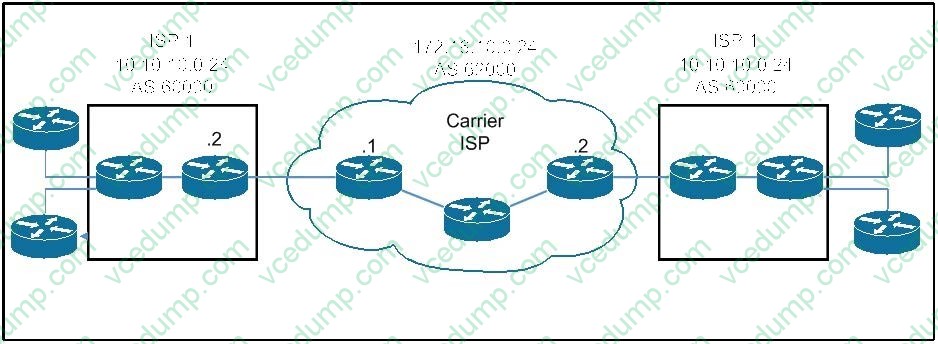
Routers B and C in transit AS 200 are the exit points toward AS 100 and AS 300. Router B is running Cisco IOS XR and Router C IOS XE. Internally, AS 200 runs OPSF only for internal routing. Which two methods can an engineer use to ensure proper reachability between AS 100 and AS 300 for the needed routes? (Choose two.)
A. Router B: router ospf 200 redistribute bgp 200 tag 20 router bgp 200 address-family ipv4 unicast redistribute ospf 200 metric-type 2
B. Router B: router ospf 200 redistribute bgp 200 router bgp 200 address-family ipv4 unicast redistribute ospf 200
C. Router C: router ospf 200 redistribute bgp 200 metric-type 1 subnets tag 200 router bgp 200 address-family ipv4 redistribute ospf 200
D. Router C: router ospf 200 redistribute bgp 200 metric-type 1 subnets tag 200 router bgp 200 address-family ipv4 redistribute ospf 200 match external 2
E. Router C: router ospf 200 redistribute bgp 200 metric-type 1 subnets tag 200 router bgp 200 address-family ipv4 redistribute ospf 200 route-map match-tag match external route-map match-tag deny 10 match tag 200 -
Question 26:
When configuring BGP on Cisco IOS XR Software, which address-family is enabled by default?
A. IPv4 unicast
B. IPv6 unicast
C. VPNv4
D. IPv4 unicast and IPv6 unicast
E. IPv4 unicast and IPv6 unicast and VPNv4
F. No address-family is enabled by default. -
Question 27:
Which option is a characteristic of intermediate systems on multiarea IS-IS?
A. Level 2 contains routing information only for the local area.
B. Level 2 contains routing information only for stub areas.
C. Level 1 contains routing information only for the backbone area.
D. Level 1 contains routing information onlyfor the local area. -
Question 28:
Refer to the exhibit.
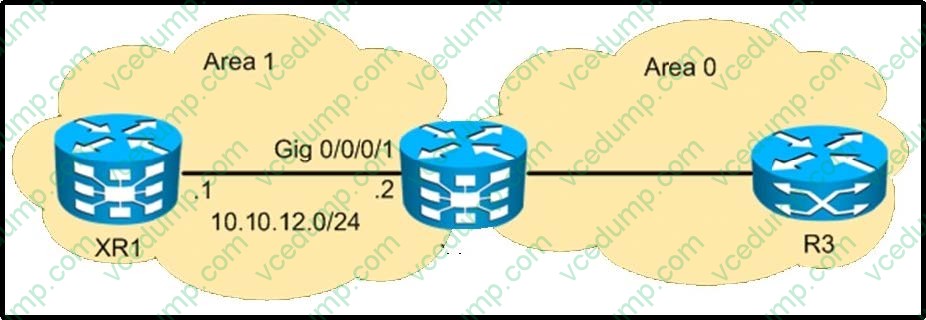
Area 1 routers must have only a default route in their OSPF routing tables. Which configuration must be completed on XR2 to meet this requirement?
A. router ospf 1 address-family ipv4 interface GigabitEthernet0/0/0/1 area 1 stub no-summary
B. router ospf 1 area 1 stub no-summary
C. router ospf 1 area 1 stub interface GigabitEthernet0/0/0/1
D. router ospf 1 area 1 stub no-summary interface GigabitEthernet0/0/0/1 -
Question 29:
Referring to the partial Cisco IOS-XR BGP configuration exhibit, when trying to commit this configuration, the following error is displayed:
% Failed to commit one or more configuration items during a pseudo-atomic operation. All changes made have been reverted. Please issue 'show configuration failed' from this session to view the errors.
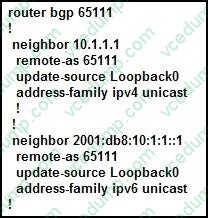
What is wrong with the configuration?
A. IPv6 unicast routing has not been enabled globally using the ipv6 unicast-routing command
B. The configuration is missing the required network command
C. The update-source loopback 0 commands must be configured under the respective neighbor address-family
D. The configuration is missing the address-family ipv4 unicast and address-family ipv6 unicast commands under router bgp 65111 -
Question 30:
A service provider has set up new eBGP sessions for new customers who require Internet connectivity for their own public AS sessions. To connect, these sessions require MD5 authentication and no cluster ID configured. The NOC notified that one of these eBGP neighbors does not establish any session with the CE BGP speaker. Which option is a potential cause if the BGP configuration is correct?
A. The BGPMD5 password has been typed incorrectly producing a failure in the authentication process.
B. A public AS does not require another service provider to connect to the Internet. The BGP configuration automatically blocks this type of design due to loop-avoidance built-in mechanisms.
C. The customer BGP speaker is receiving too many prefixes at once and no connection can be established without a maximum 璸refix value configured.
D. No cluster ID is configured, so the BGP process does not find a way to identifythe service provider BGP speaker in the customer BGP route reflectors cluster-list. The session is not established to keep the customer iBGP core network loop-free.
Related Exams:
-
300-745
Designing Cisco Security Infrastructure (300-745 SDSI) v1.0 -
350-101
Implementing and Operating Cisco Wireless Core Technologies (350-101 WLCOR)v1.0 -
352-011
Cisco Certified Design Expert Practical -
500-052
Cisco Unified Contact Center Express -
500-173
Designing the FlexPod Solution (FPDESIGN) -
500-201
Deploying Cisco Service Provider Mobile Backhaul Solutions -
500-210
SP Optical Technology Field Engineer Representative -
500-220
Engineering Cisco Meraki Solutions (ECMS) v2.2 -
500-230
Cisco Service Provider Routing Field Engineer -
500-240
Cisco Mobile Backhaul for Field Engineers
Tips on How to Prepare for the Exams
Nowadays, the certification exams become more and more important and required by more and more enterprises when applying for a job. But how to prepare for the exam effectively? How to prepare for the exam in a short time with less efforts? How to get a ideal result and how to find the most reliable resources? Here on Vcedump.com, you will find all the answers. Vcedump.com provide not only Cisco exam questions, answers and explanations but also complete assistance on your exam preparation and certification application. If you are confused on your 642-883 exam preparations and Cisco certification application, do not hesitate to visit our Vcedump.com to find your solutions here.