500-440 Exam Details
-
Exam Code
:500-440 -
Exam Name
:Designing Cisco Unified Contact Center Enterprise (UCCED) -
Certification
:Cisco Certifications -
Vendor
:Cisco -
Total Questions
:93 Q&As -
Last Updated
:Dec 07, 2025
Cisco 500-440 Online Questions & Answers
-
Question 1:
In a Cisco Finesse 10.0(x) deployment, which option is needed from the primary and secondary servers for certificate authority to generate a root, intermediate, and application certificate for Cisco Finesse?
A. fully qualified domain name of the servers
B. physical MAC address of the NIC card from the Cisco Finesse servers
C. Certificate Signing Request
D. IP address of server
E. system ID of the server -
Question 2:
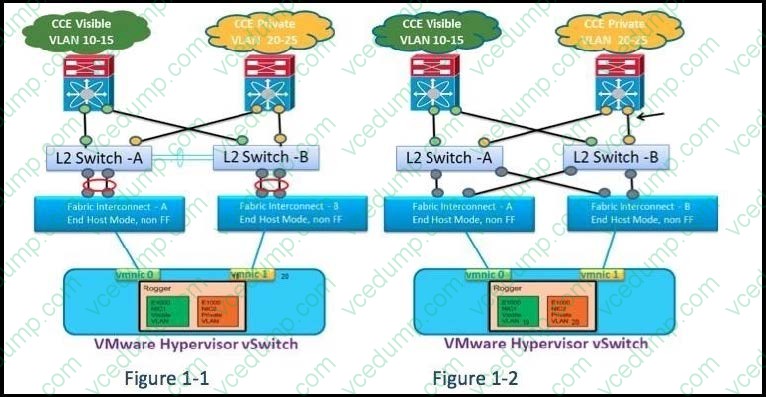
Refer to the exhibit. Which option describes Cisco Unified CCE on the UCS B Fabric Interconnection pair to the upstream network connectivity?
A. Have a straight links scheme from the UCS B FI pair to the upstream Layer 2 switches as shown in Figure 1-1.
B. Have a cross-connect links scheme from the UCS B FI pair to the upstream Layer 2 switches as shown in Figure 1-2.
C. Any of the design options can be deployed with Cisco Unified CCE, but only one of those two options can be deployed within the entire solution.
D. Both design options can be deployed with Cisco Unified CCE and you can include both design options within the solution. -
Question 3:
In a Cisco Unified Contact Center Enterprise deployment with geographically redundant central controllers, a new site is added with new redundancy requirements for Administration. Which option is the recommended configuration?
A. 1 - Primary AW, 1 - Secondary AW
B. 1 - Primary AW, 1 ?Administration Client
C. 1 - Secondary AW, 1 ?Administration Client
D. 2 - Primary Administration Client, 1 - Secondary Administration Client -
Question 4:
When using microapps, which core components are required for calls that originate from Cisco Unified Communications Manager to Cisco Unified CVP using Comprehensive mode?
A. CUCM: CTI Route Point and SIP Trunk, ICM: CVP Type 2 VRU and Network VRU labels, VXML Gateway
B. CUCM: CTI Route Port, SIP Trunk, ICM: CVP Type 2 VRU, CUBE, VXML Gateway
C. SIP Trunk, ICM: CVP Type 7 VRU and Network VRU labels, VXML Gateway
D. CUCM: CTI Route Point and SIP Trunk, ICM: CVP Type 10 VRU and Network VRU labels, VXML Gateway -
Question 5:
Which setup is correct when you configure the Cisco UCS B VICs to reach the Fabric Interconnect Switches for the Cisco UCCE on UCS B deployments?
A. Disable the Fabric Failover only when the UCS B FI connects to a Disjointed L2 domain in the upstream network
B. Enable the Fabric Failover to reach both Fabric Interconnect A and B in HA paths
C. Disable the Fabric Failover option.
D. Enable the Fabric Failover only when the UCS B FI connects to a Common L2 domain in the upstream network -
Question 6:
Which three statements about Courtesy Callback are true? (Choose three.)
A. Courtesy Callback reduces the time callers have to wait in a queue.
B. Courtesy Callback enables Cisco Unified Communication Manager to offer callers (who meet your criteria) the option to receive a courtesy callback by the system instead of waiting in the queue.
C. The caller who has been queued by Cisco Unified Communication Manager can hang up and subsequently be called back when an agent is close to becoming available (preemptive callback).
D. Courtesy Callback does not change the time a customer must wait to be connected to an agent.
E. If the caller decides to be called back by the system, they leave their name and the time they want to be callback.
F. You can schedule a callback for a specific time.
G. Courtesy Callback is supported only with Cisco Voice Gateway.
H. Courtesy Callback is not allowed with Agent Request API. -
Question 7:
In the Cisco Unified Contact Center Enterprise Outbound Option with SIP Dialer, which two Dialing Modes apply to Transfer to IVR based campaigns? (Choose two.)
A. Preview dialing mode
B. Direct Preview dialing mode
C. Progressive dialing mode
D. Predictive dialing mode
E. Callback mode -
Question 8:
Which two features does Cisco Finesse provide as an out-of-the-box agent desktop? (Choose three.)
A. desktop for third-party ACD
B. phonebooks and workflows
C. content sharing gadget
D. basic call control (answer, hold, retrieve, end, and make call)
E. agent historical reports -
Question 9:
Which option describes when a call type is assigned to a call in the Cisco Unified Contact Center Enterprise system?
A. when the call is routed to an agent
B. when the call is first post-routed from Cisco Unified Customer Voice Portal
C. when the call terminates and data is written to the Cisco TCD table
D. when a call-routing script hits the first Queue to Skill Group node -
Question 10:
Which three benefits does a Cisco Unified Contact Center Enterprise centralized deployment with small agents branch provide? (Choose three.)
A. It requires only a small data switch and router, IP phones, and agent desktops at remote sites for a few agents.
B. It requires only limited system and network management skills at remote sites.
C. Small remote branches require PSTN and SIP trunks, in addition to the ones needed for local POTS lines for emergency services (911) in the event of a WAN link loss.
D. PSTN trunks for incoming traffic connect to data centers for efficiency.
E. It does not use VoIP WAN bandwidth when an agent is answering the call.
F. Calls extend over the WAN only while calls are in queue.
Related Exams:
-
300-745
Designing Cisco Security Infrastructure (300-745 SDSI) v1.0 -
350-101
Implementing and Operating Cisco Wireless Core Technologies (350-101 WLCOR)v1.0 -
352-011
Cisco Certified Design Expert Practical -
500-052
Cisco Unified Contact Center Express -
500-173
Designing the FlexPod Solution (FPDESIGN) -
500-201
Deploying Cisco Service Provider Mobile Backhaul Solutions -
500-210
SP Optical Technology Field Engineer Representative -
500-220
Engineering Cisco Meraki Solutions (ECMS) v2.2 -
500-230
Cisco Service Provider Routing Field Engineer -
500-240
Cisco Mobile Backhaul for Field Engineers
Tips on How to Prepare for the Exams
Nowadays, the certification exams become more and more important and required by more and more enterprises when applying for a job. But how to prepare for the exam effectively? How to prepare for the exam in a short time with less efforts? How to get a ideal result and how to find the most reliable resources? Here on Vcedump.com, you will find all the answers. Vcedump.com provide not only Cisco exam questions, answers and explanations but also complete assistance on your exam preparation and certification application. If you are confused on your 500-440 exam preparations and Cisco certification application, do not hesitate to visit our Vcedump.com to find your solutions here.