4A0-108 Exam Details

  • Exam Code
    :4A0-108
  • Exam Name
    :Nokia Multicast Protocols
  • Certification
    :Nokia Certifications
  • Vendor
    :Nokia
  • Total Questions
    :247 Q&As
  • Last Updated
    :

Nokia 4A0-108 Online Questions & Answers

  • Question 1:

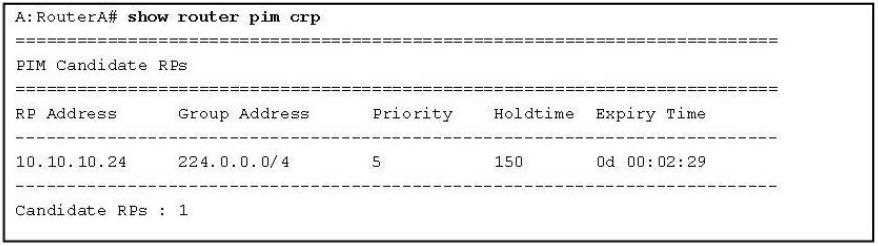
    Click the exhibit.

    Which of the following regarding the displayed RP configuration is TRUE?

    A. Two static RPs cannot be configured on the same device.
    B. 10.10.10.24 is the RP for 230.1.1.1; while 10.10.10.66 is the RP for 234.1.1.1.
    C. 10.10.10.24 is the RP for 234.1.1.1; while 10.10.10.66 is the RP for 230.1.1.1.
    D. Only one static RP can be configured with override.

  • Question 2:

    Which of the following regarding the BGP Shared Tree Join route is TRUE?

    A. The PE with a receiver for C-multicast group sends a BGP Shared Tree Join update to the PE attached to the C-RP.
    B. The PE with a receiver for C-multicast group sends a BGP Shared Tree Join update to the RP in the provider core network.
    C. The PE attached to C-RP sends a BGP Shared Tree Join update to the C-RP.
    D. The PE attached to C-RP sends a BGP Shared Tree Join update to the PE attached to the source.

  • Question 3:

    Which two protocols are used to signal P2MP LSPs?

    A. BGPA-DandRSVP-TE
    B. RSVP-TE and mLDP
    C. mLDPamd PIM
    D. mLDP and BGP A-D

  • Question 4:

    Choose the statements that describe Bootstrap Router mechanism. (Choose three)

    A. It is a mechanism to distribute RP-set information dynamically
    B. The bootstrap router gets and propagates RP information via multicast messages
    C. The bootstrap router gets and propagates RP information via unicast and multicast messages
    D. BSR relies on timers to discover that an RP-Candidate router is no longer available
    E. For BSR to work, every router in the multicast network should be configured as BSR candidate

  • Question 5:

    Under what circumstances will the multicast data flow remain on the Shared Path Tree in a PIM ASM network?

    A. When multicast traffic is below a configured threshold
    B. It will always remain on the Shared Path Tree
    C. It will never remain on the Shared Path Tree
    D. When PIM Dense Mode is in use

  • Question 6:

    Select the statements that relate to the Source Path Tree in ASM. (Choose three)

    A. The RP is the root of the tree
    B. The multicast source is the root of the tree
    C. It is represented by (*, G) entries
    D. It is represented by (S, G) entries
    E. The path between receiver and source is always the shortest path
    F. The Source Path Tree cannot be created without the RP
    G. It is the initial forwarding path created

  • Question 7:

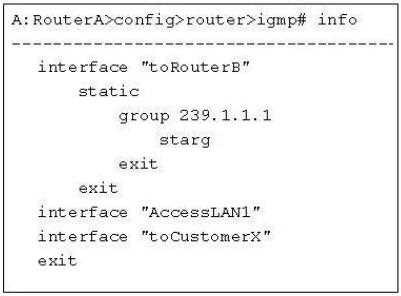
    Click the exhibit.

    Based on the configuration, channels 239.1.1.1, 239.1.1.2, 239.1.1.3 and 239.1.1.5 have already been established. What happens when this router receives an IGMP report to join group 239.1.1.6?

    A. The router tears down channel 239.1.1.3 first, and then establishes a new channel for 239.1.1.6.
    B. The router tears down either channel 239.1.1.1 or 239.1.1.2 first, and then establishes a new channel for 239.1.1.6.
    C. No existing channel is torn down, and the new channel for 239.1.1.6 is established as there are enough resources.
    D. The new channel 239.1.1.6 cannot be established, and a log is generated.

  • Question 8:

    Which of the following are NOT characteristics of the many to many model of multicast data delivery? (Choose two)

    A. Receivers are generally unknown by the source
    B. Receivers are generally known by each other since any receiver may be a source
    C. Well suited for applications in which the receivers provide feedback to each other and the source
    D. All devices are potentially capable of generating multicast data
    E. Well suited for applications such as video on demand where each source sends a separate data stream to each of the many different receivers

  • Question 9:

    Where is the best placement of the Rendezvous Point in a PIM SSM network?

    A. As close as possible to the multicast source
    B. The Rendezvous Point is not required in a PIM SSM network
    C. In the redundant core
    D. As close as possible to the receiver
    E. The Rendezvous Point can be positioned at any router without impact

  • Question 10:

    Which of the following regarding the use of RSVP-TE P2MP LSP as MVPN I-PMSI is TRUE?

    A. If RSVP-TE P2MP LSP is used as I-PMSI, either mLDP or RSVP-TE P2MP LSP can be used as S-PMSI.
    B. The signaling protocol used for S-PMSI is independent of that used for I-PMSI.
    C. If the signaling protocol used for I-PMSI is RSVP-TE, BGP must be used for signaling customer multicast information.
    D. The protocol used for signaling customer multicast information is independent of that used for the I-PMSI.

Tips on How to Prepare for the Exams

Nowadays, the certification exams become more and more important and required by more and more enterprises when applying for a job. But how to prepare for the exam effectively? How to prepare for the exam in a short time with less efforts? How to get a ideal result and how to find the most reliable resources? Here on Vcedump.com, you will find all the answers. Vcedump.com provide not only Nokia exam questions, answers and explanations but also complete assistance on your exam preparation and certification application. If you are confused on your 4A0-108 exam preparations and Nokia certification application, do not hesitate to visit our Vcedump.com to find your solutions here.