400-051 Exam Details
-
Exam Code
:400-051 -
Exam Name
:CCIE Collaboration Written -
Certification
:Cisco Certifications -
Vendor
:Cisco -
Total Questions
:585 Q&As -
Last Updated
:Dec 15, 2021
Cisco 400-051 Online Questions & Answers
-
Question 431:
Tom Lee is an active user in a Cisco Unified CM deployment with fully functional LDAP synchronization and authentication to an Active Directory. Daily resynchronization is set at 11:00 pm. At 8:00 am on March 1st 2014, this user was deleted from the AD. What is the status of this user in the Unified CM database at 1:00 am on March 2nd 2014?
A. active
B. inactive
C. delete pending
D. awaiting authorization
E. permanently deleted -
Question 432:
In a Cisco Unified Communications Manager design where +E.164 destinations are populated in directory entries, which call routing practice is critical to prevent unnecessary toll charges caused by internal calls routed through the PSTN?
A. forced on-net routing
B. automated alternate routing
C. forced authorization codes
D. client matter codes
E. tail-end hop-off -
Question 433:
Which software component in Cisco Meeting Server deployment supports clustering for scalability and resilience?
A. Web Admin
B. Call Bridge
C. Web Bridge
D. XMPP Server
E. TURN Server
F. Database -
Question 434:
Company ABC is planning to migrate from Cisco MCS-hosted Cisco Unified Communications Manager applications to Cisco UC on UCS B-Series servers. Which statement about external media supportability is true for this migration?
A. The Cisco Music on Hold USB audio sound card on the MCS servers will continue to work on the USB ports on the UCS server.
B. The Cisco Music on Hold USB audio sound card on the MCS servers will continue to work through the USB ports on the Cisco UCS server KVM dongle cable adaptor connected to the front of the UCS server.
C. The Cisco Music on Hold USB audio sound card on the MCS servers will not work on the UCS server.
D. The Cisco Music on Hold USB audio sound card can be mapped to a virtual USB port on a VMware virtual machine on the UCS server.
E. The Cisco Music on Hold USB audio sound card can be mapped to a virtual serial port on a VMware virtual machine on the UCS server. -
Question 435:
What is the maximum number of call-processing subscribers in a standard deployment of a Cisco Unified Communications Manager Session Management Edition cluster?
A. 3
B. 4
C. 5
D. 8
E. 16 -
Question 436:
Under which three conditions will a Cisco 9971 IP Phone request the "xmldefault.cnf.xml" file from a TFTP server in a Cisco Unified CM cluster? (Choose three)
A. The phone is registered to the CUCM cluster but need to update its firmware
B. The phone is attempting to register to the CUCM cluster for the first time
C. Auto-registration is disabled on CUCM cluster
D. The phone has not yet been defined in the CUCM database
E. The phone is attempting to change from SIP firmware to SCCP firmware
F. Auto-registration is enabled on CUCM cluster -
Question 437:
Refer to the exhibit.
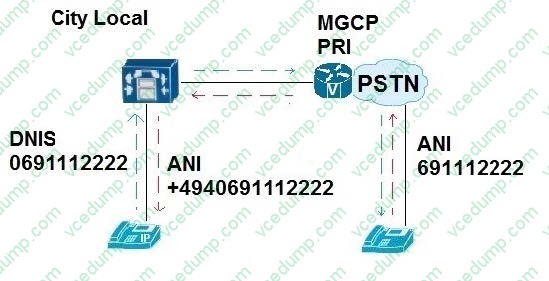
An engineer is working with globalization and has these requirements:
-the ANI to be presented in the E.164 format to the phone on the Cisco Unified Communications Manager
-allow redialing from the call history without manually manipulating the digit string
Which three configuration steps in Cisco Unified Communications Manager are needed to meet these requirements? (Choose three.)
A. Set the subscriber number prefix with +4940
B. Set the prefix digits with 0 and calling number type subscriber
C. Set the national prefix with +4940
D. Set the prefix digits with 0 and calling number type national.
E. Set the calling-party transformation pattern with /+4940.!, and discard digits preDot.
F. Set the calling-party transformation pattern with /+4940.!, and discard digits preAt. -
Question 438:
Which configuration component in Cisco Unified Communications Manager Enhanced Location Call Admission Control is designated to participate directly in intercluster replication of location, links, and bandwidth allocation data?
A. an active member of a Location Bandwidth Manager Group
B. a member of a Location Bandwidth Manager Hub Group
C. a standby member of a Location Bandwidth Manager Group
D. all members of a Location Bandwidth Manager Group
E. a shadow member of a Location Bandwidth Manager Hub Group -
Question 439:
In Cisco IOS routers that use low latency queuing, which algorithm is used to presort traffic going into the default queue?
A. first-in, first-out
B. last-in, first-out
C. weighted round robin
D. fair queuing
E. random processing -
Question 440:
Refer to the exhibit.
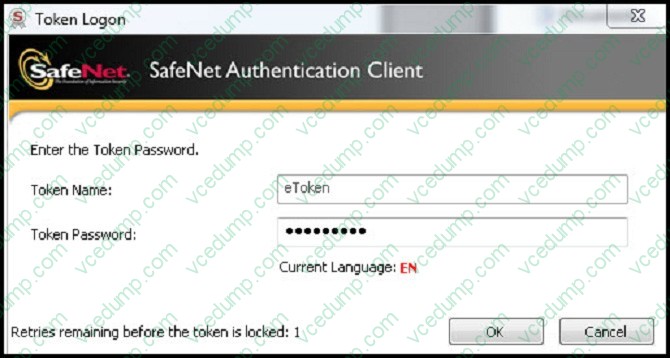
What happens to the USB e-token after the administrator fails to enter the correct password at the next attempt?
A. The token is locked for five days, after which the retry counter resets.
B. The token is locked until unlocked by Cisco TAC.
C. The token is locked until Cisco CTL Client is uninstalled and reinstalled on the client PC.
D. The token cannot be used on the same client PC again. It can be used with another Cisco CTL Client on a different PC.
E. The token is locked forever.
Related Exams:
-
300-745
Designing Cisco Security Infrastructure (300-745 SDSI) v1.0 -
350-101
Implementing and Operating Cisco Wireless Core Technologies (350-101 WLCOR)v1.0 -
352-011
Cisco Certified Design Expert Practical -
500-052
Cisco Unified Contact Center Express -
500-173
Designing the FlexPod Solution (FPDESIGN) -
500-201
Deploying Cisco Service Provider Mobile Backhaul Solutions -
500-210
SP Optical Technology Field Engineer Representative -
500-220
Engineering Cisco Meraki Solutions (ECMS) v2.2 -
500-230
Cisco Service Provider Routing Field Engineer -
500-240
Cisco Mobile Backhaul for Field Engineers
Tips on How to Prepare for the Exams
Nowadays, the certification exams become more and more important and required by more and more enterprises when applying for a job. But how to prepare for the exam effectively? How to prepare for the exam in a short time with less efforts? How to get a ideal result and how to find the most reliable resources? Here on Vcedump.com, you will find all the answers. Vcedump.com provide not only Cisco exam questions, answers and explanations but also complete assistance on your exam preparation and certification application. If you are confused on your 400-051 exam preparations and Cisco certification application, do not hesitate to visit our Vcedump.com to find your solutions here.