352-001 Exam Details
-
Exam Code
:352-001 -
Exam Name
:CCDE Written -
Certification
:Cisco Certifications -
Vendor
:Cisco -
Total Questions
:705 Q&As -
Last Updated
:Dec 07, 2025
Cisco 352-001 Online Questions & Answers
-
Question 331:
Refer to the exhibit.
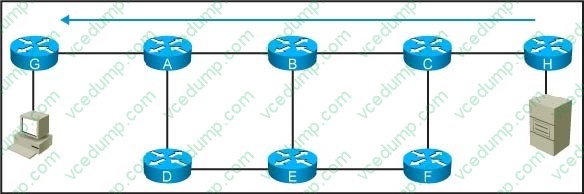
This network is running IS-IS as the single routing protocol and the LSP and SPF timers are aggressively configured so the network converges in subsecond. The customer reports that router B had a memory crash and reloaded, which resulted in some packets from the application being lost. The application servers are behind router G and the end users are behind router H. Which design change should be made to prevent this packet-loss problem from reoccurring?
A. Enable the advertisement of the overload bit for a specific amount of time after a reload on router B.
B. Optimize the LSP/SPF timers to send LSPs immediately after a topology change.
C. Redesign the network as a flat level 2.
D. Use asymmetric carrier delay timer.
E. Deploy all links as point-to-point. -
Question 332:
What are two benefits of protecting the control plane of a network device? (Choose two.)
A. prevents the delivery of packets from spoof sources
B. preserves the confidentiality of traffic encrypted by IPsec
C. maintains routing protocol adjacencies with local neighbors
D. maintains remote management access to the router -
Question 333:
Which two best practices for the security design of an IPv6 network are true? (Choose two.)
A. BGP and IS-IS only support unencrypted password authentication when IPv6 is enabled on the network
B. IPv4 ICMP policies are different from IPv6 ICMP policies on the firewall
C. uRPF is no longer required with IPv6 FHS implementation
D. IPsec must be used if there is a requirement to secure OSPFv3
E. IPv6 host security controls are enough to block and inspect IPv6 traffic from one device to another -
Question 334:
A large enterprise customer has more than 300 worldwide locations, each with at least two different WAN connections to their five regional data centers across US, Europe, and Asia. These data centers offer different application services and work as primary, with a remote data center as backup. You must provide a solution to securely select the traffic path for specific applications based on an IT policy.
Which solution allows the easiest management of the path decision from the data center sites?
A. Apply policy-based routing at each remote site
B. Use LISP over the current WAN
C. Set up each center with its own AS and use BGP AS-PATH prepend configuration
D. Add Cisco MPLS TE devices in the data centers and activate Cisco MPLS TE -
Question 335:
Your customer asks you to assist with their traffic policy design. They want to guarantee a minimum amount of bandwidth to certain traffic classes. Which technique would you advise them to implement?
A. Modular QoS CLI
B. committed accessrRate
C. policy-based routing
D. traffic shaping -
Question 336:
A very large enterprise customer is migrating from EIGRP to IS-IS .What is your main concern in regards to change in the path packets take after the migration is complete?
A. The areas sizes.
B. The number of prefixes
C. The redistribution points.
D. The bandwidth and metrics of the links. -
Question 337:
Which three different behaviors must a network designer expect when bidirectional PIM is used instead of PIM Sparse Mode? (Choose three)
A. The source IP addresses from the multicast senders cannot be seen in the multicast routing table
B. The RPF check does not prevent routing loops when bidirectional PIM is used
C. Many possible rendezvous point can be used for bidirectional PIM as compared to PIM Sparse Mode
D. PIMv2 BSR is not supported with bidirectional PIM
E. The join messages to join a bidirectional PIM multicast group are different compared to PIM-SM
F. No rendezvous point is required when bidirectional PIM is used
G. Auto-RP is not supported with bidirectional PIM -
Question 338:
Refer to the exhibit.
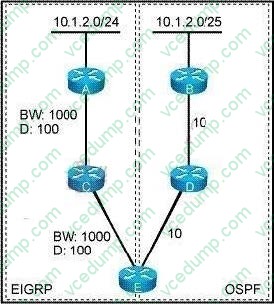
Which routes in this network will be installed in the routing table at router E?
A. the OSPF route
B. the EIGRP route
C. the OSPF and EIGRP routes
D. neither the OSPF nor the EIGRP route -
Question 339:
An enterprise has a large number of retail locations that are currently serviced by a hub- and-spoke Frame Relay network using OSPF as the routing protocol. The enterprise is planning to deploy a high-bandwidth application that requires any-to-any connectivity. Which technology would provide this enterprise with the best bandwidth utilization and greatest scalability?
A. pseudowires based on L2TPv3
B. multipoint GRE tunnels between all locations
C. a full mesh of IPsec tunnels between all locations
D. L3VPNs (RFC 2547-based) using MP-BGP -
Question 340:
What is the advantage of using a router instead of a switch when implementing Hierarchical VPLS (H-VPLS) CE devices?
A. MAC addresses on the entire broadcast domain are hidden from PEs, allowing for batter scalability
B. It is easier to troubleshoot.
C. Layer 3 equal-cost multipath can be used with redundant connections
D. Layer 2 requires a full-mesh network
Related Exams:
-
300-745
Designing Cisco Security Infrastructure (300-745 SDSI) v1.0 -
350-101
Implementing and Operating Cisco Wireless Core Technologies (350-101 WLCOR)v1.0 -
352-011
Cisco Certified Design Expert Practical -
500-052
Cisco Unified Contact Center Express -
500-173
Designing the FlexPod Solution (FPDESIGN) -
500-201
Deploying Cisco Service Provider Mobile Backhaul Solutions -
500-210
SP Optical Technology Field Engineer Representative -
500-220
Engineering Cisco Meraki Solutions (ECMS) v2.2 -
500-230
Cisco Service Provider Routing Field Engineer -
500-240
Cisco Mobile Backhaul for Field Engineers
Tips on How to Prepare for the Exams
Nowadays, the certification exams become more and more important and required by more and more enterprises when applying for a job. But how to prepare for the exam effectively? How to prepare for the exam in a short time with less efforts? How to get a ideal result and how to find the most reliable resources? Here on Vcedump.com, you will find all the answers. Vcedump.com provide not only Cisco exam questions, answers and explanations but also complete assistance on your exam preparation and certification application. If you are confused on your 352-001 exam preparations and Cisco certification application, do not hesitate to visit our Vcedump.com to find your solutions here.