352-001 Exam Details
-
Exam Code
:352-001 -
Exam Name
:CCDE Written -
Certification
:Cisco Certifications -
Vendor
:Cisco -
Total Questions
:705 Q&As -
Last Updated
:Dec 07, 2025
Cisco 352-001 Online Questions & Answers
-
Question 211:
You have been hired by a startup company to provide optical services using MPLS-TP. Which three options describe reasons to use the MPLS-TP standard in your design? (Choose three.)
A. MPLS-TP is a newer packet transport technology that replaces SONET/SDH.
B. MPLS-TP includes extensions to native MPLS OAM for fault detection, monitoring, and propagation.
C. MPLS-TP requires a routing protocol.
D. MPLS-TP uses an IANA assigned label 13 for OAM.
E. MPLS-TP uses Ethernet Y.1731 OAM. -
Question 212:
When creating a design plan for IPv6 integration, you decide to use stateless encapsulation of IPv6 packets into IPv4 tunnels between subscriber CPEs and a border relay. Which deployment technique allows for this functionality?
A. 6rd
B. Dual-Stack Lite
C. 4rd
D. DSTM -
Question 213:
A network engineer has been tasked to design an IPV6 wireless sensor network using IEEE 802.15.4 to support an IoT project.
Which two protocols does the engineer need to utilize for this design? (Choose two.)
A. 802.11ax
B. 802.11ac
C. 802.11
D. 6LoWPAN
E. VPN -
Question 214:
You are designing a solution to eliminate the risk of high CPU utilization on a core network composed of CRS-1 devices. Which option would eliminate the risk of high CPU utilization across the network?
A. Use Local Packet Transport Services (LPTS) to manage hardware SNMP flow rate.
B. Use the in-band control plane policy feature to reduce the SNMP flow rate.
C. Use the control plane policy feature and reduce SNMP flow rate.
D. Use control-plane management-plane in-band and reduce the SNMP flow rate.
E. Use the control-plane management-plane out-of-band feature to reduce the SNMP flow rate. -
Question 215:
Refer to the exhibit.
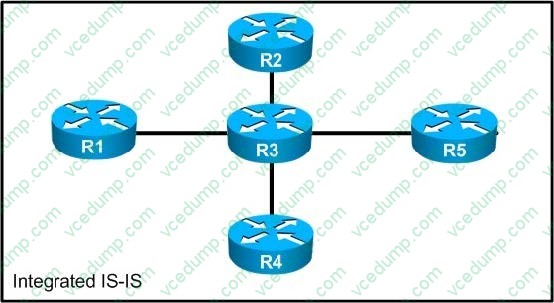
You are developing a migration plan to enable IPv6 in your IPv4 network. Starting at R3 and assuming default IS-IS operations, what is likely to happen when you enable IPv6 routing on the link from R3 to R2?
A. Only R3 and R2 have IPv4 and IPv6 reachability.
B. R2 receives an IPv6 default route from R3.
C. Loopback reachability between all routers for IPv4 is lost.
D. All routers except R2 are reachable through IPv4.
E. R3 advertises the link from R3-R2 to R1, R4 and R5 only. -
Question 216:
You are designing dual-homed active/active ISP connections from an enterprise customer for internet services, and you have recommended BGP between the customer and ISP. When three security mechanisms do you enable to secure the connection? (Choose three)
A. uRPF is strict mode
B. remote triggered black holes
C. IDS
D. GTSM
E. Routing protocol authentication
F. uRPF in loose mode -
Question 217:
You are designing a network virtualization solution across an enterprise campus. The design requirements include the ability to virtualize the data plane and control plane using VLANs and VRFs while maintaining end-to-end logical path transport separation across the network, with access to grouped resources available at the access edge. Your network virtualization design can be categorized as which three primary models? (Choose 3)
A. group virtualization
B. services virtualization
C. edge isolation
D. session isolation
E. path isolation
F. device virtualization -
Question 218:
You are evaluating convergence characteristics of various interior gateway protocols for a new network design.
Which technology allows link-state routing protocols to calculate paths to destination prefixes that are functionally similar to feasible successors in Enhanced Interior Gateway Routing Protocol?
A. Incremental Shortest Path First
B. Cisco Multiprotocol Label Switching Traffic Engineering Fast Reroute
C. Loop-Free Alternate Fast Reroute
D. partial route calculation
E. Fast-Flooding -
Question 219:
Your company is designing a service provider network management solution in which customers are billed for 95th percentile network utilization. The service provider requires that an IETF standard be utilized to collect the data. Which method should be used to collect the data?
A. IPFIX
B. NETFLOW
C. RMON
D. IPFLOW
E. NBAR -
Question 220:
Refer to the exhibit. A new high availability DB server cluster is installed in the network. These two servers require high bandwidth and low latency Layer 2 connectivity for database replication.
Which solution supports these requirements?
A. Add two new links between SW1 and SW2 configured as LACP trunk with STP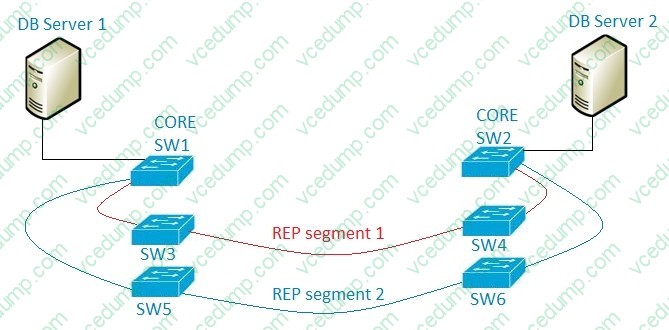
B. Add two new links between SW1 and SW2 configured as REP segments 1 and 2, respectively
C. Add secondary links to REP segments 1 and 2
D. Add two new links between SW1 and SW2 configured as REP segment 3
Related Exams:
-
300-745
Designing Cisco Security Infrastructure (300-745 SDSI) v1.0 -
350-101
Implementing and Operating Cisco Wireless Core Technologies (350-101 WLCOR)v1.0 -
352-011
Cisco Certified Design Expert Practical -
500-052
Cisco Unified Contact Center Express -
500-173
Designing the FlexPod Solution (FPDESIGN) -
500-201
Deploying Cisco Service Provider Mobile Backhaul Solutions -
500-210
SP Optical Technology Field Engineer Representative -
500-220
Engineering Cisco Meraki Solutions (ECMS) v2.2 -
500-230
Cisco Service Provider Routing Field Engineer -
500-240
Cisco Mobile Backhaul for Field Engineers
Tips on How to Prepare for the Exams
Nowadays, the certification exams become more and more important and required by more and more enterprises when applying for a job. But how to prepare for the exam effectively? How to prepare for the exam in a short time with less efforts? How to get a ideal result and how to find the most reliable resources? Here on Vcedump.com, you will find all the answers. Vcedump.com provide not only Cisco exam questions, answers and explanations but also complete assistance on your exam preparation and certification application. If you are confused on your 352-001 exam preparations and Cisco certification application, do not hesitate to visit our Vcedump.com to find your solutions here.