350-501 Exam Details
-
Exam Code
:350-501 -
Exam Name
:Implementing and Operating Cisco Service Provider Network Core Technologies (SPCOR) -
Certification
:CCIE Service Provider -
Vendor
:Cisco -
Total Questions
:568 Q&As -
Last Updated
:Jul 11, 2026
Cisco 350-501 Online Questions & Answers
-
Question 261:
Refer to the exhibit.
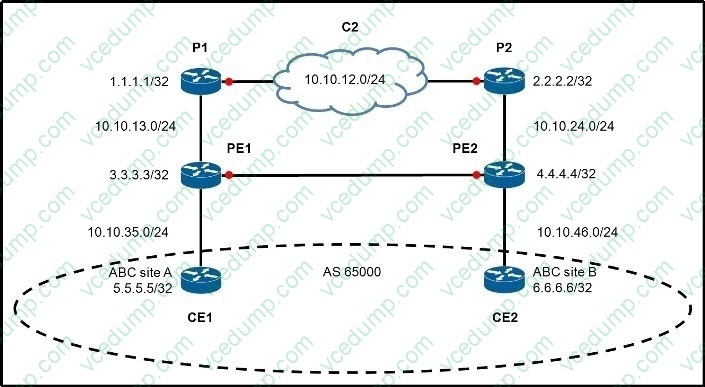
An engineer is viewing the CE1 routing table for CE2 Loopback 0. Each CE runs OSPF with its PE.
Which statement describes why the CE2 Loopback address is installed as an external OSPF route at the CE1 routing table?
A. PE1 and PE2 have mutual redistribution between OSPF and BGP.
B. CE2 is configured under OSPF with the command redistribute connected.
C. CE1 and CE2 are in different areas.
D. CE1 and CE2 have different OSPF processes.
E. PE1 and PE2 have different OSPF VRF processes. -
Question 262:
The administrator of a small company network notices that intermittent network issues occasionally cause inbound notifications to its SNMP servers to be lost.
Which configuration must the administrator apply so that the SNMP servers acknowledge the notifications that they receive?
A. snmp-server community ciscotest rw 10
B. snmp-server host tests.cisco.com publicsnmp-server community ciscotest rw 10
C. snmp-server enable traps bgpsnmp-server host 192.169.2.1 Informs
D. snmp-server enable traps snmp -
Question 263:
Which are the two limitations of the predefined NAT solution? (Choose two)
A. Only the port-presentation option is available
B. NetFlow and syslog are not supported
C. The predefined mode cannot be turned on or off during the active translations
D. Port allocation must be uniform for all subscribers
E. The global port limit parameter is not available for the predefined mode -
Question 264:
What is a characteristic of data modeling language?
A. It provides an interface for state data.
B. It separates configuration and state data.
C. It ensures devices are individually configured.
D. It replaces SNMP. -
Question 265:
Refer to the exhibit.
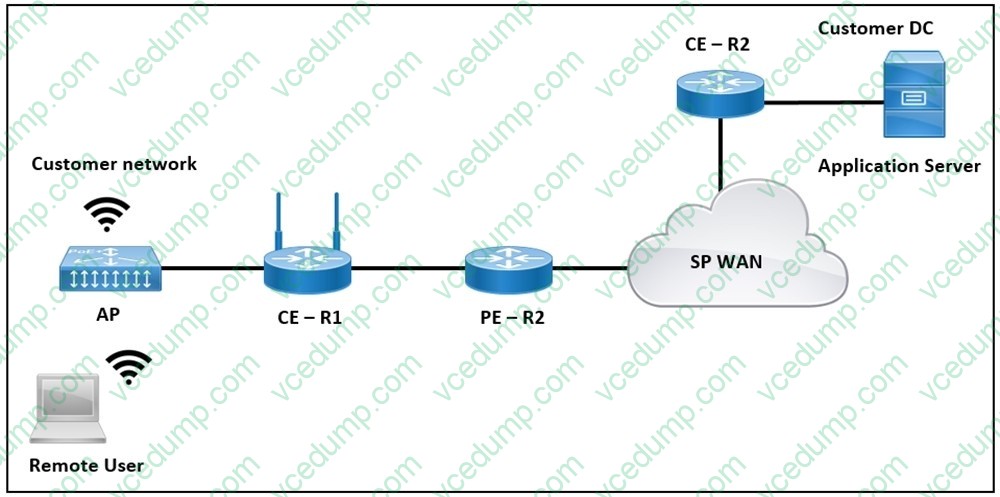
The application server in the data center hosts voice, video, and data applications over the internet. The data applications run more slowly than the voice and video applications. To ensure that all applications run smoothly, the service provider decided to implement a QoS policy on router PER 2 to apply traffic shaping.
Which two actions must an engineer take to implement the task? (Choose two.)
A. Configure the scheduling function to handle delayed packets.
B. Enable packet remarking for priority traffic.
C. Configure a queue to buffer excess traffic.
D. Set the token value for secondary traffic.
E. Set a threshold to discard excess traffic. -
Question 266:
Refer to the exhibit.
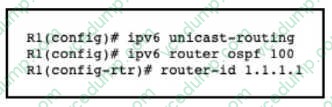
An engineer is configuring router R1 for OSPFv3 as shown.
Which additional configuration must be performed so that the three active interfaces on the router will advertise routes and participate in OSPF IPv6 processes?
A. R1(config)# interface Ethernet1/1R1(config-if)# ipv6 ospf 100 area 0R1(config)# interface Ethernet1/2R1(config-if)# ipv6 ospf 100 area 10R1(config)# interface Ethernet1/3R1(config-if)# ipv6 ospf 100 area 20
B. R1(config)# interface Ethernet1/1R1(config-if)# ip ospf hello-interval 1R1(config-if)# ipv6 ospf 100 area 0R1(config)# interface Ethernet1/2R1(config-if)# ip ospf hello-interval 1R1(config-if)# ipv6 ospf 100 area 10R1(config)# interface Ethernet1/3R1(config-if)# ip ospf hello-interval 1R1(config-if)# ipv6 ospf 100 area 20
C. R1(config)# interface Ethernet1/1R1(config-if)# ipv6 ospf 1 area 0R1(config)# interface Ethernet1/2R1(config-if)# ipv6 ospf 1 area 10R1(config)# interface Ethernet1/3R1(config-if)# ipv6 ospf 1 area 20 -
Question 267:
Refer to the exhibit.
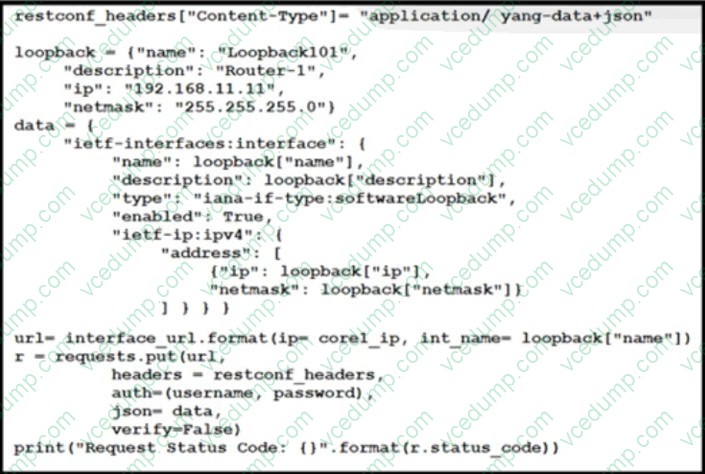
An engineer at a new ISP must configure many Cisco devices in the data center. To make the process more efficient, the engineer decides to automate the task with a REST API.
Which action does this JSON script automate?
A. Configure the IP address for the existing loopback interface.
B. Configure a physical interface on the router with an IP address and then create a loopback interface.
C. Configure a physical interface on the router with an IP address.
D. Delete the existing loopback Interface and replace it with a new loopback interface. -
Question 268:
Refer to the exhibit.

A network administrator wants to enhance the security for SNMP for this configuration.
Which action can the network administrator implement?
A. Add a community string to the existing entry.
B. Maintain the configuration but switch to an encrypted password for device access through SSH.
C. Re-configure to use SNMPv2 with MD5 authentication.
D. Re-configure to use SNMPv3. -
Question 269:
FRR is configured on a network. What occurs when the headend router on the path is alerted to a link failure over IGP?
A. LSP attempts fast switching on the backup path until the primary path returns to the active state.
B. The headend router uses a presignaled LSP to bypass the failure point.
C. A new backup tunnel is established past the PLR to pass through the protected nodes.
D. Backup tunnel is established and intersects with the primary tunnel at the headend. -
Question 270:
Refer to the exhibit.
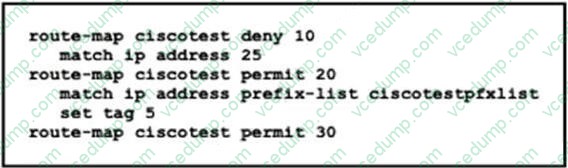
A client wants to filter routes to a BGP peer to limit access to restricted areas within the network. The engineer configures the route map ciscotest to filter routes from the BGP neighbor. The engineer also sets a tag that will be used for QoS in the future.
Which task must be performed to complete the implementation?
A. Create a route map, configure BGP with an IPv4 address family, and activate the neighbor.
B. Attach the new route map to the BGP neighbor statement in the inbound direction.
C. Create a policy map named ciscotest and apply it to inbound traffic on the link that is directly connected to the BGP neighbor.
D. Add a route map statement with sequence 40 that links a BGP community to the routing protocol.
Tips on How to Prepare for the Exams
Nowadays, the certification exams become more and more important and required by more and more enterprises when applying for a job. But how to prepare for the exam effectively? How to prepare for the exam in a short time with less efforts? How to get a ideal result and how to find the most reliable resources? Here on Vcedump.com, you will find all the answers. Vcedump.com provide not only Cisco exam questions, answers and explanations but also complete assistance on your exam preparation and certification application. If you are confused on your 350-501 exam preparations and Cisco certification application, do not hesitate to visit our Vcedump.com to find your solutions here.