350-501 Exam Details
-
Exam Code
:350-501 -
Exam Name
:Implementing and Operating Cisco Service Provider Network Core Technologies (SPCOR) -
Certification
:CCIE Service Provider -
Vendor
:Cisco -
Total Questions
:568 Q&As -
Last Updated
:Jul 11, 2026
Cisco 350-501 Online Questions & Answers
-
Question 251:
Refer to the exhibit.
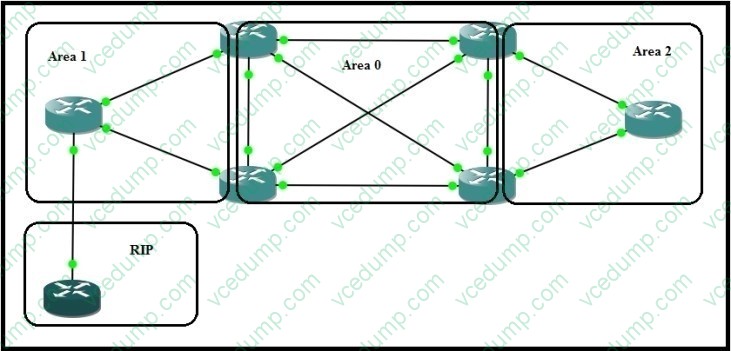
RIP network 192.168.1.0/24 is redistributed in OSPF Area 1; both Area 1 and Area 2 are configured as NSSAs.
Which three statements describe the OSPF behavior in this scenario? (Choose three.)
A. Area 2 does not see the network 192.168.1.0/24 in its link-state database.
B. Network 192.168.1.0/24 is advertised in a Type 7 LSA in Area 1.
C. Network 192.168.1.0/24 is advertised in a Type 5 LSA in Area 0.
D. Network 192.168.1.0/24 is advertised in a Type 7 LSA in Area 0.
E. ABR between Area 0 and Area 2 converts network 192.168.1.0/24 to a Type 7 LSA.
F. Network 192.168.1.0/24 is advertised in a Type 5 LSA in Area 2. -
Question 252:
An engineer working for a private service provider with employee Id: 1234:56:789 is configuring a Cisco device to redistribute OSPF into BGP. Which task enables the device to filter routes?
A. Configure an access list and reference it with the redistribute command.
B. Configure a route map and reference it with the redistribute command.
C. Configure a prefix list and associate it to the BGP peer interface.
D. Configure a distribute list and associate it to the BGP peer interface. -
Question 253:
You are creating new Cisco MPLS TE tunnels. Which type of RSVP message does the headend router send to reserve bandwidth on the path to the tailend router?
A. path
B. tear
C. error
D. reservation -
Question 254:
A regional operation center deployed SQL servers that were synchronized with the company's backend storage servers by using a 768 Kbps link. Although network congestion is not a frequent issue, the VoIP service suffers a serious degradation. Which two technologies can be implemented to improve the quality of the customer's VoIP traffic? (Choose two)
A. A decrease in the wan interface buffer size
B. LLQ for management traffic
C. cRTP
D. TCP/UDP filtering based on NBAR
E. TCP traffic prioritization
F. LFI
G. TCP starvation -
Question 255:
Refer to the exhbit.
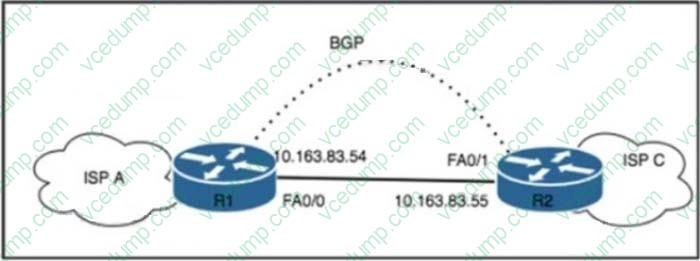

ISP A has a BGP peering with ISP C with the maximum-prefix 150 configuration on R1. After a recent security breach on the ISP A network, a network engineer has been asked to enable a lightweight security mechanism to protect the R1 CPU and BGP membership from spoofing attacks. Which solution must ISP A implement?
A. Configure bgp maxas-limit 1 in the IPv4 address family urateUhe global BGP configuration.
B. Configure neighbor 10.163.83.54 enable-connected-check under the BGP IPv4 address family.
C. Configure neighbor 10.163.83.55 password Cisco under the global BGP IPv4 address family.
D. Configure neighbor 10.163.83.55 ttl-stcurity hops 2 under the global BGP configuration. -
Question 256:
Refer to the exhibit.

What does this value mean when it is received in XML?
A. It indicates a value assigned by a network administrator to tag a route.
B. It indicates a break in a sequence.
C. It means a data field is blank.
D. It shows the ending of the script. -
Question 257:
A service provider requires continuous real-time network monitoring to provide reliable SLAs to its customers. To satisfy this requirement, a network administrator is implementing gRPC dial out on an ASR with TLS. Receiver 192.168.10.2 will be assigned one of the subscriptions, and it will manage the ASR. Which configuration must the engineer apply to the router as part of the configuration process?
A. snmp-server community publicsnmp-server enable trapssnmp-server host 192.168.10.2 version 2c public.
B. telemetry model-drivendestination-group DGroup1address family ipv4 192.168.10.2 1 port 10encoding self-describing-gpb
C. snmp-server community publicsnmp-server enable trapssnmp-server enable traps snmp authenticationsnmp-server managersnmp-server manager session-timeout 1000
D. telemetry model-drivendestination-group ciscotestaddress family ipv4 192.168.10.2 port 10encoding self-describing-gpbprotocol grpc tis-hostname ciscotest.com -
Question 258:
Refer to the exhibit.
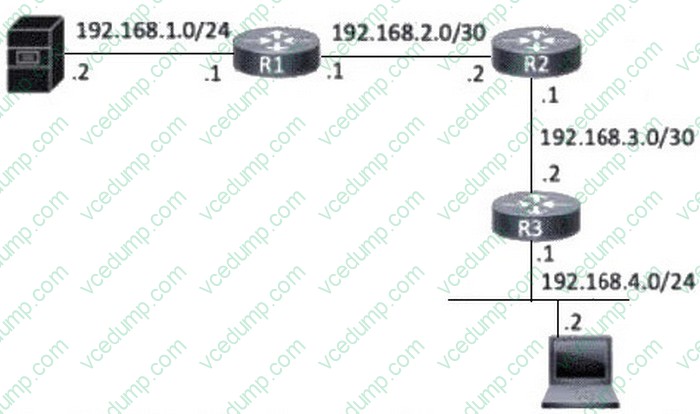
A company uses PIM-SM multicast with IGMPv2 to stream training videos from a server in network 192.168.1.2/24 to hosts that reside in 192.168.4.0/24. The company is implementing SSM to improve efficiency within Layer 2.
Which task should the engineer perform to allow hosts to dynamically register to a multicast group when reaching the server at 192.168.1.2?
A. Implement PIM-DM on the interface between R2 and R3.
B. Implement IGMPv3 on all routers.
C. Configure bidirectional PIM on R2.
D. Configure an IGMP querier on R3. -
Question 259:
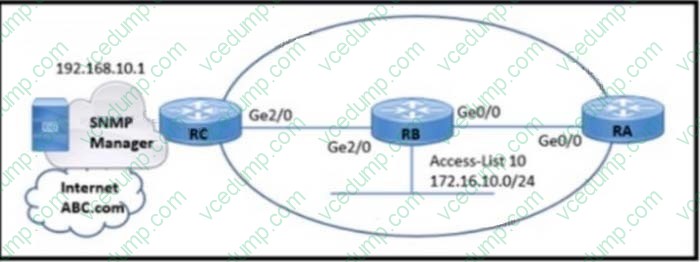
Refer to the exhibit. A network engineer is configuring an SNMP community on router RB with these requirements:
Allow read-only access for all objects to members of Access-List 10 that use the comaccess community string.
Other SNMP managers must not have access to objects. SNMP authentication failure traps must be sent to SNMPv2c and then to the host using SNMPv2c with the public community string.
Which configuration meets these requirements?
A. Option A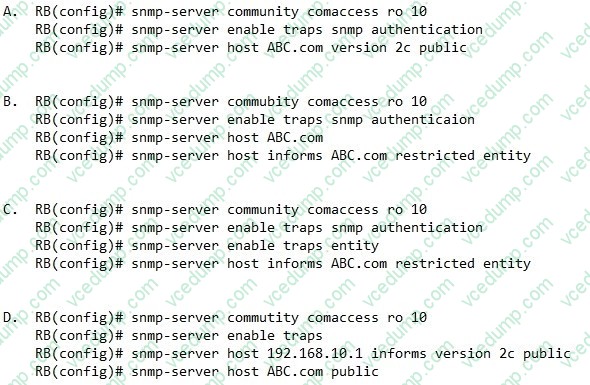
B. Option B
C. Option C
D. Option D -
Question 260:
Refer to the exhibit
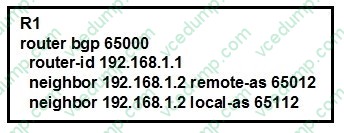
A network engineer is implementing a BGP protocol. Which effect of the local-as keyword in this configuration is true?
A. It enables peer 192.168.1.2 to establish a BGP relationship with R1 using AS 65012 without additional configuration.
B. It enables peer 192.168.1.2 to establish a BGP relationship with R1 using AS 65112 and the VPNv4 address family.
C. It enables peer 192.168.1.2 to establish a BGP relationship with R1 using AS 65012 and the VPNv4 address family.
D. It enables peer 192.168.1.2 to establish a BGP relationship with R1 using AS 65112 without additional configuration.
Tips on How to Prepare for the Exams
Nowadays, the certification exams become more and more important and required by more and more enterprises when applying for a job. But how to prepare for the exam effectively? How to prepare for the exam in a short time with less efforts? How to get a ideal result and how to find the most reliable resources? Here on Vcedump.com, you will find all the answers. Vcedump.com provide not only Cisco exam questions, answers and explanations but also complete assistance on your exam preparation and certification application. If you are confused on your 350-501 exam preparations and Cisco certification application, do not hesitate to visit our Vcedump.com to find your solutions here.