350-501 Exam Details
-
Exam Code
:350-501 -
Exam Name
:Implementing and Operating Cisco Service Provider Network Core Technologies (SPCOR) -
Certification
:CCIE Service Provider -
Vendor
:Cisco -
Total Questions
:568 Q&As -
Last Updated
:
Cisco 350-501 Online Questions & Answers
-
Question 281:
Refer to the exhibit.
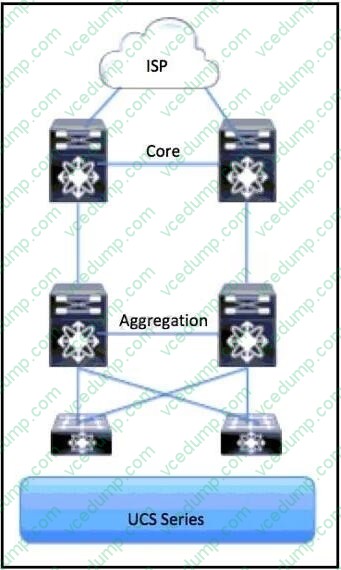
Which part of the diagram will host OpenStack components?
A. UCS Series
B. Aggregation
C. Access
D. Core -
Question 282:
Which benefit is provided by FRR?
A. It provides fast forwarding path failure detection times for all media.
B. It provides rapid failure detection between forwarding engines.
C. It provides performance data for the service provider network.
D. It protects Cisco MPLS TE LSPs from link and node failures. -
Question 283:
How can shared services in an MPLS Layer 3 VPN provide Internet access to the Customers of a central service provider?
A. Static routes on CE routers allow route leakage from a PE global routing table.
B. The CE router can establish a BGP peering to a PE router and use the PE device to reach the Internet.
C. The customer VRF uses route targets to import and export routes to and from a shared services VRF.
D. Route distinguishers are used to identify the routes that CEs can use to reach the Internet. -
Question 284:
Refer to the exhibit.
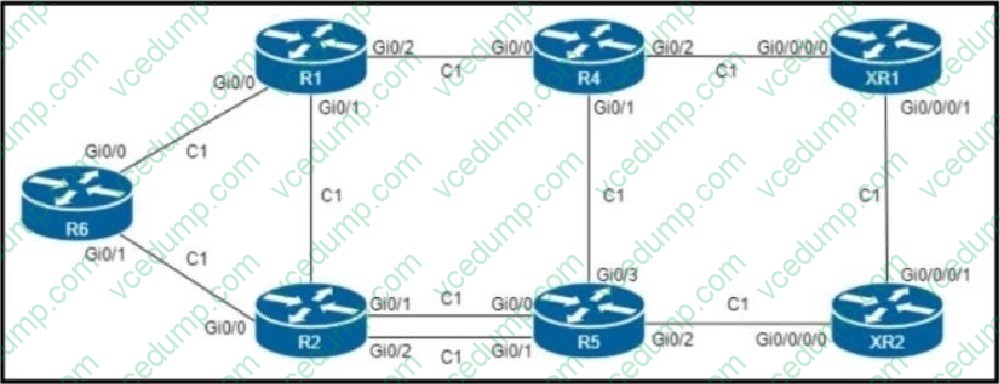
An engineer configured R6 as the headend LSR of an RSVP-TE LSP to router XR2, with the dynamic path signaled as R6-R2-R5-XR2. and set the OSPF cost of all links to 1. MPLS autotunnel backup Is enabled on all routers to protect the LSP.
Which two NNHOP backup tunnels should the engineer use to complete the implementation? (Choose two.)
A. The R6 backup tunnel path R6-R1-R4-R5.
B. The R2 backup tunnel path R2-R5 across the alternate link.
C. The R2 backup tunnel path R2-R1-R4-XR1-XR2.
D. The R6 backup tunnel path R6-R2-R5
E. The R6 backup tunnel path R6-R1-R2. -
Question 285:
Which function does RSVP perform in a Cisco MPLS TE environment?
A. It establishes targeted LDP sessions between neighbors that are directly connected.
B. It signals to LDP protocol along the path that a Cisco MPLS TE will be configured.
C. It reserves bandwidth for LDP sessions between routers participating in a Cisco MPLS TE.
D. It reserves the bandwidth along the path between the head-end and tail-end router. -
Question 286:
What is the difference between SNMP and model-driven telemetry?
A. SNMP uses the YANG data modeling language.
B. Telemetry uses traps and inform messages to deliver data to a network administrator on a polling basis.
C. Telemetry allows for modeled network data to be pushed to the network administrator on an as-needed basis.
D. SNMP pushes network data to the network administrator whenever it is queried. -
Question 287:
You are configuring MPLS traffic-engineering tunnels in the core. Which two ways exist for the tunnel path across the core? (Choose two )
A. Tunnel links inherit IGP metrics by default unless overridden
B. Tunnels can be configured with dynamic path or explicitly defined path
C. A zero bandwidth tunnel is not a valid option
D. The bandwidth statement creates a "hard" reservation on the link-The dynamic path option is supported only with IS-IS -
Question 288:
Which QoS model allows hosts to report their OoS needs to the network?
A. DiffServ
B. CB-WFQ
C. IntServ
D. MQC -
Question 289:
Refer to the exhibit.
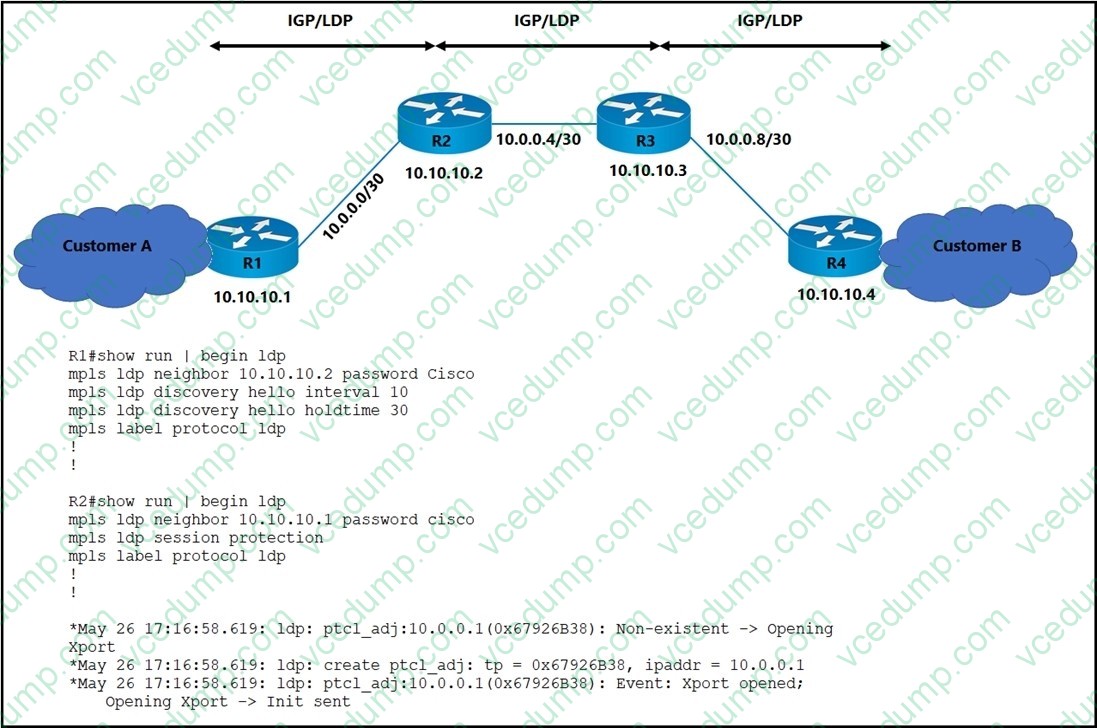
The operations team is implementing an LDP-based configuration in the service provider core network with these requirements:
1. R1 must establish LDP peering with the loopback IP address as its Router-ID.
2. Session protection must be enabled on R2.
How must the team update the network configuration to successfully enable LDP peering between R1 and R2?
A. Change the LDP password on R2 to Cisco.
B. Configure mpls ldp router-id loopback0 on R1 and R2.
C. Configure LDP session protection on R1.
D. Change the discover hello hold time and interval to their default values. -
Question 290:
After recent network outages and customer complaints, a large Tier 1 service provider has asked a network engineer to implement MPLS OAM policy on all Provider Edge devices in the MPLS network. To improve network performance and reliability, the policy must be able to detect 2% packet drops and a delay of 0.05 seconds. The solution must be based on RFC 6374 and RFC 4379 standards for MPLS OAM. The CCM to detect connectivity issues has already been configured with interval 1000.
Which two actions must the engineer take to achieve the goal? (Choose two.)
A. Set loopback delay-frequency 50 and drop-threshold 0.2 on the PE routers.
B. Implement mpls ldp tracing on the PE and P routers.
C. Implement mpls oam policy oam on the PE routers.
D. Implement mpls ip oam map-policy on the PE routers.
E. Set loss-threshold 2 and delay-threshold 50 on the P routers.

Tips on How to Prepare for the Exams
Nowadays, the certification exams become more and more important and required by more and more enterprises when applying for a job. But how to prepare for the exam effectively? How to prepare for the exam in a short time with less efforts? How to get a ideal result and how to find the most reliable resources? Here on Vcedump.com, you will find all the answers. Vcedump.com provide not only Cisco exam questions, answers and explanations but also complete assistance on your exam preparation and certification application. If you are confused on your 350-501 exam preparations and Cisco certification application, do not hesitate to visit our Vcedump.com to find your solutions here.