350-401 Exam Details
-
Exam Code
:350-401 -
Exam Name
:Implementing and Operating Cisco Enterprise Network Core Technologies (ENCOR) -
Certification
:CCIE Enterprise Wireless -
Vendor
:Cisco -
Total Questions
:1524 Q&As -
Last Updated
:Jul 10, 2026
Cisco 350-401 Online Questions & Answers
-
Question 71:
What are two characteristics of a directional antenna? (Choose two.)
A. commonly used to cover large areas
B. low gain
C. provides the most focused and narrow beam-width
D. receive signals equally from all directions
E. high gain -
Question 72:
Which statement describes the Cisco SD-Access plane functionality for fabric-enabled wireless?
A. Control plane traffic and data plane traffic are sent to the WLC through VXLAN.
B. The control plane traffic is sent to the WLC through CAPWAP tunnels, and the data plane traffic is sent from the AP to the fabric edge switch through VXLAN.
C. The control plane traffic is sent to the WLC through VXLAN, and the data plane traffic is sent to the WLC through CAPWAP tunnels.
D. Control plane traffic and data plane traffic are sent to the WLC through CAPWAP tunnels. -
Question 73:
Which function does a Cisco SD-Access extended node perform?
A. provides fabric extension to nonfabric devices through remote registration and configuration
B. performs tunneling between fabric and nonfabric devices to route traffic over unknown networks
C. used to extend the fabric connecting to downstream nonfabric enabled Layer 2 switches
D. in charge of establishing Layer 3 adjacencies with nonfabric unmanaged node -
Question 74:
Which character formatting is required for DHCP Option 43 to function with current AP models?
A. MD5
B. Base64
C. ASCII
D. Hex -
Question 75:
SIMULATION
Guidelines
This is a lab item in which tasks will be performed on virtual devices.
1. Refer to the Tasks tab to view the tasks for this lab item.
2. Refer to the Topology tab to access the device console(s) and perform the tasks.
3. Console access is available for all required devices by clicking the device icon or using the tab(s) above the console window.
4. All necessary preconfigurations have been applied.
5. Do not change the enable password or hostname for any device.
6. Save your configurations to NVRAM before moving to the next item.
7. Click Next at the bottom of the screen to submit this lab and move to the next question.
8. When Next is clicked, the lab closes and cannot be reopened.
Topology
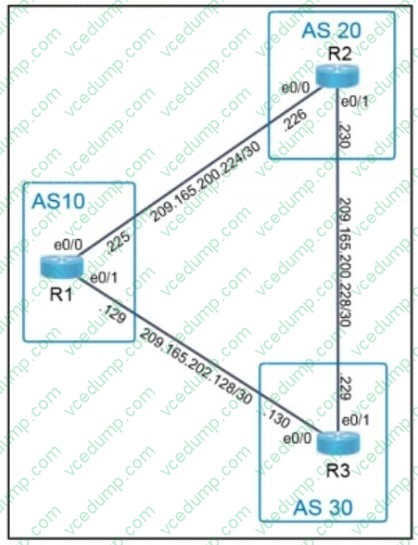
A. See the solution below in Explanation.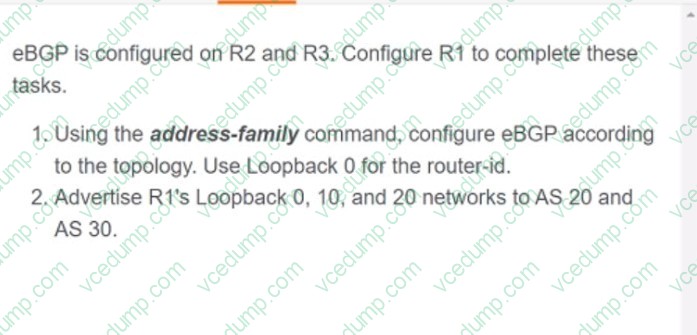
B. Place Holder
C. Place Holder
D. Place Holder -
Question 76:
What is a characteristic of an AP operating in FlexConnect mode?
A. All traffic traverses the WLC to ensure policy enforcement on client traffic.
B. Forwarding for locally switched traffic continues when the AP loses connectivity to the WLC.
C. APs connect in a mesh topology and elect a root AP
D. FlexConnect enables an AP to connect to multiple WLCs. -
Question 77:
Which two descriptions of FlexConnect mode for Cisco APs are true? (Choose two.)
A. APs that operate in FlexConnect mode cannot detect rogue APs.
B. When connected to the controller, FlexConnect APs can tunnel traffic back to the controller.
C. FlexConnect mode is used when the APs are set up in a mesh environment and used to bridge between each other.
D. FlexConnect mode is a feature that is designed to allow specified CAPWAP-enabled APs to exclude themselves from managing data traffic between dents and infrastructure.
E. FlexConnect mode is a wireless solution for branch office and remote office deployments. -
Question 78:
What are two common sources of interface for WI-FI networks? (Choose two.)
A. radar
B. LED lights
C. rogue AP
D. conventional oven
E. fire alarm -
Question 79:
A customer requested a GRE tunnel through the provider network between two customer sites using loopback to hide internal networks.
Which configuration on R2 establishes the tunnel with R1?
A. R2(config)#interface Tunnel1 R2(config-if)#ip address 172.20.1.2 255.255.255.0 R2(config-if)#ip mtu 1500 R2(config-if}#ip tcp adjust-mss 1360 R2(config-if)#tunnel source 192.168.20.1 R2(config-if)#tunnel destination 10.10.1.1
B. R2(config)#interface Tunnel1 R2(config-if)#ip address 172.20.1.2 255.255.255.0 R2(config-if)#ip mtu 1400 R2(config-if)#ip tcp adjust-mss 1360 R2(config-if)#tunnel source 192.168.20.1 R2(config-if)#tunnel destination 192.168.10.1
C. R2(config)#interface Tunnel1 R2(config-if)#ip address 172.20.1.2 255.255.255.0 R2(config-if)#ip mtu 1400 R2(config-if)#ip tcp adjust-mss 1360 R2(config-if)#tunnel source 10.10.2.2 R2(config-if)#tunnel destination 10.10.1.1
D. R2(config)#interface Tunnel1 R2(config-if)#ip address 172.20.1.2 255.255.255.0 R2(config-if)#ip mtu 1500 R2(config-if)#ip tcp adjust-mss 1360 R2(config-if)#tunnel source 10.10.2.2 R2(config-if)#tunnel destination 10.10.1.1Correct -
Question 80:
An engineer is implementing a Cisco MPLS TE tunnel to improve the streaming experience for the clients of a video-on-demand server.
Which action must the engineer perform to configure extended discovery to support the MPLS LDP session between the headend and tailend routers?
A. Configure the interface bandwidth to handle TCP and UDP traffic between the LDP peers
B. Configure a Cisco MPLS TE tunnel on both ends of the session
C. Configure an access list on the interface to permit TCP and UDP traffic
D. Configure a targeted neighbor session.
Tips on How to Prepare for the Exams
Nowadays, the certification exams become more and more important and required by more and more enterprises when applying for a job. But how to prepare for the exam effectively? How to prepare for the exam in a short time with less efforts? How to get a ideal result and how to find the most reliable resources? Here on Vcedump.com, you will find all the answers. Vcedump.com provide not only Cisco exam questions, answers and explanations but also complete assistance on your exam preparation and certification application. If you are confused on your 350-401 exam preparations and Cisco certification application, do not hesitate to visit our Vcedump.com to find your solutions here.