350-401 Exam Details
-
Exam Code
:350-401 -
Exam Name
:Implementing and Operating Cisco Enterprise Network Core Technologies (ENCOR) -
Certification
:CCIE Enterprise Wireless -
Vendor
:Cisco -
Total Questions
:1524 Q&As -
Last Updated
:Jul 18, 2026
Cisco 350-401 Online Questions & Answers
-
Question 511:
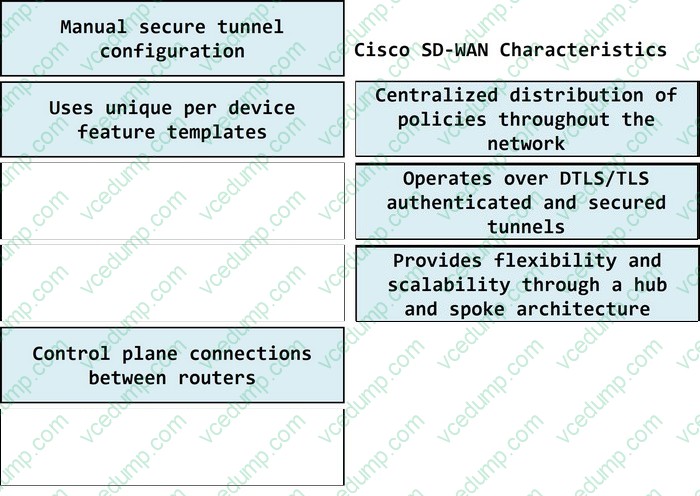
DRAG DROP
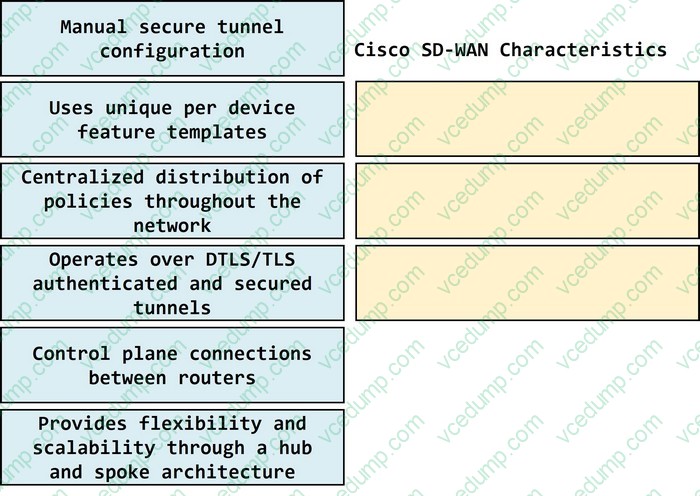
Drag and drop the characteristics of Cisco Catalyst SD-WAN from the left onto the right. Not all options are used.
Select and Place:
-
Question 512:
An engineer is implementing MPLS OAM to monitor traffic within the MPLS domain.
Which action must the engineer perform to prevent from being forwarded beyond the service provider domain when the LSP is down?
A. Disable IP redirects only on outbound interfaces.
B. Implement the destination address for the LSP echo request packet in the 127.x.y.z/8 network.
C. Disable IP redirects on all ingress interfaces.
D. Configure a private IP address as the destination address of the headend router of Cisco MPLS TE. -
Question 513:
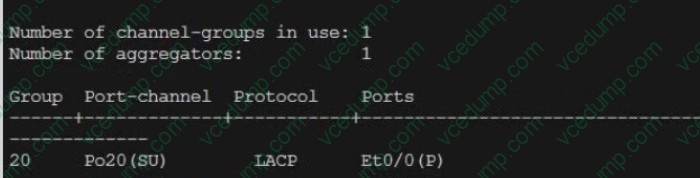
Refer to the exhibit.
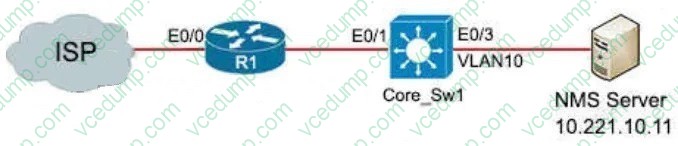
During ISP router maintenance, the network produced many alerts because of the flapping interface.
Which configuration on R1 resolves the issue?
A. snmp trap ip verify drop-rate
B. no snmp trap link-status
C. ip verify drop-rate notify hold-down 60
D. snmp trap link-status down -
Question 514:
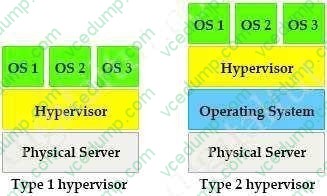
Which statement explains why Type 1 hypervisor is considered more efficient than Type 2 hypervisor?
A. Type 1 hypervisor runs directly on the physical hardware of the host machine without relying on the underlying OS.
B. Type 1 hypervisor enables other operating systems to run on it.
C. Type 1 hypervisor relics on the existing OS of the host machine to access CPU, memory, storage, and network resources.
D. Type 1 hypervisor is the only type of hypervisor that supports hardware acceleration techniques. -
Question 515:
Which two namespaces does the LISP network architecture and protocol use? (Choose two.)
A. TLOC
B. RLOC
C. DNS
D. VTEP
E. EID -
Question 516:
A network administrator received reports that a 40Gb connection is saturated. The only server the administrator can use for data collection in that location has a 10Gb connection to the network.
Which of the following is the best method to use on the server to determine the source of the saturation?
A. Port mirroring
B. Log aggregation
C. Flow data
D. Packet capture -
Question 517:
Which two protocols are used with YANG data models? (Choose two.)
A. HTTPS
B. SSH
C. RESTCONF
D. TLS
E. NFTCONF -
Question 518:
What is a benefit of deploying an on-premises infrastructure versus a cloud infrastructure deployment?
A. faster deployment times because additional infrastructure does not need to be purchased
B. lower latency between systems that are physically located near each other
C. less power and cooling resources needed to run infrastructure on-premises
D. ability to quickly increase compute power without the need to install additional hardware -
Question 519:
SIMULATION
Guidelines
This is a lab item in which tasks will be performed on virtual devices.
1. Refer to the Tasks tab to view the tasks for this lab item.
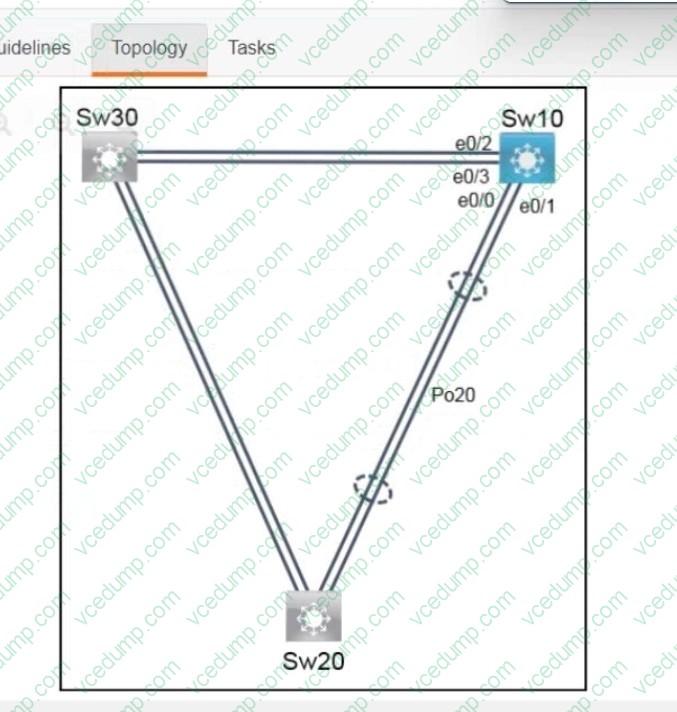
2. Refer to the Topology tab to access the device console(s) and perform the tasks.
3. Console access is available for all required devices by clicking the device icon or using the tab(s) above the console window.
4. All necessary preconfigurations have been applied.
5. Do not change the enable password or hostname for any device.
6. Save your configurations to NVRAM before moving to the next item.
7. Click Next at the bottom of the screen to submit this lab and move to the next question.
8. When Next is clicked, the lab closes and cannot be reopened.
Topology
Tasks
A. See the solution below in Explanation.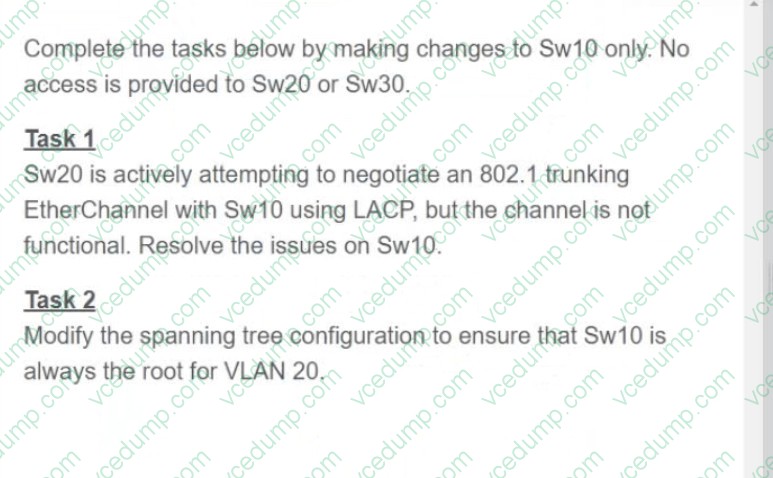
B. Place Holder
C. Place Holder
D. Place Holder -
Question 520:
Which mobility role is assigned to a client in the client table of the new controller after a Layer 3 roam?
A. anchor
B. foreign
C. mobility
D. transparent
Tips on How to Prepare for the Exams
Nowadays, the certification exams become more and more important and required by more and more enterprises when applying for a job. But how to prepare for the exam effectively? How to prepare for the exam in a short time with less efforts? How to get a ideal result and how to find the most reliable resources? Here on Vcedump.com, you will find all the answers. Vcedump.com provide not only Cisco exam questions, answers and explanations but also complete assistance on your exam preparation and certification application. If you are confused on your 350-401 exam preparations and Cisco certification application, do not hesitate to visit our Vcedump.com to find your solutions here.