350-029 Exam Details
-
Exam Code
:350-029 -
Exam Name
:CCIE Service Provider written -
Certification
:Cisco Certifications -
Vendor
:Cisco -
Total Questions
:520 Q&As -
Last Updated
:Dec 14, 2021
Cisco 350-029 Online Questions & Answers
-
Question 241:
In MPLS VPN, where must MP-BGP peering be configured?
A. in all CE routers within a VPN community
B. in all CE routers across a VPN community
C. in all PE routers within a VPN community
D. in all PE routers across a VPN community
E. in all PE and CE routers within a VPN community
F. in all PE and CE routers across a VPN community -
Question 242:
Which two statements about DS-Lite are true? (Choose two.)
A. IPv4 packets are carried over IPv6 tunnels to the LSN while IPv6 traffic is forwarded natively.
B. Ipv6 packets are carried over IPv4 tunnels to the LSN while IPv4 traffic is forwards natively.
C. The LSN performs NAT44 on private IPv4 source addresses.
D. DS-Lite does not perform any address translation. -
Question 243:
RIPv2 differs from RIPv1 in which three things? (Choose three).
A. it uses multicast address 224.0.0.10, instead of broadcast.
B. it uses multicast address 224.0.0.9, instead of broadcast.
C. it can use either multicast or broadcast addresses,instead of just broadcast.
D. it sends incremental updates,instead of periodic updates.
E. it is classless, instead of classfull
F. it supports authentication, and RIPv1 does not -
Question 244:
Which of the following statements is correct regarding PIM Sparse Mode operations?
A. Receivers are "registered" with RP by their first-hop router
B. It supports shared trees only assuming all hosts want the multicast traffic
C. From the RP, traffic flows down a Source Tree to each receiver
D. It does not support all underlying unicast routing protocols like BGP
E. Receivers are "joined" to the Shared Tree (rooted the rp) by their local Designated Router (DR) -
Question 245:
When IPv6 is deployed by a Service Provider to bring on an IPv6 Enterprise, which transition strategy works the best?
A. Deploy IPv6 at the Edges and tunnel Enterprise through the core
B. None of the above will work
C. Deploy IPv6 at Edges and Core at the same time for smooth transition
D. Deploy IPv6 at the core first and then move to Edges toward the end customer -
Question 246:
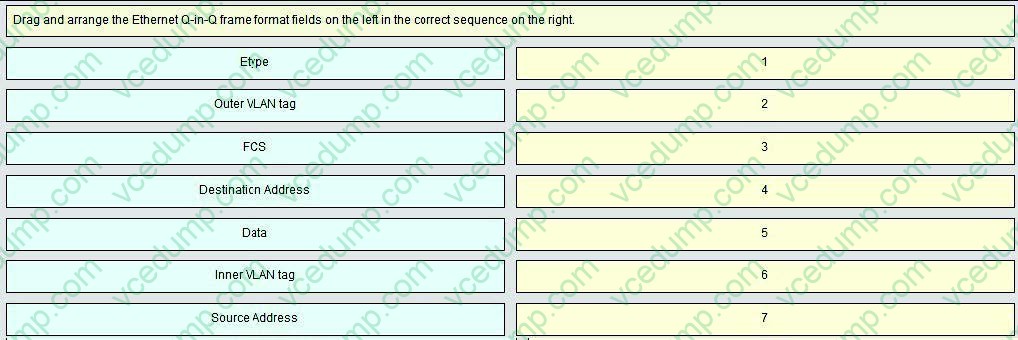
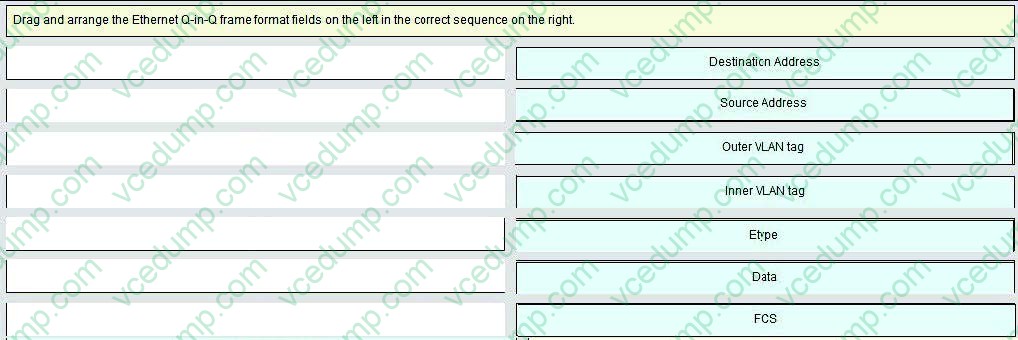
Select and Place:
-
Question 247:
There are two cabling schemes to choose from when implementing a Cisco CRS-1 multi shelf system: single module cabling and multi module cabling. What is the maximum capacity of the LCCs that are supported in multi module cabling?
A. 9 LCCs
B. 7 LCCs
C. 10 LCCs
D. 6 LCCs
E. 8 LCCs -
Question 248:
A customer is connected to a service provider by a low-speed link and wants to increase the bandwidth of this connectivity without creating additional IP addresses. Multiple physical links with the same bandwidth value are already available between the customer and the service provider. Which technology can be used to achieve these requirements?
A. HDLC
B. PPTP
C. Multilink PPP
D. Frame Relay -
Question 249:
What is the purpose of Dual Ring Interconnect with D C for SDH rings?
A. Protects signals when a ring switch fails
B. Protects signals when multiple span switches fail
C. Protects pre-emptible traffic from being dropped when a ring switch occurs
D. Protects signals against any combination of link failure in each ring -
Question 250:
R1 and R2 share the same Fast Ethernet connection. OSPFv3 is configured on each interface, but the adjacency is not being established.
Review the configuration provided. Which option explains why the OSPFv3 adjacency is not coming up?
R1 Interface fastethernet 0/0 ipv6 address 2001:db8:1234:1::1/64 ipv6 ospf 1 area 0 instance 2 ipv6 enable ipv6 router ospf 1 router-id 1.1.1.1
R2 Interface fastethernet 0/0 ipv6 address 2001:db8:6789:9::1/64 ipv6 ospf 2 area 0 instance 3
ipv6 router ospf 2 router-id 2.2.2.2
A. The two routers are not on the same subnet.
B. IPv6 is not enabled on R2 Fast Ethernet 0/0.
C. There is no reachability to 1.1.1.1 or 2.2.2.2.
D. The OSPFv3 processes do not match.
E. The instance IDs do not match.
Related Exams:
-
300-745
Designing Cisco Security Infrastructure (300-745 SDSI) v1.0 -
350-101
Implementing and Operating Cisco Wireless Core Technologies (350-101 WLCOR)v1.0 -
352-011
Cisco Certified Design Expert Practical -
500-052
Cisco Unified Contact Center Express -
500-173
Designing the FlexPod Solution (FPDESIGN) -
500-201
Deploying Cisco Service Provider Mobile Backhaul Solutions -
500-210
SP Optical Technology Field Engineer Representative -
500-220
Engineering Cisco Meraki Solutions (ECMS) v2.2 -
500-230
Cisco Service Provider Routing Field Engineer -
500-240
Cisco Mobile Backhaul for Field Engineers
Tips on How to Prepare for the Exams
Nowadays, the certification exams become more and more important and required by more and more enterprises when applying for a job. But how to prepare for the exam effectively? How to prepare for the exam in a short time with less efforts? How to get a ideal result and how to find the most reliable resources? Here on Vcedump.com, you will find all the answers. Vcedump.com provide not only Cisco exam questions, answers and explanations but also complete assistance on your exam preparation and certification application. If you are confused on your 350-029 exam preparations and Cisco certification application, do not hesitate to visit our Vcedump.com to find your solutions here.