303 Exam Details
-
Exam Code
:303 -
Exam Name
:BIG-IP ASM Specialist -
Certification
:F5 Certifications -
Vendor
:F5 -
Total Questions
:524 Q&As -
Last Updated
:Jul 12, 2026
F5 303 Online Questions & Answers
-
Question 381:
A new VLAN vlan301 has been configured on a highly available LTM device in partition ApplicationA. A new directly connected backend server has been placed on vlan301. However, there are connectivity issues pinging the default gateway. The VLAN self IPs configured on the LTM devices are 192.168.0.251 and 192.168.0.252 with floating IP 192.168.0.253. The LTM Specialist needs to perform a packet capture to assist with troubleshooting the connectivity.
Which command should the LTM Specialist execute on the LTM device command line interface to capture the attempted pings to the LTM device default gateway on VLAN vlan301?
A. tcpdump -ni /ApplicationA/vlan301 'host 192.168.0.253'
B. tcpdump -ni vlan301 'host 192.168.0.253'
C. tcpdump -ni /ApplicationA/vlan301 'host 192.168.0.251 or host 192.168.0.252'
D. tcpdump -ni vlan301 'host 192.168.0.251 or host 192.168.0.252' -
Question 382:
A BIG-IP Administrator receives an RMA replacement for a failed F5 device. The BIG-IP Administrator tries to restore a UCS taken from the previous device, but the restore fails. The following error appears inthe/var/log/itm.
mcpd [****J: ?****?0; License is not operational (expired or digital signature does not match contents.)
What should the BIG-IP Administrator do to avoid this error?
A. Use the appropriate tmsh command with the no-license option
B. Revoke the license prior to restoring
C. Reactivate the license on the new device using the manual activation method
D. Remove the license information from the UCS archive -
Question 383:
An LTM Specialist needs to gather website statistics such as latency and throughput on the existing virtual server. This virtual server loadBalances the backend web servers. Which F5 feature will provide this?
A. the Performance panel
B. the AVR module
C. the Dashboard
D. the Statistics panel -
Question 384:
An LTM Specialist is setting up a monitor for an HTTP 1.1 server. The response to a GET /is:
HTTP/1.1 302 Moved Temporarily
Location: http://www.example.com/new/location.html
Which send string settings should the LTM Specialist use to force a proper response?
A. GET / HTTP/1.0\r\nHost: host.domain.com\r\nConnection: Close\r\n\r\n
B. GET /new/location.html HTTP/1.1\r\nHost: www.example.com\r\nConnection: Close\r\n\r\n
C. GET / HTTP/1.1\r\nHost: www.example.com/new/location.html\r\nConnection: Close\r\n\r\n
D. GET /new/location.html HTTP/1.1\r\nHost: host.domain.com/new/locations.html\r\nConnection: Close\r\n\r\n -
Question 385:
Refer to the exhibit.
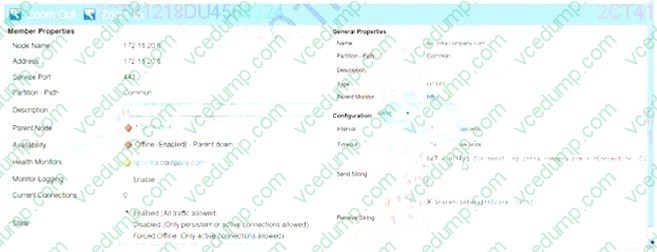
A BIG-IP Administrator notices that one of the servers that runs an application is NOT receiving any traffic. The BIG-IP Administrator examines the configuration status of the application and observes the displayed monitor configuration and affected Pool Member status. What is the possible cause of this issue?
A. The Node Health Monitor is NOT responding.
B. The application is NOT responding with the expected Receive String.
C. HTTP 1.1 is NOT appropriate for monitoring purposes.
D. The BIG-IP device is NOT able to reach the Pool. -
Question 386:
A web server administrator informs the BIG-IP Administrator that web servers are overloaded Starting next month, the BIG-IP device will terminate SSL to reduce web server load. The BIG-IP device is ready using client SSL client profile and Rules on HTTP level. What actions should the BIG-IP Administrators to achieve the desired configuration?
A. Remove the server SSL profile and configure the Pool Members to use HTTP
B. Remove the client SSL profile and configure the Pool Members to US HTTP
C. Remove the chart SSL profile and change the Virtual Server to accept HTTP
D. Remove the server SSL profile and change the Virtual Server to accept HTTP traffic -
Question 387:
After replacing a failed BIG-IP device, configuration sync fails with error “Master key mismatch.” What is the correct resolution?
A. Run tmsh save sys ucs on the standby device and restore it on the active device.
B. Regenerate a new self-device certificate on both units.
C. Copy the master key from the surviving peer using f5mku -K / f5mku -r.
D. Reset the Device Trust and re-establish the ConfigSync group. -
Question 388:
A virtual server for a set of web services is constructed on an LTM device. The LTM Specialist has created an iRule and applied this iRule to the virtual server: when HTTP_REQUEST {
switch [HTTP::uri] { "/WS1/ws.jsp" { log local0. "[HTTP::uri]-Redirected to JSP Pool" pool JSP } default { log local0. "[HTTP::uri]-Redirected to Non-JSP Pool" pool NonJSP } } } However, the iRule is NOT behaving as expected. Below is a snapshot of the log: /WS1/ws.jsp-Redirected to JSP Pool /WS1/ws.jsp-Redirected to JSP Pool /WS1/ws.jsp-Redirected to JSP Pool /WS1/WS.jsp-Redirected to Non-JSP Pool /ws1/WS.jsp-Redirected to Non-JSP Pool /WS1/ws.jsp-Redirected to JSP Pool /ws1/ws.jsp-Redirected to Non-JSP Pool What is the problem?
A. The condition in the iRule is case sensitive.
B. The 'switch' command in the iRule has been used incorrectly.
C. The pool members of both pools need to be set up as case-insensitive members.
D. The "Process Case-Insensitivity" option for the virtual server needs to be selected. -
Question 389:
An LTM Specialist must log all HTTP requests that contain the string "cmd=" in the URI to an external syslog server.
Which iRule achieves this goal most efficiently?
when HTTP_REQUEST {
if {[string tolower [HTTP::uri]] contains "cmd="} {
HSL::send $hsl "[HTTP::uri] from [IP::client_addr]"
}
}
Where should $hsl be defined?
A. In the system variable by default
B. In the RULE_INIT event using HSL::open -proto UDP -pool syslog_pool
C. In the CLIENT_ACCEPTED event using HSL::open -proto TCP -pool syslog_pool
D. In the HTTP_REQUEST event before first HSL::send -
Question 390:
Refer to the exhibit.
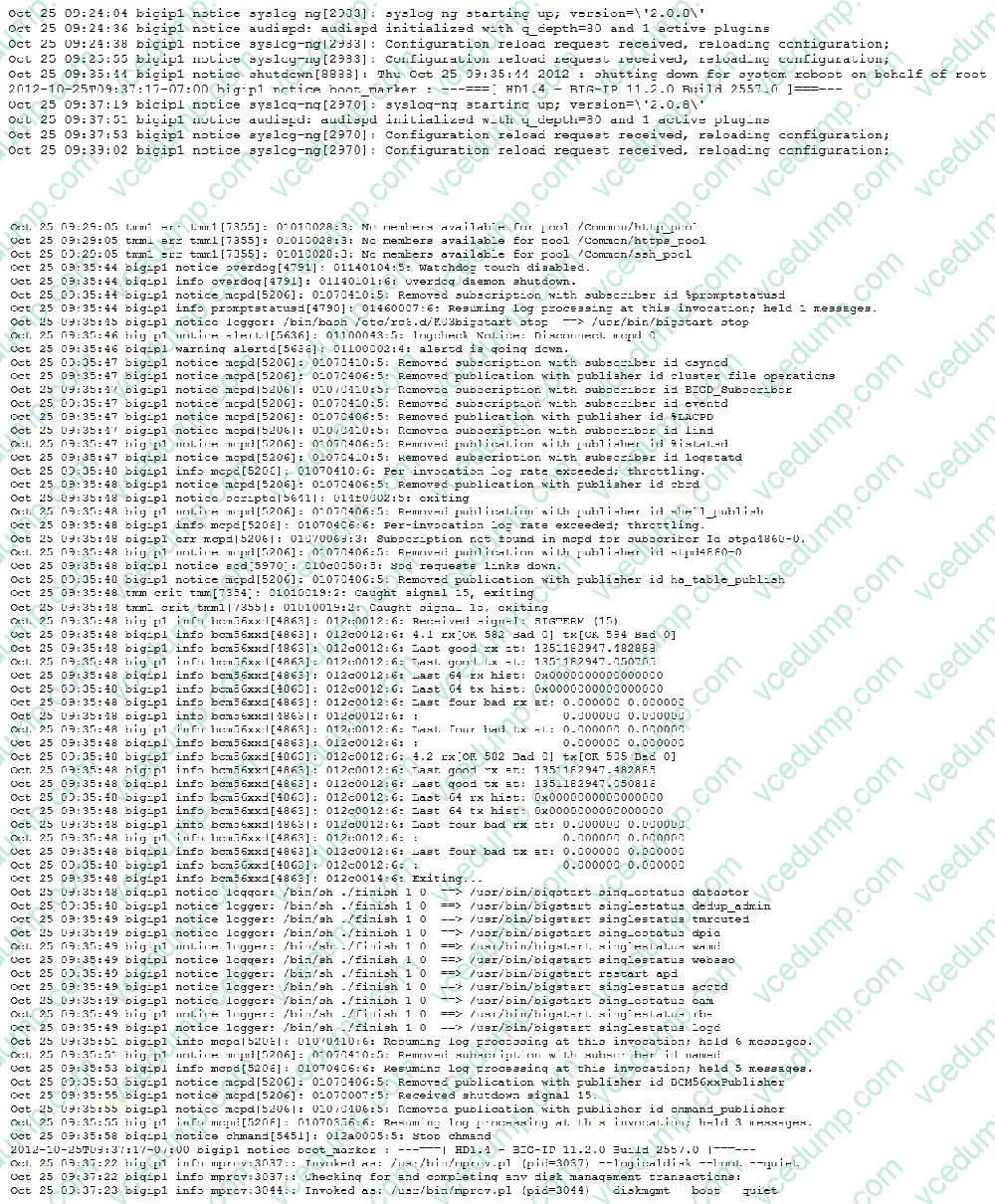
An LTM Specialist uses the information in the logs to determine the cause of a failover event in a high-availability (HA) pair.
What caused the failover?
A. The overdog process crashed.
B. The system was administratively rebooted.
C. The process bcm56xxd received SIGTERM from the watchdog process.
D. The configuration reload request caused the config to reload and the device to failover.
Related Exams:
-
101
Application Delivery Fundamentals -
201
TMOS Administration -
301A
BIG-IP LTM Specialist: Architect, Set up and Deploy -
301B
BIG-IP Local Traffic Manager (LTM) Specialist: Maintain & Troubleshoot -
302
BIG-IP DNS Specialist -
303
BIG-IP ASM Specialist -
402
F5 Cloud Solutions -
771-101
Application Delivery Fundamentals -
F50-506
F5 FirePass 600 V5 -
F50-531
BIG-IP v10.x LTM Essentials V10.x
Tips on How to Prepare for the Exams
Nowadays, the certification exams become more and more important and required by more and more enterprises when applying for a job. But how to prepare for the exam effectively? How to prepare for the exam in a short time with less efforts? How to get a ideal result and how to find the most reliable resources? Here on Vcedump.com, you will find all the answers. Vcedump.com provide not only F5 exam questions, answers and explanations but also complete assistance on your exam preparation and certification application. If you are confused on your 303 exam preparations and F5 certification application, do not hesitate to visit our Vcedump.com to find your solutions here.