303 Exam Details
-
Exam Code
:303 -
Exam Name
:BIG-IP ASM Specialist -
Certification
:F5 Certifications -
Vendor
:F5 -
Total Questions
:524 Q&As -
Last Updated
:Jul 12, 2026
F5 303 Online Questions & Answers
-
Question 371:
An LTM Specialist is troubleshooting a problem on an eCommerce website. The user browses the online store using port 80, adding items to the shopping cart. The user then clicks the "Checkout" button on the site, which redirects the user to port 443 for the checkout process. Suddenly, the user's shopping cart is shown as empty. The shopping cart data is stored in memory on the server, and the default source address persistence profile is used on both virtual servers.
What is the issue?
A. The port 80 pool member is deleting the user's session cookie.
B. The port 443 pool member is deleting the user's session cookie.
C. The port 80 and port 443 connections are balanced to the same node.
D. The port 80 and port 443 connections are balanced to different nodes. -
Question 372:
A new BIG-IP VE is deployed with default settings. The BIG-IP Administrator completes the setup utility in the Configuration Utility. The internal self IP address fails to respond to a ping request. What is a possible cause of this issue?
A. Port lockdown on internal self IP is set to Allow None
B. Route is NOT assigned to internal self IP.
C. Internal interface VLAN is set to untagged
D. Internal interface VLAN is set to tagged -
Question 373:
Refer to the exhibit.

The LTM devicesLTM1 and LTM2 are configured in a Device Group (Sync Failover) with Network Failover configured on both the management and HA and Internal VLANS. and ConfigSync is confined in a Device Group (Sync Failover) with Network Failover and internal are tagged ona single trunk with subnets Connection Mirroring is configured on both the HA interlace directly connected between LTM1 and LTM2, and the management interlace is connected to a management switch. The LTM devices have four Traffic Groups defined, and both LTM devices are healthy and capable of passing traffic for any of the Traffic Groups.
An LTM Specialist disconnects the cable for the HA network in an effort to test failover.
Which HA functionality works in this case?
A. ConfigSync does NOT work. Connection Mirroring floes NOT work.
B. ConfigSync works Connection Mirroring works
C. ConfigSync works. Connection Mirroring docs NOT work
D. ConfigSync does NOT work; Connection Mirroring works -
Question 374:
A BIG-IP Administrator is working with a BIG-IP device and discovers that one of the Interfaces on a Trunk is DOWN. What is the reason for this Interface status?
A. The switch is NOT connected to the Interface
B. There is NO transceiver installed on the Interface
C. There is NO default route configured for this trunk
D. The media speed of the interface has NOT been set -
Question 375:
set payload {CACHE :: payload} }
Which two profiles should be used on the virtual server? (Choose two.)
A. http-transparent
B. http compression
C. http
D. webacceleration
E. stream -
Question 376:
Refer to the exhibit.
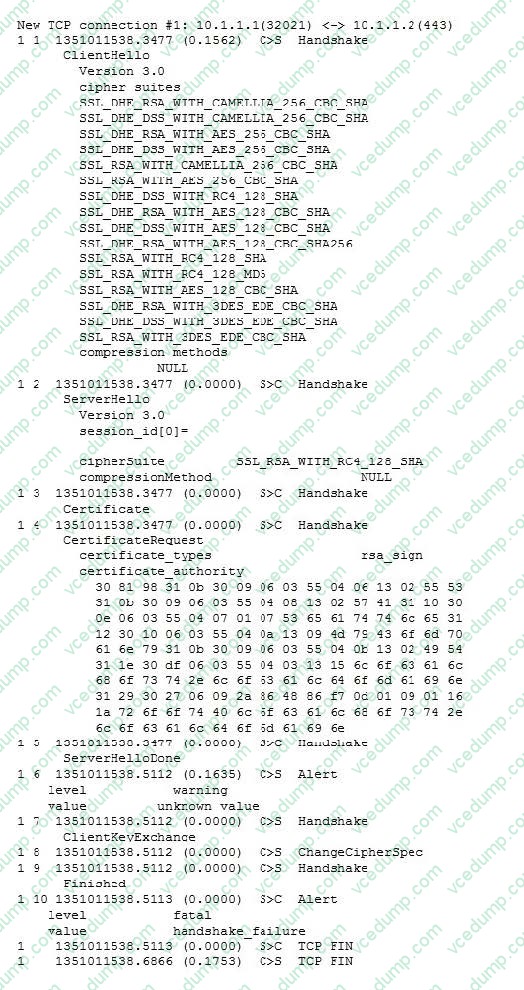
A user is unable to access a secure application via a virtual server.
What is the cause of the issue?
A. The client authentication failed.
B. The virtual server does NOT have a pool configured.
C. The client and server CANNOT agree on a common cipher.
D. The virtual server does NOT have a client SSL profile configured. -
Question 377:
During a high-demand traffic event, the BIG-IP Administrator needs to limit the number of new connections per second allowed to a Virtual Server. What should the administrator apply to accomplish this task?
A. An HTTP Compression profile to the Virtual Server
B. A connection rate limit to the Virtual Server
C. A connection limit to the Virtual Server
D. A OneConnect profile to the Virtual Server -
Question 378:
An LTM Specialist has installed a hotfix that updated the SCCP firmware package. Which command will ensure that the host subsystem and SCCP reboot?
A. reboot
B. full_box_reboot
C. shutdown -r now
D. The reboot should be initiated via the HTTPS administration GUI. -
Question 379:
Users report that traffic is negatively affected every time a BIG-IP device fails over. The traffic becomes stabilized after a few minutes. What should the BIG-IP Administrator do to reduce the impact of future failovers?
A. Enable Failover Multicast Configuration
B. Set up Failover Method to HA Order
C. Configure MAC Masquerade
D. Configure a global SNAT Listener -
Question 380:
A BIG-IP system has the following configuration:
1.SNAT is set to Auto Map
2.There are two VLANs internal and external
3.Default route is pointed to the gateway on external VLAN
4.Self P for internal VLAN is 1921.1.2
5.Self IP for external VLAN is 192.1.2.2
6.Floating IP addresses for internal VLAN is 192.1.1.1
7.Floating IP addresses for external VLAN is 192.1.2.1
8.The Virtual Server IP address is 192.1.1.100
Which IP address does the BIG-IP system use first when traffic reaches the servers on the internal VLAN?
A. 192.1.1.100
B. 192.1.2.2
C. 192.1.1.1
D. 192.1.2.1
Related Exams:
-
101
Application Delivery Fundamentals -
201
TMOS Administration -
301A
BIG-IP LTM Specialist: Architect, Set up and Deploy -
301B
BIG-IP Local Traffic Manager (LTM) Specialist: Maintain & Troubleshoot -
302
BIG-IP DNS Specialist -
303
BIG-IP ASM Specialist -
402
F5 Cloud Solutions -
771-101
Application Delivery Fundamentals -
F50-506
F5 FirePass 600 V5 -
F50-531
BIG-IP v10.x LTM Essentials V10.x
Tips on How to Prepare for the Exams
Nowadays, the certification exams become more and more important and required by more and more enterprises when applying for a job. But how to prepare for the exam effectively? How to prepare for the exam in a short time with less efforts? How to get a ideal result and how to find the most reliable resources? Here on Vcedump.com, you will find all the answers. Vcedump.com provide not only F5 exam questions, answers and explanations but also complete assistance on your exam preparation and certification application. If you are confused on your 303 exam preparations and F5 certification application, do not hesitate to visit our Vcedump.com to find your solutions here.