300-425 Exam Details
-
Exam Code
:300-425 -
Exam Name
:Designing Cisco Enterprise Wireless Networks (ENWLSD) -
Certification
:CCNP Enterprise -
Vendor
:Cisco -
Total Questions
:286 Q&As -
Last Updated
:Jul 10, 2026
Cisco 300-425 Online Questions & Answers
-
Question 201:
Refer to the exhibit.
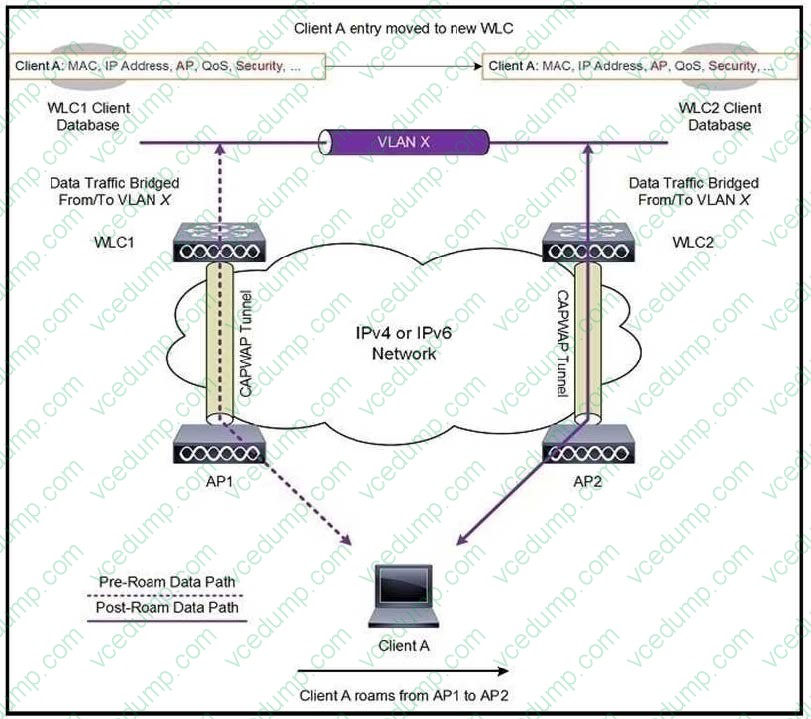
A client roams between two APs that are registered to two different controllers, where each controller has an interface in the client subnet. Both controllers are running AireOS. Which scenario explains the client roaming behavior?
A. Controllers exchange mobility control messages (over UDP port 16666) and the client database entry is moved from the original controller to the new controller.
B. Controllers do not exchange mobility control messages (over UDP port 16666) and the client database, entry is not moved from the original controller to the new controller.
C. Controllers exchange mobility control messages (over UDP port 16666) and a new client session is started with the new controller.
D. Controllers exchange mobility control messages (over UDP port 16666) and the client database entry is tunneled from the original controller to the new controller. -
Question 202:
Guest anchoring is configured for a newly created SSID for your company. It has been noticed that the mobility tunnels are not up, and that MPING fails from your foreign WLC to the anchor WLC. What is the reason that it is failing?
A. A rule is needed at the firewall to allow UDP port 16666 for communication to work.
B. A rule is needed at the firewall to allow UDP port 97 for communication to work.
C. A rule is needed at the firewall to allow TCP port 97 for communication to work.
D. A rule is needed at the firewall to allow TCP port 16666 for communication to work. -
Question 203:
Which metric best indicates client experience in a WLAN design?
A. SNR
B. RSSI
C. Data rate
D. Round-trip latency -
Question 204:
A customer has noticed that Client Band Select is enabled and no clients are utilizing the 5 GHz band. Which three parameters must be met to ensure that wireless clients use the 5 GHz band? (Choose three.)
A. Ensure that channel bonding is enabled on the WLAN.
B. Ensure that the co-channel interference has not exceeded-85 dBm.
C. Ensure that the UNII-2 extended channels are enabled on the 802.11a radios.
D. Ensure that the client is receiving RSSI above the minimum band select RSSI threshold.
E. Ensure that the client is dual-band capable.
F. Ensure that the WLAN has 802.11a enabled. -
Question 205:
When a wireless network is designed for location services, how many APs must be heard by each location-ready AP at a signal level of -75 dBm or better?
A. three APs
B. no more than three APs
C. two APs
D. at least four APs -
Question 206:
An engineer working for an enterprise deployed multiple Cisco WLCs. A controller that sits in the RandD division is connected through a firewall and is part of the same mobility group. The engineer must ensure that the mobility tunneling is available through the firewall and test it as RandD engineers roam the production floor within their department. How is this requirement met?
A. mping on UDP port 16666 and eping on Protocol 96 between management ports
B. mping on UDP port 16666 and eping on Protocol 97 between management ports
C. mping on UDP port 16667 and eping on Protocol 97 between management ports
D. mping on UDP port 16667 and eping on Protocol 96 between management ports -
Question 207:
Users who leave the office with a wireless headset must be able to hand off the voice call with minimal disruption. The engineer drafted four possible floor plans for AP placement:
1.
red dots and arrows represent the direction of travel
2.
blue dots represent the AP placements
Which floor plan provides the requested functionality?
A. Option A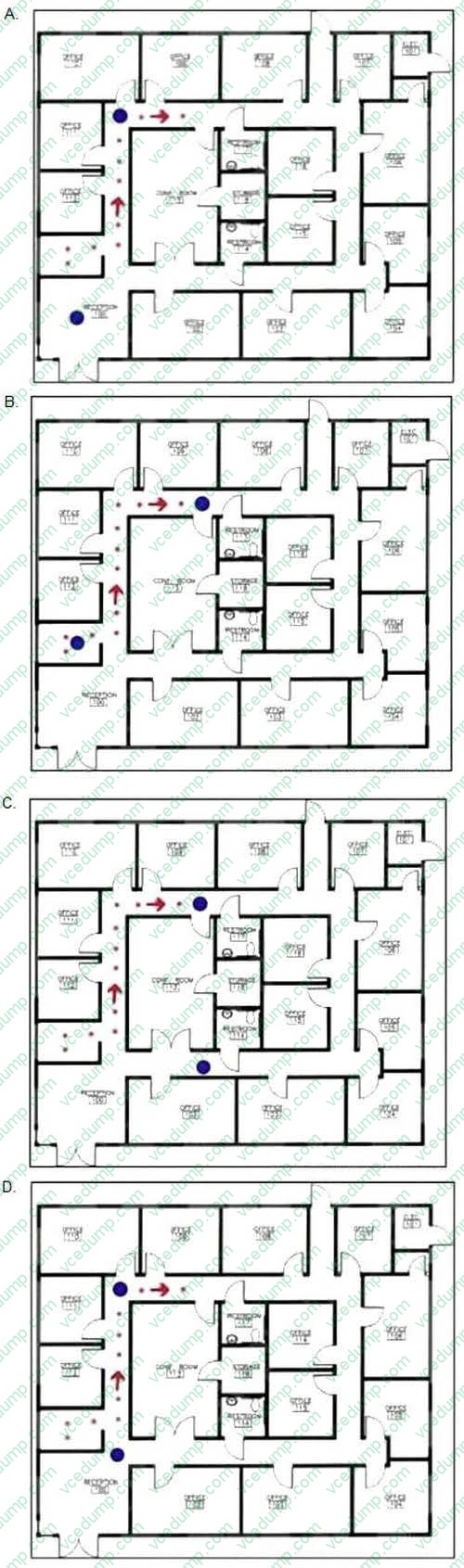
B. Option B
C. Option C
D. Option D -
Question 208:
What is the recommended signal threshold for designing a wireless network that supports voice over Wi-Fi (VoWi-Fi)?
A. -72 dBm
B. -67 dBm
C. -80 dBm
D. -50 dBm -
Question 209:
What is the main purpose of conducting a post-deployment site survey?
A. To validate coverage and capacity
B. To estimate AP placement
C. To create heatmaps
D. To document network topology -
Question 210:
Which type of wireless survey involves physically walking the site and measuring signal strength in real time with APs powered on?
A. Predictive survey
B. Passive survey
C. Validation survey
D. Active survey
Related Exams:
-
300-410
Implementing Cisco Enterprise Advanced Routing and Services (ENARSI) -
300-415
Implementing Cisco SD-WAN Solutions (ENSDWI) -
300-420
Designing Cisco Enterprise Networks (ENSLD) -
300-425
Designing Cisco Enterprise Wireless Networks (ENWLSD) -
300-430
Implementing Cisco Enterprise Wireless Networks (ENWLSI) -
300-435
Automating and Programming Cisco Enterprise Solutions (ENAUTO) -
300-440
Designing and Implementing Cloud Connectivity (ENCC) -
350-401
Implementing and Operating Cisco Enterprise Network Core Technologies (ENCOR)
Tips on How to Prepare for the Exams
Nowadays, the certification exams become more and more important and required by more and more enterprises when applying for a job. But how to prepare for the exam effectively? How to prepare for the exam in a short time with less efforts? How to get a ideal result and how to find the most reliable resources? Here on Vcedump.com, you will find all the answers. Vcedump.com provide not only Cisco exam questions, answers and explanations but also complete assistance on your exam preparation and certification application. If you are confused on your 300-425 exam preparations and Cisco certification application, do not hesitate to visit our Vcedump.com to find your solutions here.