300-425 Exam Details
-
Exam Code
:300-425 -
Exam Name
:Designing Cisco Enterprise Wireless Networks (ENWLSD) -
Certification
:CCNP Enterprise -
Vendor
:Cisco -
Total Questions
:286 Q&As -
Last Updated
:Jul 10, 2026
Cisco 300-425 Online Questions & Answers
-
Question 11:
A network engineer needs to create a wireless design wired IP surveillance cameras in the parking lot through a mesh AP. To which operate mode of the AP should the cameras connect?
A. Flexconnect
B. MAP
C. RAP
D. Local -
Question 12:
Refer to the exhibit.
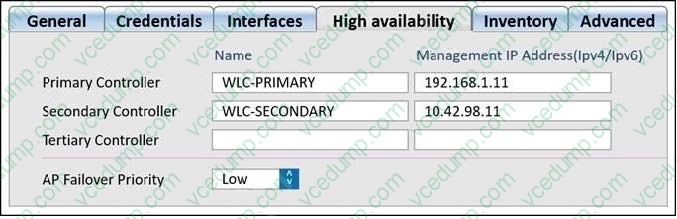
An engineer determined that during a recent controller failure, some APs did not failover to their secondary controller based on the network design, which has sufficient licenses for all APs. The controllers are not in a mobility group but have A records for their hostnames in DNS. Which setting needs to be addressed?
A. The controllers must be in the same mobility group.
B. The secondary controller IP address is incorrect.
C. DNS hostnames are required to be FQDN.
D. The AP failover priority was not set high enough. -
Question 13:
Which authentication method is most scalable for enterprise WLAN deployments?
A. WPA2-PSK
B. MAC filtering
C. WPA3-SAE
D. 802.1X with RADIUS -
Question 14:
Which statement about AP failover priority for access points when configured with priority 1 or 4 is true?
A. When configured with priority 1, the access point is assigned with the highest priority level and it is marked as critical. This access point fails over before other access points with the lower priority when there is primary controller failure.
B. When configured with priority 4, the access point is assigned with the highest priority level and it is marked as critical. This access point fails over before other access points with the lower priority when there is primary controller failure.
C. When configured with priority 4, the access point is assigned with the lowest priority level and it is marked as low. This access point fails over after other access points with the higher priority when there is primary controller failure.
D. When configured with priority 1, the access point is assigned with the medium priority level and it is marked as medium. This access point fails over after other access points with the higher priority when there is primary controller failure. -
Question 15:
An engineer must create data-link redundancy for the company's Cisco Wireless LAN Controller. The engineer has decided to configure LAG-based redundancy instead of port-based redundancy. Which three features of LAG-based
redundancy influenced this decision? (Choose three.)
A. Packets are always sent out on the same port they are received on.
B. All interface traffic passes as long as one port is up.
C. The same port has multiple untagged dynamics interfaces.
D. Interface connection to two separate nonstacked switches is available.
E. Full bandwidth of all links is available.
F. Ports are grouped into multiple LAGs. -
Question 16:
A company is in the process of relocating to a new office space and finds out that the Internet circuit will not be ready before the move. The new building has a non-Cisco WLAN to which they can connect. The engineer has a 12-port switch and one Cisco autonomous AP and must connect multiple wired devices. Which additional device is needed to get all clients connected over the workgroup bridge?
A. router
B. transparent firewall
C. hub
D. wireless controller -
Question 17:
An engineer has deployed Cisco Aironet 3800 Series APs with switches that support 802.11bz on existing CAT-5e cabling. Which value is the maximum distance supported to achieve up to 5 Gb speed?
A. 30 m
B. 40 m
C. 70 m
D. 90 m -
Question 18:
Refer to the exhibit.
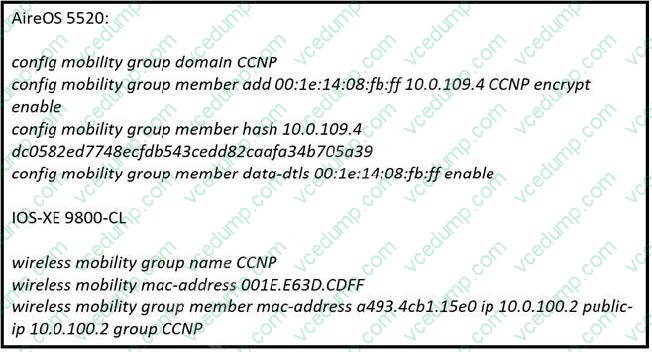
An engineer is about to establish a mobility peer connection between a Cisco Catalyst 9800-CL version 16.10.1e and Cisco AireOS 5520 version 8.8.120.0. The data path between the 9800-CL and AireOS 5520 is down, but its control path is up. Based on the configuration, what is the cause of the issue?
A. The certificate hash key is incorrect leading to data path down.
B. The data-link-encryption configuration is missing from the 9800-CL configuration.
C. Encrypted mobility is being used in the 5520 configuration leading to data path down.
D. CAPS is used to key in MAC address in the IOS_XE configuration leading to data path down. -
Question 19:
Which survey is performed after deployment to ensure coverage matches design requirements?
A. Predictive
B. Passive
C. Validation
D. Active -
Question 20:
An engineer is designing a wireless network to support Cisco Hyperlocation. The customer indicated some locations that require high density. How is the design adjusted?
A. Add additional APs to all the comers of the site.
B. Add more APs than indicated from the site survey spread across all areas.
C. Add an additional AP in the middle of the dense area.
D. Run the site survey using -57dBm as a threshold.
Related Exams:
-
300-410
Implementing Cisco Enterprise Advanced Routing and Services (ENARSI) -
300-415
Implementing Cisco SD-WAN Solutions (ENSDWI) -
300-420
Designing Cisco Enterprise Networks (ENSLD) -
300-425
Designing Cisco Enterprise Wireless Networks (ENWLSD) -
300-430
Implementing Cisco Enterprise Wireless Networks (ENWLSI) -
300-435
Automating and Programming Cisco Enterprise Solutions (ENAUTO) -
300-440
Designing and Implementing Cloud Connectivity (ENCC) -
350-401
Implementing and Operating Cisco Enterprise Network Core Technologies (ENCOR)
Tips on How to Prepare for the Exams
Nowadays, the certification exams become more and more important and required by more and more enterprises when applying for a job. But how to prepare for the exam effectively? How to prepare for the exam in a short time with less efforts? How to get a ideal result and how to find the most reliable resources? Here on Vcedump.com, you will find all the answers. Vcedump.com provide not only Cisco exam questions, answers and explanations but also complete assistance on your exam preparation and certification application. If you are confused on your 300-425 exam preparations and Cisco certification application, do not hesitate to visit our Vcedump.com to find your solutions here.