300-425 Exam Details
-
Exam Code
:300-425 -
Exam Name
:Designing Cisco Enterprise Wireless Networks (ENWLSD) -
Certification
:CCNP Enterprise -
Vendor
:Cisco -
Total Questions
:286 Q&As -
Last Updated
:Jul 10, 2026
Cisco 300-425 Online Questions & Answers
-
Question 191:
A company installs a new anchor controller in the DMZ. The company has not upgraded the foreign controller for several years. The foreign controller runs code 7.5. The IT administrator suggests that the company upgrade the foreign controller and the new anchor controller to 8.10 or later. Which two benefits must be incorporated into the design regarding the code upgrade? (Choose two.)
A. The foreign controller load balances guest clients across the list of anchor controllers
B. Guest clients are load balanced in round-robin fashion among the anchor controllers.
C. User devices must upgrade their WLAN card drivers.
D. Guest clients are tunneled to anchors with the highest priority.
E. The foreign controller designates one anchor as primary and one or more anchors as secondary. -
Question 192:
A network engineer is working on a design for a wireless network that must support data, voice, and location services. To support these services, which access point placement must the engineer use?
A. corner only
B. perimeter and corner
C. perimeter only
D. indoor and outdoor -
Question 193:
What is the primary purpose of a validation survey?
A. To predict AP placement before installation
B. To confirm that the deployed WLAN meets design requirements
C. To simulate wireless performance using CAD drawings
D. To test AP throughput in a lab environment -
Question 194:
An engineer has deployed a group of APs in an auditorium and notices that the APs are showing high cochannel interference. Which profile can be used to adjust the parameters for these high-density APs?
A. QoS profile
B. AVC profile
C. RF profile
D. ISE profile -
Question 195:
How does AP failover priority for access points function when configured with priority 1 or 4?
A. When configured with priority 1, the access point is assigned with the highest priority level and it is marked as critical. This access point fails over before other access points with the lower priority when there is primary controller failure.
B. When configured with priority 4, the access point is assigned with the highest priority level and it is marked as critical. This access point fails over before other access points with the lower priority when there is primary controller failure.
C. When configured with priority 4, the access point is assigned with the lowest priority level and it is marked as low. This access point fails over after other access points with the higher priority when there is primary controller failure.
D. When configured with priority 1, the access point is assigned with the medium priority level and it is marked as medium. This access point fails over after other access points with the higher priority when there is primary controller failure. -
Question 196:
A wireless engineer must assess constraints for a future WLAN deployment for a site that consists of office cubicles. Which signal propagation attenuation result is associated with this environment?
A. reflection
B. absorption
C. noise
D. refraction -
Question 197:
An engineer performs a Layer 1 survey by using Metegeek chanalyzer only on the current operating channel. Which operating mode is configured for a Cisco CleanAIR AP?
A. Local
B. Sniffer
C. Monitor
D. SE-connect -
Question 198:
An engineer is reducing the subnet size of the corporate WLAN by segmenting the VLAN into smaller subnets. Clients will be assigned a subnet by location. Which type of groups can the engineer use to map the smaller subnets to the corporate WLAN?
A. WLC port groups
B. RF groups
C. AP groups
D. interface groups -
Question 199:
A network engineer is designing a new wireless network. The network needs to have these characteristics:
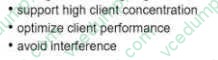
Which approach should be taken?
A. Deploy APs near each other for 5 GHz coverage, and disable the 2.4 GHz radios for some Aps.
B. Deploy APs near each other for 2.4 GHz coverage, and disable the 5 GHz radios for all APs.
C. Deploy APs near each other for 5 GHz coverage, and enable the 2.4 GHz radios for all Aps.
D. Deploy APs near each other for 2.4 GHz coverage, and disable the 5 GHz radios for some APs. -
Question 200:
An enterprise is using two wireless controllers to support the wireless network. The data centre is located in the head office Each controller has a corporate WLAN configured with the nameCopr-NET390595865WLC-1 and CoprNET6837l638WLC-2. The APs are installed using a round-robin approach to load balance the traffic. What should be changed on the configuration to optimize roaming?
A. Move all access points to one controller and use the other as N+1 HA.
B. Move the controllers to an external data center with higher internet speeds.
C. Use the same WLAN name for the corporate network on both controllers.
D. Place the access points per floor on the same controller.
Related Exams:
-
300-410
Implementing Cisco Enterprise Advanced Routing and Services (ENARSI) -
300-415
Implementing Cisco SD-WAN Solutions (ENSDWI) -
300-420
Designing Cisco Enterprise Networks (ENSLD) -
300-425
Designing Cisco Enterprise Wireless Networks (ENWLSD) -
300-430
Implementing Cisco Enterprise Wireless Networks (ENWLSI) -
300-435
Automating and Programming Cisco Enterprise Solutions (ENAUTO) -
300-440
Designing and Implementing Cloud Connectivity (ENCC) -
350-401
Implementing and Operating Cisco Enterprise Network Core Technologies (ENCOR)
Tips on How to Prepare for the Exams
Nowadays, the certification exams become more and more important and required by more and more enterprises when applying for a job. But how to prepare for the exam effectively? How to prepare for the exam in a short time with less efforts? How to get a ideal result and how to find the most reliable resources? Here on Vcedump.com, you will find all the answers. Vcedump.com provide not only Cisco exam questions, answers and explanations but also complete assistance on your exam preparation and certification application. If you are confused on your 300-425 exam preparations and Cisco certification application, do not hesitate to visit our Vcedump.com to find your solutions here.