300-425 Exam Details
-
Exam Code
:300-425 -
Exam Name
:Designing Cisco Enterprise Wireless Networks (ENWLSD) -
Certification
:CCNP Enterprise -
Vendor
:Cisco -
Total Questions
:286 Q&As -
Last Updated
:Jul 18, 2026
Cisco 300-425 Online Questions & Answers
-
Question 171:
Which statement about creating a mobility group is true, excluding mobility anchors?
A. Each WLC must use the same mobility name and be defined as a peer in each other's static mobility members list.
B. If WLCs with HA SSO are deployed, each WLC in the WLC HA pair considered separately as a mobility peer.
C. The WLCs do not have to be of the same model or type to be a member of a mobility group, however each member should be running different software versions.
D. A mobility groups does not require all WLCs in the group to use the same virtual IP address. -
Question 172:
A network engineer must design a new wireless solution for a company, but the budget can only stretch to include a single Cisco 9800-40 WLC. The company requires high availability between the WLC and the core switch in the event of a cable failure. The WLC must dynamically manage port redundancy and perform load balancing between APs transparently. Which design approach must the engineer take to meet the requirements?
A. LAG
B. Multi-LAG
C. LACP
D. PAgP -
Question 173:
Refer to the exhibit.
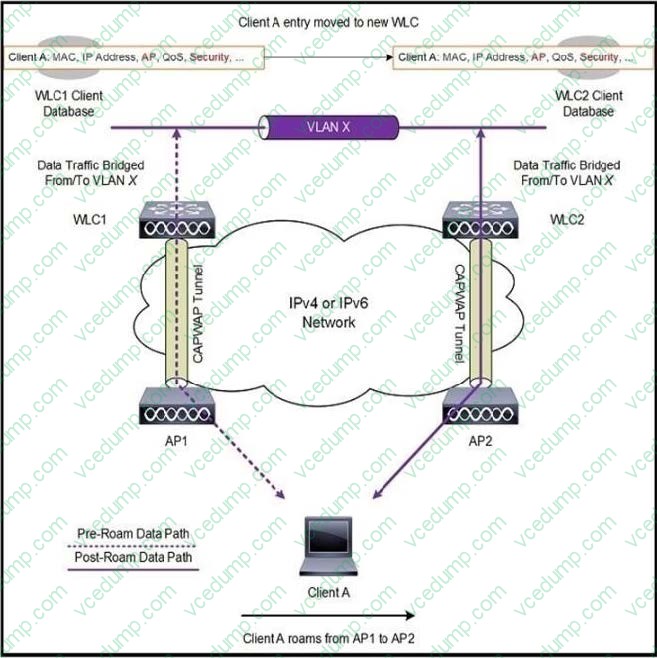
Client A is roaming from AP1 on WLC1 to AP2 on WLC2. The client roams between two APs registered to two different controllers. The WLAN on the two controllers is on a different subnet. Which scenario explains the client's roaming behavior?
A. The client database entry is different than that of Layer 2 roam. (Instead of copying, it moves the database to the new controller.)
B. The client database entry is different than that of Layer 2 roam. (Instead of moving, it copies the database to the new controller.)
C. The client database entry is different than that of Layer 2 roam because the client database is neither moved nor copied into the new controller.
D. The client database remains in the mobility anchor controller and it is not copied or moved. -
Question 174:
Refer to the exhibit.
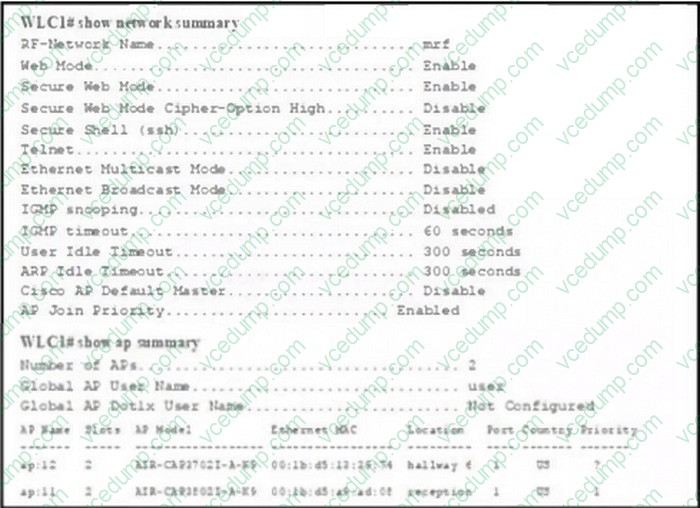
A company is designing a Cisco wireless solution that has two WLCs named WLC1 and WLC2 and several APs. An AP named AP12 is a critical AP and is provisioned to be installed in hallway 6, which is located just outside the office of the company director and must always connect to WLC1.
Which priority level must be incorporated in the design for AP12?
A. 1
B. 2
C. 3
D. 4 -
Question 175:
A wireless engineer is hired to design a network for a technology company. The company campus has four buildings and a warehouse with access points that provide full wireless coverage as well as a pair of WLCs located in the core of the network. Which type of wireless architecture is being used?
A. unified deployment
B. autonomous deployment
C. centralized deployment
D. distributed deployment -
Question 176:
An engineer is trying to configure the APs installed in a new auditorium to use 40 MHz channels with high data rates and lower TX power. The APs in the building hallway must use lower-density design settings configured for the rest of the building. Which two configurations achieve this design? (Choose two.)
A. TPC
B. DCA
C. AP group
D. RRM
E. RF profile -
Question 177:
A network engineer is retrofitting an existing building wired with Category 5e with Cisco Aironet 3800 Series APs and mGig switches. Which cable length allows for 5G operation?
A. 70 m
B. 120 m
C. 130 m
D. 150 m -
Question 178:
In a multifloor office building that contains an auditorium in the basement, all the access points are joined to the same WLC. The plan is to implement a high-density, high-speed design in the auditorium and a low-density VoWiFi design in the offices. How must the access point groups be configured for the auditorium and the offices?
A. To all the access points, apply one RF profile that supports Vo WLAN.
B. Join the access points in each area to area-specific access point groups that have separate RF profiles.
C. To all the access points, apply one RF profile that supports high speed.
D. Join the access points in each area to different controllers that have separate RF profiles. -
Question 179:
During a post-deployment site Survey, issues are found with non wi-Fi interference. What should the engineer use to identify the source of the Interference?
A. Network analysis module
B. Wireless intrusion prevention
C. Wireshark
D. Cisco spectrum expert -
Question 180:
A customer celled with a requirement that internal clients must be on different subnets depending on the building they are in, AH access points are operating in local mode and will not be modified, and this is a single controller solution. Which design approach creates the desired result?
A. Create an SSID, place it to the desired VLAN under WLANs, and configure 802 lx in ISE to assign the correct VLAN based on the SSID from which the client is authenticating.
B. Create FlexConnecI groups, place the access points in. and sat the correct VLAN to SSID mapping based on location.
C. Create AP groups for each desired location, map the correct VLANs to the internal SSID, and add the access points for that location.
D. Create mobility anchors for the SSID, and on the controller under the internal SSID. create a foreign map to the desired VLAN based on location.
Related Exams:
-
300-410
Implementing Cisco Enterprise Advanced Routing and Services (ENARSI) -
300-415
Implementing Cisco SD-WAN Solutions (ENSDWI) -
300-420
Designing Cisco Enterprise Networks (ENSLD) -
300-425
Designing Cisco Enterprise Wireless Networks (ENWLSD) -
300-430
Implementing Cisco Enterprise Wireless Networks (ENWLSI) -
300-435
Automating and Programming Cisco Enterprise Solutions (ENAUTO) -
300-440
Designing and Implementing Cloud Connectivity (ENCC) -
350-401
Implementing and Operating Cisco Enterprise Network Core Technologies (ENCOR)
Tips on How to Prepare for the Exams
Nowadays, the certification exams become more and more important and required by more and more enterprises when applying for a job. But how to prepare for the exam effectively? How to prepare for the exam in a short time with less efforts? How to get a ideal result and how to find the most reliable resources? Here on Vcedump.com, you will find all the answers. Vcedump.com provide not only Cisco exam questions, answers and explanations but also complete assistance on your exam preparation and certification application. If you are confused on your 300-425 exam preparations and Cisco certification application, do not hesitate to visit our Vcedump.com to find your solutions here.