300-165 Exam Details
-
Exam Code
:300-165 -
Exam Name
:Implementing Cisco Data Center Infrastructure -
Certification
:Cisco Certifications -
Vendor
:Cisco -
Total Questions
:328 Q&As -
Last Updated
:Dec 15, 2021
Cisco 300-165 Online Questions & Answers
-
Question 241:
Which three Cisco UCS C-Series CNAs support Adapter FEX? (Choose three.)
A. Qlogic QLE8152
B. Broadcom BCM57712
C. Cisco UCS P81E
D. Cisco UCS VIC 1220
E. Emulex OCe10102-FX-C
F. Intel X520 -
Question 242:
N7k# show ip lisp locator-table DataCenter
Information applicable to all KID instances: Router-lisp ID: 1 Locatot table: vrf DataCenter Ingress Tunnel Router (ITR): disabled Eggress Tunnel Router (ETR): disabled Proxy-ITR Router (PITR): enabled RLOCs:
192.168.1.200 Proxy-ETR Router (PETR): enabled MAP Server (MS): disabled MAP Resolver (MR): disabled Delegated Database Tree (DDT) disabled ITR Map-Resolver(s): 192.168.1.201 ITR Solicit Map Request (SMR): accept and processes Max SMRs per map-cache entry: 8 more specifies Multiple SMR supression time: 20 secs ETR accept mapping data: disabled, verify disabled ETR map-cache TTL: 1d00h Locator Status Algorithms: RLOC-probe algorithm: disabled LSB reports: processes Map-cache limit: 1000 Map-cache activity check period: 60 secs Persistent map-cache: disabled
Refer to the exhibit. Which description of the output is true?
A. The table output applies to the default VRF.
B. The default map-cache limit is used.
C. PETR is disabled.
D. The switch acts as an IPv4 LISP ETR. -
Question 243:
Which two statements about implementing Cisco NPV and NPIV on a Cisco Nexus 5000 Series switch are true? (Choose two.)
A. STP must run inside the FP network.
B. All VLANs must be in the same mode, CE, or FP.
C. FP port can join the private and nonprivate VLANs.
D. Only F and M series modules can run FabricPath.
E. These require an enhanced Layer 2 license to run. -
Question 244:
What is the result when the configured RTT of an FCIP link is smaller than the measured RTT?
A. The link might not be fully utilized.
B. The minimum available bandwidth for the link must be increased.
C. The link might be oversubscribed.
D. The TCP sliding window constantly resets. -
Question 245:
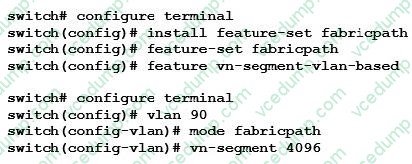
Refer to the exhibit. Which type of domain does the configuration create?
A. Layer 3 local
B. Layer 2 global
C. Layer 3 global
D. Layer 2 local -
Question 246:
Refer to the exhibit. Which fabric-provided MAC address does the switch use when connecting to an end node on VSAN 9?
A. 40.15.18.5e.ff.01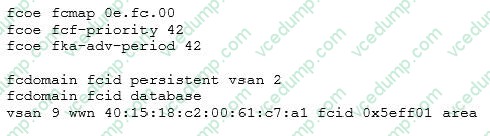
B. 0e.fc.00.5e.ff.01
C. 5e.ff.01.0e.fc.00
D. 40.15.18.oe.fc.00 -
Question 247:
DRAG DROP
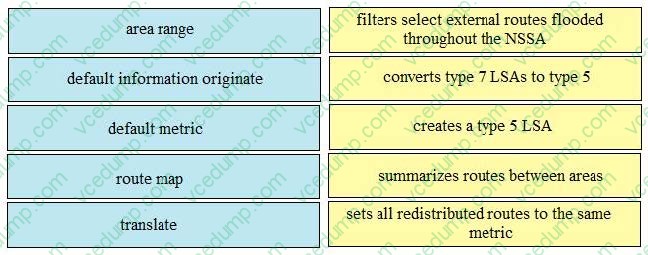
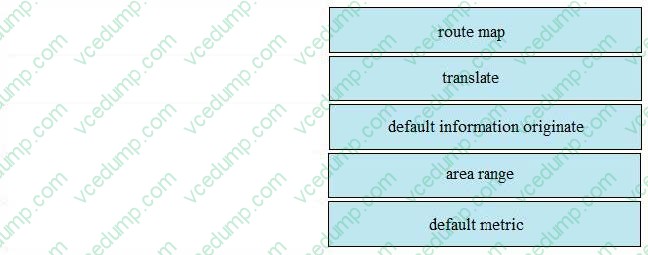
Drag and drop the optional OSPF parameters from the left onto the correct functions on the right.
Select and Place:
-
Question 248:
Refer to the exhibit.

What is the result when you run the force command?
A. Port channel mode uses force mode.
B. The command forces the addition of a port to a SAN port channel.
C. The port is enabled and active.
D. The command forces the deletion of a port from a SAN port channel. -
Question 249:

Refer to the exhibit. Which action does the switch take when a security violation occurs on Ethernet 2/1?
A. drops all the packets and then increments the security violation count
B. places the port in an error disabled state
C. shuts down the port
D. drops all the packets without incrementing the security violation count -
Question 250:
Which two PIM modes on a Cisco Nexus 7000 Series switch require you to configure an RP? (Choose two.)
A. SDM
B. DM
C. ASM
D. SSM
E. BIDIR
Related Exams:
-
300-745
Designing Cisco Security Infrastructure (300-745 SDSI) v1.0 -
350-101
Implementing and Operating Cisco Wireless Core Technologies (350-101 WLCOR)v1.0 -
352-011
Cisco Certified Design Expert Practical -
500-052
Cisco Unified Contact Center Express -
500-173
Designing the FlexPod Solution (FPDESIGN) -
500-201
Deploying Cisco Service Provider Mobile Backhaul Solutions -
500-210
SP Optical Technology Field Engineer Representative -
500-220
Engineering Cisco Meraki Solutions (ECMS) v2.2 -
500-230
Cisco Service Provider Routing Field Engineer -
500-240
Cisco Mobile Backhaul for Field Engineers
Tips on How to Prepare for the Exams
Nowadays, the certification exams become more and more important and required by more and more enterprises when applying for a job. But how to prepare for the exam effectively? How to prepare for the exam in a short time with less efforts? How to get a ideal result and how to find the most reliable resources? Here on Vcedump.com, you will find all the answers. Vcedump.com provide not only Cisco exam questions, answers and explanations but also complete assistance on your exam preparation and certification application. If you are confused on your 300-165 exam preparations and Cisco certification application, do not hesitate to visit our Vcedump.com to find your solutions here.