300-165 Exam Details
-
Exam Code
:300-165 -
Exam Name
:Implementing Cisco Data Center Infrastructure -
Certification
:Cisco Certifications -
Vendor
:Cisco -
Total Questions
:328 Q&As -
Last Updated
:Dec 15, 2021
Cisco 300-165 Online Questions & Answers
-
Question 221:
Which two options are limitations of NetFlow Version 5? (Choose two.)
A. no support for IPv6, Layer 2, or MPLS fields
B. fixed field specifications
C. excessive network utilization
D. analyzes all packets on the interface -
Question 222:
Which three attributes encompass a local user account on a Cisco NX-OS device? (Choose three.)
A. expiration date
B. cisco-avpair
C. password
D. AAA server address
E. user roles
F. bind user DN
G. user privileges -
Question 223:
You have a Cisco FabricPath network. You must implement vPC+ for a downstream switch. Which three actions should you perform? (Choose three.)
A. Configure the switch ID on the peer switches.
B. Configure a peer keepalive between the peer switches.
C. Connect the downstream switch to a 10-Gb port.
D. Configure the upstream switch to use PagP on EtherChannel.
E. Establish a peer link between the peer switches.
F. Configure the downstream switch to use PagP on EtherChannel. -
Question 224:
Instructions
This task does not require device configuration.
Click Cisco Nexus 5548 to gain console access. No console or enable passwords are required.
To access the multiple-choice questions, click the numbered boxes on the left of the top panel.
There are four multiple-choice questions with this task.
Scenario
Customer is deploying Cisco Nexus 5548 switch with FCoE in their new data center, as shown in the topology diagram. Click Nexus5548 icon to run show commands and answer the questions.
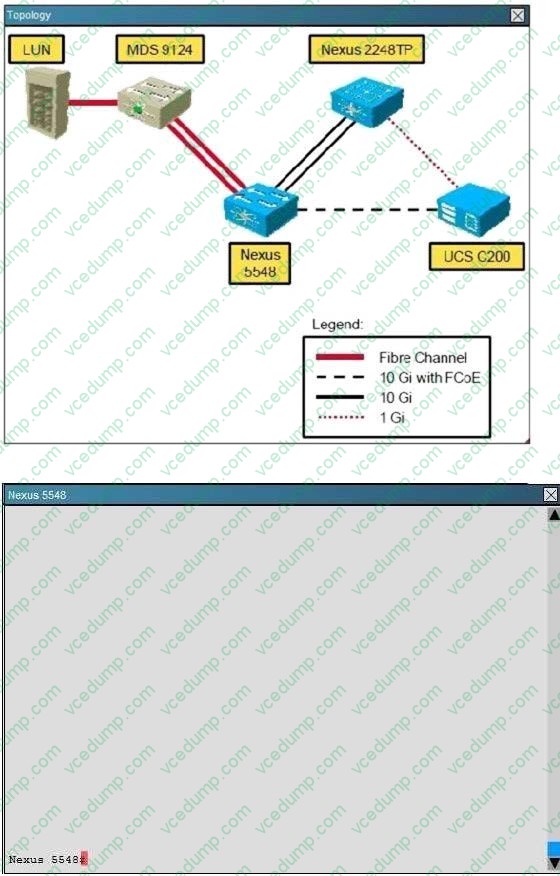
Ethernet interface 1/5 on Cisco Nexus 5548 is connected to Cisco UCS C220 rack server. What is the status of Ethernet 1/5 interface for FCoE functionality?
A. Interface reset on Ethernet 1/5 is preventing the FCoE connection from coming up
B. MTU size of 1500 on Ethernet interface 1/5 needs to be changed for FCoE to come UP
C. Cisco Nexus 5548 needs a layer 3 daughter card for FCoE to come UP on the Ethernet interface 1/5
D. Ethernet interface 1/5 is operational for FCoE and the status is UP -
Question 225:
Which three options are CallHome predefined destination profiles that are supported on Cisco NX-OS? (Choose three.)
A. CiscoTAC-1
B. full-text-destination
C. pager-xml-destination
D. short-text-destination
E. xml-text-destination
F. pager-json-destination -
Question 226:
Instructions
This task does not require device configuration.
Click Cisco Nexus 5548 to gain console access. No console or enable passwords are required.
To access the multiple-choice questions, click the numbered boxes on the left of the top panel.
There are four multiple-choice questions with this task.
Scenario
Customer is deploying Cisco Nexus 5548 switch with FCoE in their new data center, as shown in the topology diagram. ClickNexus 5548 icon to run show commands and answer the questions.
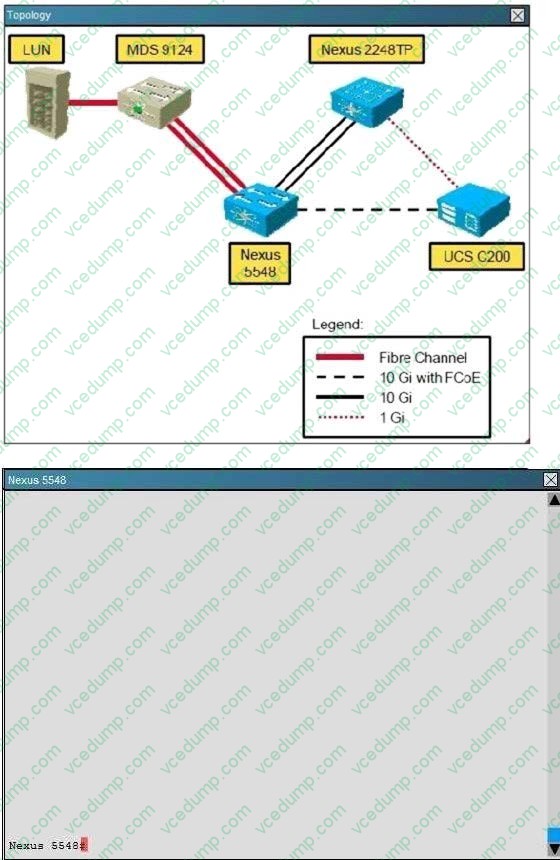
What is the status of FCoE license on Cisco Nexus 5548 switch?
A. FCoE license is not installed B. FCoE license is installed, but it is expired
C. FCoE license is installed and status is enabled
D. FCoE license does not need to be installed because it is part of ENTERPRISE_PKG -
Question 227:
Which two statements about Cisco Nexus 7000 line cards are true? (Choose two.)
A. M1, M2, and F1 cards are allowed in the same VDC.
B. M line cards are service-oriented and likely face the access layer and provide Layer 2 connectivity.
C. F line cards are performance-oriented and likely connect northbound to the core layer for Layer 3 connectivity.
D. M line cards support Layer 2, Layer 3, and Layer 4 with large forwarding tables and a rich feature set.
E. The F2 line card must reside in the admin VDC. -
Question 228:
In the dynamic vNIC creation wizard, why are choices for Protection important?
A. They allow reserve vNICs to be allocated out of the spares pool.
B. They enable hardware-based failover.
C. They select the primary fabric association for dynamic vNICs.
D. They allow dynamic vNICs to be reserved for fabric failover. -
Question 229:
Which statement accurately describes EPLD upgrades?
A. A system reboot is required after an EPLD upgrade
B. They should be performed only if advised by the Cisco TAC
C. EPLD upgrades apply only to supervisor modules
D. They are disruptive to the module to which they are applied -
Question 230:
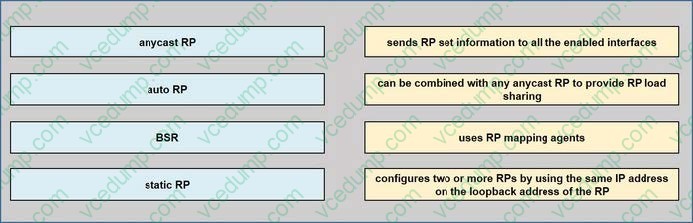
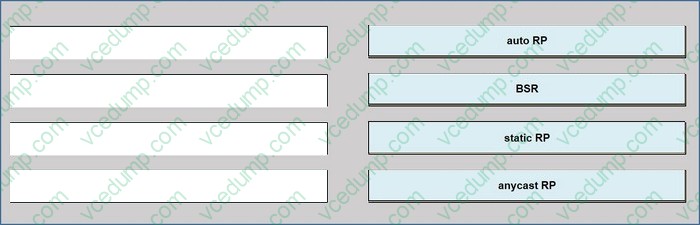
Drag and drop the RP mechanisms on the left to their correct redundancy implementations on the right.
Select and Place:
Related Exams:
-
300-745
Designing Cisco Security Infrastructure (300-745 SDSI) v1.0 -
350-101
Implementing and Operating Cisco Wireless Core Technologies (350-101 WLCOR)v1.0 -
352-011
Cisco Certified Design Expert Practical -
500-052
Cisco Unified Contact Center Express -
500-173
Designing the FlexPod Solution (FPDESIGN) -
500-201
Deploying Cisco Service Provider Mobile Backhaul Solutions -
500-210
SP Optical Technology Field Engineer Representative -
500-220
Engineering Cisco Meraki Solutions (ECMS) v2.2 -
500-230
Cisco Service Provider Routing Field Engineer -
500-240
Cisco Mobile Backhaul for Field Engineers
Tips on How to Prepare for the Exams
Nowadays, the certification exams become more and more important and required by more and more enterprises when applying for a job. But how to prepare for the exam effectively? How to prepare for the exam in a short time with less efforts? How to get a ideal result and how to find the most reliable resources? Here on Vcedump.com, you will find all the answers. Vcedump.com provide not only Cisco exam questions, answers and explanations but also complete assistance on your exam preparation and certification application. If you are confused on your 300-165 exam preparations and Cisco certification application, do not hesitate to visit our Vcedump.com to find your solutions here.