300-115 Exam Details
-
Exam Code
:300-115 -
Exam Name
:Implementing Cisco IP Switched Networks -
Certification
:Cisco Certifications -
Vendor
:Cisco -
Total Questions
:1076 Q&As -
Last Updated
:Dec 10, 2021
Cisco 300-115 Online Questions & Answers
-
Question 551:
Assuming that preempt is not configured, when does a router in an HSRP group assume the role of the active router for the group?
A. A router in standby status will become the active router if it has a higher priority than the active router.
B. A router in standby status will become the active router when it does not detect three consecutive hello messages from the active router.
C. A router in standby status will become the active router when it does not detect any hello messages from the active router within the configured hold time.
D. A router in listening status will become the active router when it does not detect any hello messages from the active router within the configured hold time. -
Question 552:
Which two characteristics apply to Cisco Catalyst 6500 Series Switch supervisor redundancy using NSF? (Choose two.)
A. supported by RIPv2, OSPF, IS-IS, and EIGRP
B. uses the FIB table
C. supports IPv4 and IPv6 multicast
D. prevents route flapping -
Question 553:
Which command prevents all access ports on a switch from sending or receiving BPDUs?
A. spanning-tree portfast bpduguard default
B. spanning-tree bpdufilter default
C. spanning-tree bpdufilter enable
D. spanning-tree portfast bpdufilter default -
Question 554:
Which configuration do you apply to a device to place interface GigabitEthernet0/0 info VRRP group 10?
A. interface GigabitEthernet0/0 ip address 172.16.13.2 265 255.255.0 standby 10 ip 172.16.13.254 255.255.255.0 standby 10 priority 120 standby 10 preempt
B. interface GigabitEthernet0/0 description to Executive Offices A 08-38338 ip address 172.16.13.2 265.255.255.0 vrrp 10 ip 172.16.13.254 255.255.255.0 vrrp 10 active
C. interface GigabitEthernet0/0 description to Executive Offices A 08-38338 ip address 172.16.13.2 255.255.250.0 vrrp group 10 ip 172.16.13.254 255.256.255.0 vrrp group 10 priority 120
D. interface GigabitEthernet0/0 ip address 172.16.13.2 255.255.255.0 vrrp 10 ip 172.16.13.254 vrrp 10 priority 120 vrrp 10 preempt
E. interface GigabitEthernet0/0 ip address 172.16.13.2 255.255.255.0 vrrp 10 ip 172.16.13.254 256.255.255.0 vrrp 10 priority 120 vrrp 10 preempt
F. interface GigabitEthernet0/0 ip address 172.16.13.2 255.255.255.0 standby 10 ip 172.16.13.254 -
Question 555:
Refer to the exhibit.
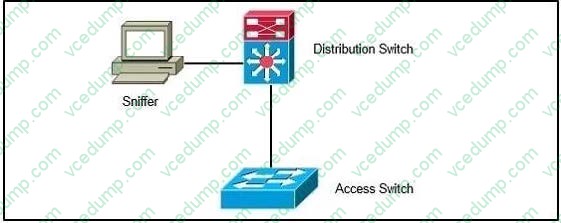
A network engineer wants to analyze all incoming and outgoing packets for an interface that is connected to an access switch. Which three items must be configured to mirror traffic to a packet sniffer that is connected to the distribution switch? (Choose three.)
A. A monitor session on the distribution switch with a physical interface as the source and the remote SPAN VLAN as the destination
B. A remote SPAN VLAN on the distribution and access layer switch
C. A monitor session on the access switch with a physical interface source and the remote SPAN VLAN as the destination
D. A monitor session on the distribution switch with a remote SPAN VLAN as the source and physical interface as the destination
E. A monitor session on the access switch with a remote SPAN VLAN source and the physical interface as the destination
F. A monitor session on the distribution switch with a physical interface as the source and a physical interface as the destination -
Question 556:
Which two DTP negotiated interface mode combinations negotiate to form an access port? (Choose two )
A. dynamic auto and dynamic auto
B. renegotiate and trunk
C. dynamic auto and trunk
D. dynamic desirable and access
E. dynamic desirable and dynamic auto -
Question 557:
Which switch feature determines validity based on IP-to-MAC address bindings that are stored in a trusted database?
A. Dynamic ARP Inspection
B. storm control
C. VTP pruning
D. DHCP snooping -
Question 558:
Refer to the exhibit.
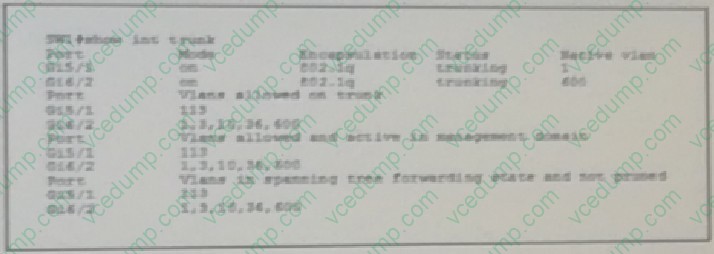
Which two statements about SW1 are true? (Choose two)
A. Interface Gi5/1 is using a Cisco proprietary trunking protocol
B. On Interface Gi5/1, all untagged traffic is tagged with VLAN 113
C. The device is configured with the default MST region
D. Interface Gi5/1 is using an industry-standard trunking protocol
E. Interface Gi6/2 is the root port for VLAN 36
F. On interface Gi6/2, all untagged traffic is tagged with VLAN 600 -
Question 559:
Which First Hop Redundancy Protocol is an IEEE Standard?
A. GLBP
B. HSRP
C. VRRP
D. OSPF -
Question 560:
A question about the port number and multicast address of VRRP. (CONCEPT ONLY)
A. VRRP uses multicast address 224.0.0.18 and uses UDP port 112.
Related Exams:
-
300-745
Designing Cisco Security Infrastructure (300-745 SDSI) v1.0 -
350-101
Implementing and Operating Cisco Wireless Core Technologies (350-101 WLCOR)v1.0 -
352-011
Cisco Certified Design Expert Practical -
500-052
Cisco Unified Contact Center Express -
500-173
Designing the FlexPod Solution (FPDESIGN) -
500-201
Deploying Cisco Service Provider Mobile Backhaul Solutions -
500-210
SP Optical Technology Field Engineer Representative -
500-220
Engineering Cisco Meraki Solutions (ECMS) v2.2 -
500-230
Cisco Service Provider Routing Field Engineer -
500-240
Cisco Mobile Backhaul for Field Engineers
Tips on How to Prepare for the Exams
Nowadays, the certification exams become more and more important and required by more and more enterprises when applying for a job. But how to prepare for the exam effectively? How to prepare for the exam in a short time with less efforts? How to get a ideal result and how to find the most reliable resources? Here on Vcedump.com, you will find all the answers. Vcedump.com provide not only Cisco exam questions, answers and explanations but also complete assistance on your exam preparation and certification application. If you are confused on your 300-115 exam preparations and Cisco certification application, do not hesitate to visit our Vcedump.com to find your solutions here.