2V0-21.23 Exam Details
-
Exam Code
:2V0-21.23 -
Exam Name
:VMware vSphere 8.x Professional -
Certification
:VMware Certifications -
Vendor
:VMware -
Total Questions
:216 Q&As -
Last Updated
:May 26, 2026
VMware 2V0-21.23 Online Questions & Answers
-
Question 191:
An administrator enables Secure Boot on an ESXi host. On booting the ESXi host, the following error message appears:
Fatal error: 39 (Secure Boot Failed)
A. The kernel has been tampered with.
B. The Trusted Platform Module chip has failed.
C. The administrator attempted to boot with a bootloader that is unsigned or has been tampered with.
D. A package (VIB or driver) has been tampered with. -
Question 192:
An administrator needs better performance and near-zero CPU utilization from the ESXI hosts for networking functions and processing. The administrator creates a new vSphere Distributed Switch and enables network offloads compatibility.
Which solution would help achieve this goal?
A. VSphere Distributed Services Engine
B. Data Processing Units (DPUs)
C. vSphere Network I/O Control
D. Universal Passthrough version 2 -
Question 193:
Which feature is a prerequisite for Proactive High Availability (HA)? (Choose the best answer.)
A. vCenter High Availability
B. vSAN Cluster
C. Predictive Distributive Resource Scheduler (DRS)
D. vSphere Distributive Resource Scheduler (DRS) -
Question 194:
An administrator is tasked with deploying a new on-premises software-defined data center (SDDC) that will contain a total of eight VMware vCenter instances.
The following requirements must be met:
All vCenter instances should be visible in a single vSphere Client session.
All vCenter inventory should be searchable from a single vSphere Client session.
Any administrator must be able to complete operations on any vCenter instance using a single set of credentials.
What should the administrator configure to meet these requirements?
A. Two Enhanced Linked Mode groups consisting of four vCenter instances each in a Single Sign-On domain.
B. A single Hybrid Linked Mode group consisting of four vCenter instances each in a Single Sign-On domain.
C. A single Enhanced Linked Mode group consisting of eight vCenter instances in one Single Sign-On domain.
D. A single Hybrid Linked Mode group consisting of eight vCenter instances in one Single Sign-On domain. -
Question 195:
An administrator adds an additional host to a cluster and is attempting to remediate the configuration with a host profile.
Which option would the administrator select on the host before it can be remediated with an existing host profile? (Choose the best answer.)
A. Export Host Customizations
B. Export Host Profile
C. Attach Host Profile
D. Copy Settings from Host -
Question 196:
An administrator plans to update the Supervisor cluster and has noticed some of the Tanzu Kubemetes Grid clusters are running an incompatible version.
Which action must the administrator take before proceeding with the Supervisor cluster update?
A. Update all Tanzu Kubernetes Grid clusters to the latest version prior to the Supervisor cluster update.
B. No action is needed - Tanzu Kubernetes Grid clusters will be updated automatically as part of the update process.
C. No action is needed - Incompatible Tanzu Kubernetes Grid clusters can be manually updated after the Supervisor cluster update.
D. Update incompatible Tanzu Kubernetes Grid clusters prior to the Supervisor cluster update. -
Question 197:
Refer to the exhibit.
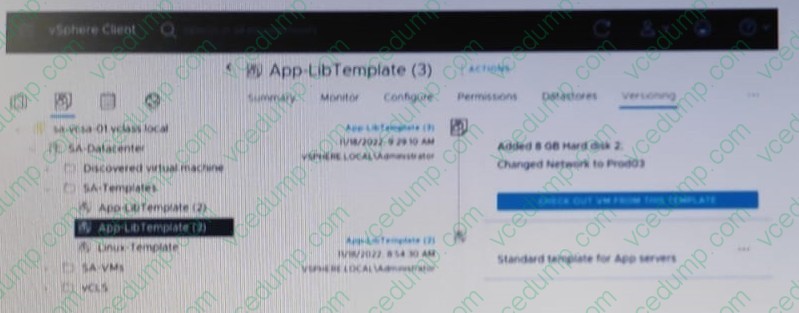
Given the configuration shown in the exhibit, what must the administrator do to delete only the latest version of the template?
A. Delete App-LibTemplete (3) from the SA-Templates folder.
B. In the SA-template folder, rename App-Libtemplate (2) to App-LibTemplate
C. Check out AppLibTemplate (3) and delete the template from the SA-Templates folder.
D. Revert to APP-LibTemplate (2) and delete App-LibTemplate (3). -
Question 198:
An administrator wants to be able to log in to the vSphere Client and view the inventories of two vCenter Server instances.
What must the administrator do to meet this requirement? (Choose the best answer.)
A. Configure Enhanced Linked Mode on each vCenter Server instance after deployment is complete.
B. Connect each vCenter Server instance to the same vCenter Single Sign-On domain during deployment.
C. Connect each vCenter Server instance to the same vCenter Single Sign-On domain using the vSphere Client.
D. Configure the vCenter Server Management Interface to view both vCenter Server instances. -
Question 199:
A development team has a recurring need to rapidly replicate hundreds of virtual machines (VMs) for load testing.
Which method should the team use to deploy the VMs? (Choose the best answer.)
A. Linked clones from a content library
B. Instant clones using the vSphere API
C. Full clones using vSphere Auto Deploy
D. Full clones from a template -
Question 200:
An administrator is tasked with looking into the disaster recovery (DR) options for a software-defined data center (SDDC).
The following requirements must be met:
All virtual machines (VMs) must be protected to a secondary site.
The source VMs must remain online until the failover.
When failing over to the secondary site, application downtime is allowed
The DR failover must be managed from the vSphere Client.
Costs must remain as low as possible.
How can the administrator accomplish this task?
A. Configure VMware Cloud Disaster Recovery (VCDR) and combine it with array-based storage replication
B. Configure VMware a Site Recovery Manager and combine it with vSphere Replication.
C. Configure a subscribed content library on the secondary site.
D. Configure VMware Site Recovery Manager and combine it with array-based storage replication.
Related Exams:
-
1V0-21.20
Associate VMware Data Center Virtualization -
1V0-31.21
Associate VMware Cloud Management and Automation -
1V0-41.20
Associate VMware Network Virtualization -
1V0-61.21
Associate VMware Digital Workspace -
1V0-71.21
Associate VMware Application Modernization -
1V0-81.20
Associate VMware Security -
2V0-11.24
VMware Cloud Foundation 5.2 Administrator -
2V0-11.25
VMware Cloud Foundation 5.2 Administrator -
2V0-13.24
VMware Cloud Foundation 5.2 Architect -
2V0-13.25
VMware Cloud Foundation 9.0 Architect
Tips on How to Prepare for the Exams
Nowadays, the certification exams become more and more important and required by more and more enterprises when applying for a job. But how to prepare for the exam effectively? How to prepare for the exam in a short time with less efforts? How to get a ideal result and how to find the most reliable resources? Here on Vcedump.com, you will find all the answers. Vcedump.com provide not only VMware exam questions, answers and explanations but also complete assistance on your exam preparation and certification application. If you are confused on your 2V0-21.23 exam preparations and VMware certification application, do not hesitate to visit our Vcedump.com to find your solutions here.