2V0-21.23 Exam Details
-
Exam Code
:2V0-21.23 -
Exam Name
:VMware vSphere 8.x Professional -
Certification
:VMware Certifications -
Vendor
:VMware -
Total Questions
:216 Q&As -
Last Updated
:May 26, 2026
VMware 2V0-21.23 Online Questions & Answers
-
Question 171:
Which TCP/IP stack can support management traffic, vSphere vMotion, IP storage and vSphere Fault Tolerance? (Choose the best answer.)
A. VXLAN TCP/IP stack
B. Provisioning TCP/IP stack
C. Default TCP/IP stack
D. vSphere vMotion TCP/IP stack -
Question 172:
In a vSphere High Availability (vSphere HA) cluster, which action does vSphere HA take when the VM Monitoring service does NOT receive heartbeats from a virtual machine (VM) in the cluster? (Choose the best answer.)
A. The VM is restarted on a different host in the cluster.
B. The VM is suspended on the same host in the cluster.
C. The VM is migrated to a different host in the cluster.
D. The VM is restarted on the same host in the cluster. -
Question 173:
An administrator is tasked with installing VMware vCenter. The vCenter Server Appliance must support an environment of:
400 hosts 4000 virtual machines
Which two resources must be allocated, at a minimum, to meet the requirements? (Choose two.)
A. 16 vCPUs
B. 30 GB Memory
C. 4 vCPUs
D. 8 vCPUs
E. 20 GB Memory -
Question 174:
An administrator is required to configure several Microsoft Windows virtual machines (VMs) to support Secure Boot for a critical secure application.
The following information is provided:
The corporate security policy states that all forms of data encryption must utilize a key provider.
The firmware of each VM is currently set to use Unified Extensible Firmware Interface (UEFI).
Due to the nature of the application running within the VMs, the guest operating system for each VM is currently a minimum of Windows Server 2008 and Windows 7.
Which security feature should the administrator implement to meet these requirements?
A. vSphere Virtual Machine Encryption
B. vSphere Visualization-Based Security
C. Virtual Intel Software Guard Extensions (vSGX)
D. Virtual Trusted Platform Module (vTPM) -
Question 175:
Which VMware offering will allow an administrator to manage the lifecycle of multiple vCenter Server instances in a single software as a service (SaaS)-based solution to help drive operational efficiency?
A. VMware vSphere with Tanzu
B. VMware Cloud Foundation
C. VMware vSphere+
D. VMware Aria Suite Lifecycle -
Question 176:
An administrator Is looking to deploy a new VMware vCenter Instance. The current environment consists of 75 hosts and is expected to grow up to 100 hosts over the next three years.
Which deployment size should the administrator select?
A. Medium
B. Tiny
C. Large
D. Small -
Question 177:
Refer to the exhibit.
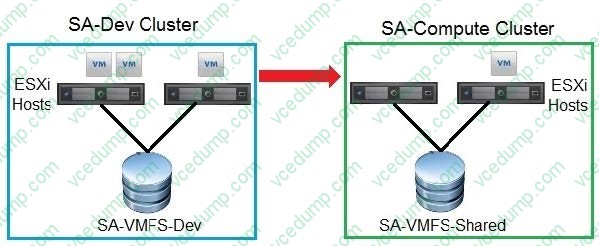
Which two migration methods can an administrator use to move virtual machines from the SA-Dev cluster to the SA-Compute cluster? (Choose two.)
A. Cold migration of compute resource only
B. Cold migration of storage only
C. Hot migration of compute resource and storage resource
D. Hot migration of compute resource only
E. Cold migration of compute resource and storage resource -
Question 178:
What are three options an administrator can configure after creating a vSphere Namespace? (Choose three.)
A. Backup schedule
B. Certificates
C. Storage policies
D. Update policies
E. Permissions
F. Resource and Object limits -
Question 179:
An administrator runs third-party software in a virtual machine (VM). The third-party licensing agreement requires payment of a license fee for each host to which the VM migrates.
How can the administrator configure Distributed Resource Scheduler (DRS) to minimize licensing costs? (Choose the best answer.)
A. Create a `Virtual Machines to Virtual Machines' dependency rule.
B. Create a `Virtual Machines to Virtual Machines' affinity rule.
C. Create a `Should run Virtual Machines to Hosts' anti-affinity rule.
D. Create a `Must run Virtual Machines to Hosts' affinity rule. -
Question 180:
A vSphere cluster hosts a three-tier application. The cluster has 50% resources available. If a host in the cluster fails, the database server must be online before the application server, and the application server must be online before the Web server.
Which feature can be used to meet these requirements?
A. Predictive DRS
B. vSphere HA Orchestrated Restart
C. vSphere HA Restart Priority
D. Proactive HA
Related Exams:
-
1V0-21.20
Associate VMware Data Center Virtualization -
1V0-31.21
Associate VMware Cloud Management and Automation -
1V0-41.20
Associate VMware Network Virtualization -
1V0-61.21
Associate VMware Digital Workspace -
1V0-71.21
Associate VMware Application Modernization -
1V0-81.20
Associate VMware Security -
2V0-11.24
VMware Cloud Foundation 5.2 Administrator -
2V0-11.25
VMware Cloud Foundation 5.2 Administrator -
2V0-13.24
VMware Cloud Foundation 5.2 Architect -
2V0-13.25
VMware Cloud Foundation 9.0 Architect
Tips on How to Prepare for the Exams
Nowadays, the certification exams become more and more important and required by more and more enterprises when applying for a job. But how to prepare for the exam effectively? How to prepare for the exam in a short time with less efforts? How to get a ideal result and how to find the most reliable resources? Here on Vcedump.com, you will find all the answers. Vcedump.com provide not only VMware exam questions, answers and explanations but also complete assistance on your exam preparation and certification application. If you are confused on your 2V0-21.23 exam preparations and VMware certification application, do not hesitate to visit our Vcedump.com to find your solutions here.