200-101 Exam Details
-
Exam Code
:200-101 -
Exam Name
:Interconnecting Cisco Networking Devices Part 2 (ICND2) -
Certification
:Cisco Certifications -
Vendor
:Cisco -
Total Questions
:149 Q&As -
Last Updated
:Dec 14, 2021
Cisco 200-101 Online Questions & Answers
-
Question 61:
Which two statements about the OSPF Router ID are true? (Choose two.)
A. It identifies the source of a Type 1 LSA.
B. It should be the same on all routers in an OSPF routing instance.
C. By default, the lowest IP address on the router becomes the OSPF Router ID.
D. The router automatically chooses the IP address of a loopback as the OSPF Router ID.
E. It is created using the MAC Address of the loopback interface. -
Question 62:
The output of the show frame-relay pvc command shows "PVC STATUS = INACTIVE". What does this mean?
A. The PVC is configured correctly and is operating normally, but no data packets have been detected for more than five minutes.
B. The PVC is configured correctly, is operating normally, and is no longer actively seeking the address of the remote router.
C. The PVC is configured correctly, is operating normally, and is waiting for interesting traffic to trigger a call to the remote router.
D. The PVC is configured correctly on the local switch, but there is a problem on the remote end of the PVC.
E. The PVC is not configured on the local switch. -
Question 63:
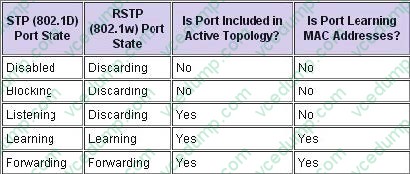
Which port state is introduced by Rapid-PVST?
A. learning
B. listening
C. discarding
D. forwarding -
Question 64:
Which term describes a spanning-tree network that has all switch ports in either the blocking or fowarding state?
A. converged
B. redundant
C. provisioned
D. spanned -
Question 65:
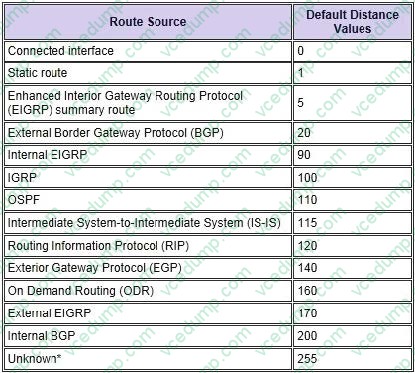
Which parameter would you tune to affect the selection of a static route as a backup, when a dynamic protocol is also being used?
A. hop count
B. administrative distance
C. link bandwidth
D. link delay
E. link cost -
Question 66:
What are two characteristics of a switch that is configured as a VTP client? (Choose two.)
A. If a switch that is configured to operate in client mode cannot access a VTP server, then the switch reverts to transparent mode.
B. On switches that are configured to operate in client mode, VLANs can be created, deleted, or renamed locally.
C. The local VLAN configuration is updated only when an update that has a higher configuration revision number is received.
D. VTP advertisements are not forwarded to neighboring switches that are configured in VTP transparent mode.
E. VTP client is the default VTP mode.
F. When switches in VTP client mode are rebooted, they send a VTP advertisement request to the VTP servers. -
Question 67:
What are two benefits of using a single OSPF area network design? (Choose two.)
A. It is less CPU intensive for routers in the single area.
B. It reduces the types of LSAs that are generated.
C. It removes the need for virtual links.
D. It increases LSA response times.
E. It reduces the number of required OSPF neighbor adjacencies. -
Question 68:
What are three factors a network administrator must consider before implementing Netflow in the network? (Choose three.)
A. CPU utilization
B. where Netflow data will be sent
C. number of devices exporting Netflow data
D. port availability
E. SNMP version
F. WAN encapsulation -
Question 69:
Which statement describes VRRP object tracking?
A. It monitors traffic flow and link utilization.
B. It ensures the best VRRP router is the virtual router master for the group.
C. It causes traffic to dynamically move to higher bandwidth links.
D. It thwarts man-in-the-middle attacks. -
Question 70:
What information does a router running a link-state protocol use to build and maintain its topological database? (Choose two.)
A. hello packets
B. SAP messages sent by other routers
C. LSAs from other routers
D. beacons received on point-to-point links
E. routing tables received from other link-state routers
F. TTL packets from designated routers
Related Exams:
-
300-745
Designing Cisco Security Infrastructure (300-745 SDSI) v1.0 -
350-101
Implementing and Operating Cisco Wireless Core Technologies (350-101 WLCOR)v1.0 -
352-011
Cisco Certified Design Expert Practical -
500-052
Cisco Unified Contact Center Express -
500-173
Designing the FlexPod Solution (FPDESIGN) -
500-201
Deploying Cisco Service Provider Mobile Backhaul Solutions -
500-210
SP Optical Technology Field Engineer Representative -
500-220
Engineering Cisco Meraki Solutions (ECMS) v2.2 -
500-230
Cisco Service Provider Routing Field Engineer -
500-240
Cisco Mobile Backhaul for Field Engineers
Tips on How to Prepare for the Exams
Nowadays, the certification exams become more and more important and required by more and more enterprises when applying for a job. But how to prepare for the exam effectively? How to prepare for the exam in a short time with less efforts? How to get a ideal result and how to find the most reliable resources? Here on Vcedump.com, you will find all the answers. Vcedump.com provide not only Cisco exam questions, answers and explanations but also complete assistance on your exam preparation and certification application. If you are confused on your 200-101 exam preparations and Cisco certification application, do not hesitate to visit our Vcedump.com to find your solutions here.