200-101 Exam Details
-
Exam Code
:200-101 -
Exam Name
:Interconnecting Cisco Networking Devices Part 2 (ICND2) -
Certification
:Cisco Certifications -
Vendor
:Cisco -
Total Questions
:149 Q&As -
Last Updated
:Dec 14, 2021
Cisco 200-101 Online Questions & Answers
-
Question 71:
Refer to the exhibit.
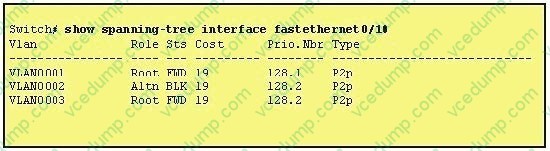
Given the output shown from this Cisco Catalyst 2950, what is the reason that interface FastEthernet 0/10 is not the root port for VLAN 2?
A. This switch has more than one interface connected to the root network segment in VLAN 2.
B. This switch is running RSTP while the elected designated switch is running 802.1d Spanning Tree.
C. This switch interface has a higher path cost to the root bridge than another in the topology.
D. This switch has a lower bridge ID for VLAN 2 than the elected designated switch. -
Question 72:
Refer to the exhibit.
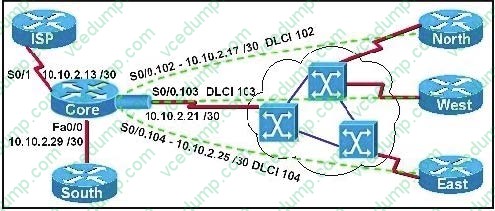
The network associate is configuring OSPF on the Core router. All the connections to the branches should be participating in OSPF. The link to the ISP should NOT participate in OSPF and should only be advertised as the default route. What set of commands will properly configure the Core router?
A. Core(config-router)# default-information originate Core(config-router)# network 10.0.0.0 0.255.255.255 area 0 Core(config-router)# exit Core(config)# ip route 0.0.0.0 0.0.0.0 10.10.2.14
B. Core(config-router)# default-information originate Core(config-router)# network 10.10.2.13 0.0.0.242 area 0 Core(config-router)# exit Core(config)# ip route 0.0.0.0 0.0.0.0 10.10.2.14
C. Core(config-router)# default-information originate Core(config-router)# network 10.10.2.16 0.0.0.15 area 0 Core(config-router)# exit Core(config)# ip route 0.0.0.0 0.0.0.0 10.10.2.14
D. Core(config-router)# default-information originate Core(config-router)# network 10.10.2.32 0.0.0.31 area 0 Core(config-router)# exit Core(config)# ip route 0.0.0.0 0.0.0.0 10.10.2.14 -
Question 73:
Refer to the exhibit.
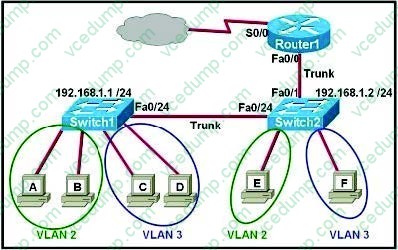
Which two statements are true about interVLAN routing in the topology that is shown in the exhibit? (Choose two.)
A. Host E and host F use the same IP gateway address.
B. Router1 and Switch2 should be connected via a crossover cable.
C. Router1 will not play a role in communications between host A and host D.
D. The FastEthernet 0/0 interface on Router1 must be configured with subinterfaces.
E. Router1 needs more LAN interfaces to accommodate the VLANs that are shown in the exhibit.
F. The FastEthernet 0/0 interface on Router1 and the FastEthernet 0/1 interface on Switch2 trunk ports must be configured using the same encapsulation type. -
Question 74:
Refer to the exhibit.
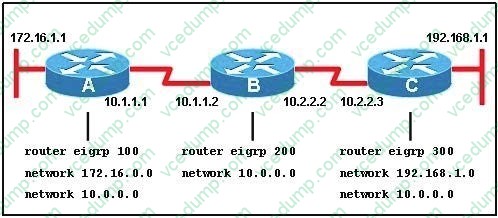
When running EIGRP, what is required for RouterA to exchange routing updates with RouterC?
A. AS numbers must be changed to match on all the routers
B. Loopback interfaces must be configured so a DR is elected
C. The no auto-summary command is needed on Router A and Router C
D. Router B needs to have two network statements, one for each connected network -
Question 75:
What are two enhancements that OSPFv3 supports over OSPFv2? (Choose two.)
A. It requires the use of ARP.
B. It can support multiple IPv6 subnets on a single link.
C. It supports up to 2 instances of OSPFv3 over a common link.
D. It routes over links rather than over networks. -
Question 76:
Scenario
Refer to the topology. Your company has connected the routers R1. R2. and R3 with serial links. R2 and R3 are connected to the switches SW1 and SW2, respectively. SW1 and SW2 are also connected to the routers R4 and R5.
The EIGRP routing protocol is configured.
You are required to troubleshoot and resolve the EIGRP issues between the various routers.
Use the appropriate show commands to troubleshoot the issues.
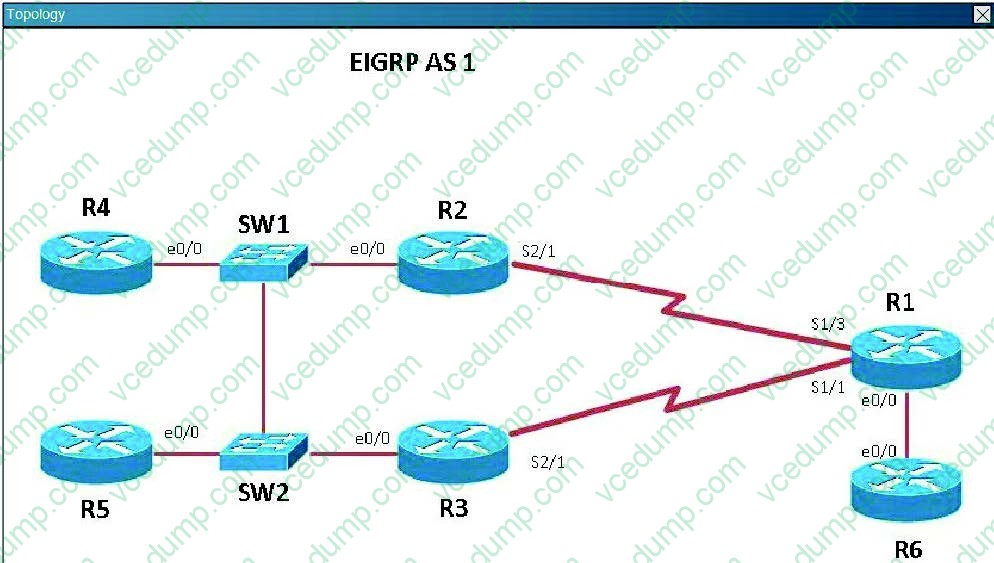
Study the following output taken on R1: R1# Ping 10.5.5.55 source 10.1.1.1
Type escape sequence to abort.
Sending 5.100-byte ICMP Echos to 10.5.5.55, timeout is 2 seconds:
Packet sent with a source address of 10.1.1.1
Why are the pings failing?
A. The network statement is missing on R5.
B. The loopback interface is shut down on R5.
C. The network statement is missing on R1.
D. The IP address that is configured on the Lo1 interface on R5 is incorrect. -
Question 77:
Which Layer 2 protocol encapsulation type supports synchronous and asynchronous circuits and has built-in security mechanisms?
A. HDLC B. PPP
C. X.25
D. Frame Relay -
Question 78:
Refer to the exhibit.
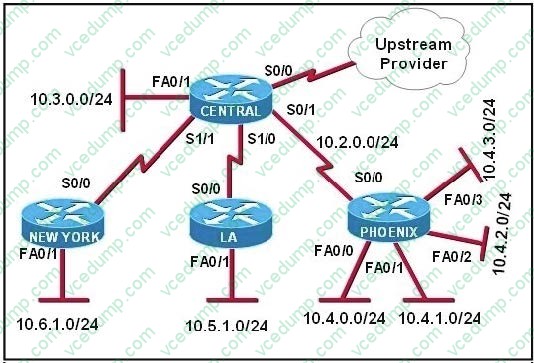
The Lakeside Company has the internetwork in the exhibit. The administrator would like to reduce the size of the routing table on the Central router. Which partial routing table entry in the Central router represents a route summary that represents the LANs in Phoenix but no additional subnets?
A. 10.0.0.0/22 is subnetted, 1 subnets D 10.0.0.0 [90/20514560] via 10.2.0.2, 6w0d, Serial0/1
B. 10.0.0.0/28 is subnetted, 1 subnets D 10.2.0.0 [90/20514560] via 10.2.0.2, 6w0d, Serial0/1
C. 10.0.0.0/30 is subnetted, 1 subnets D 10.2.2.0 [90/20514560] via 10.2.0.2, 6w0d, Serial0/1
D. 10.0.0.0/22 is subnetted, 1 subnets D 10.4.0.0 [90/20514560] via 10.2.0.2, 6w0d, Serial0/1
E. 10.0.0.0/28 is subnetted, 1 subnets D 10.4.4.0 [90/20514560] via 10.2.0.2, 6w0d, Serial0/1
F. 10.0.0.0/30 is subnetted, 1 subnets D 10.4.4.4 [90/20514560] via 10.2.0.2, 6w0d, Serial0/1 -
Question 79:
Refer to the exhibit.
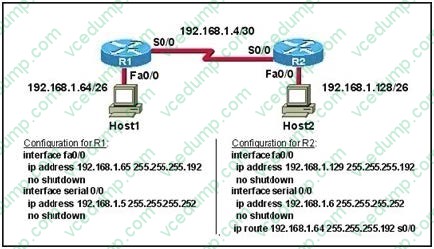
A technician pastes the configurations in the exhibit into the two new routers shown. Otherwise, the routers are configured with their default configurations. A ping from Host1 to Host2 fails, but the technician is able to ping the S0/0 interface of
R2 from Host1. The configurations of the hosts have been verified as correct.
What is the cause of the problem?
A. The serial cable on R1 needs to be replaced.
B. The interfaces on R2 are not configured properly.
C. R1 has no route to the 192.168.1.128 network.
D. The IP addressing scheme has overlapping subnetworks.
E. The ip subnet-zero command must be configured on both routers. -
Question 80:
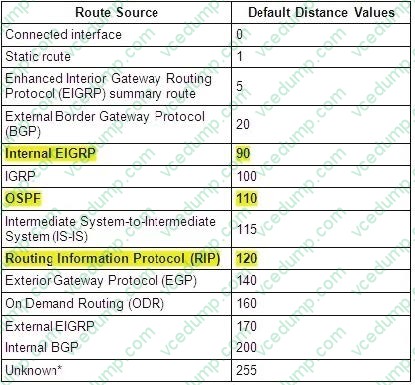
A router is running three routing processes: RIP, OSPF, and EIGRP, each configured with default characteristics. Each process learns a route to the same remote network.
If there are no static routes to the destination and none of the routes were redistributed, which route will be placed in the IP routing table?
A. the route learned through EIGRP
B. the route learned through OSPF
C. the route learned through RIP
D. the route with the lowest metric
E. all three routes with the router load balancing
Related Exams:
-
300-745
Designing Cisco Security Infrastructure (300-745 SDSI) v1.0 -
350-101
Implementing and Operating Cisco Wireless Core Technologies (350-101 WLCOR)v1.0 -
352-011
Cisco Certified Design Expert Practical -
500-052
Cisco Unified Contact Center Express -
500-173
Designing the FlexPod Solution (FPDESIGN) -
500-201
Deploying Cisco Service Provider Mobile Backhaul Solutions -
500-210
SP Optical Technology Field Engineer Representative -
500-220
Engineering Cisco Meraki Solutions (ECMS) v2.2 -
500-230
Cisco Service Provider Routing Field Engineer -
500-240
Cisco Mobile Backhaul for Field Engineers
Tips on How to Prepare for the Exams
Nowadays, the certification exams become more and more important and required by more and more enterprises when applying for a job. But how to prepare for the exam effectively? How to prepare for the exam in a short time with less efforts? How to get a ideal result and how to find the most reliable resources? Here on Vcedump.com, you will find all the answers. Vcedump.com provide not only Cisco exam questions, answers and explanations but also complete assistance on your exam preparation and certification application. If you are confused on your 200-101 exam preparations and Cisco certification application, do not hesitate to visit our Vcedump.com to find your solutions here.