200-101 Exam Details
-
Exam Code
:200-101 -
Exam Name
:Interconnecting Cisco Networking Devices Part 2 (ICND2) -
Certification
:Cisco Certifications -
Vendor
:Cisco -
Total Questions
:149 Q&As -
Last Updated
:Dec 14, 2021
Cisco 200-101 Online Questions & Answers
-
Question 41:
Refer to Exhibit: The internetwork infrastructure of company XYZ consists of a single OSPF area as shown in the graphic. There is concern that a lack of router resources is impeding internetwork performance. As part of examining the router resources, the OSPF DRs need to be known. All the router OSPF priorities are at the default and the router IDs are shown with each router. Which routers are likely to have been elected as DR? (Choose two.)
A. Corp-1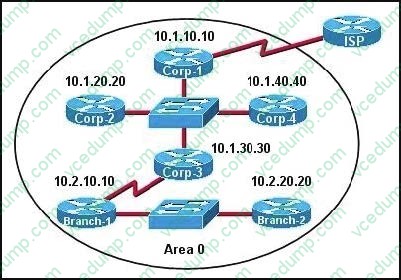
B. Corp-2
C. Corp-3
D. Corp-4
E. Branch-1
F. Branch-2 -
Question 42:
Scenario
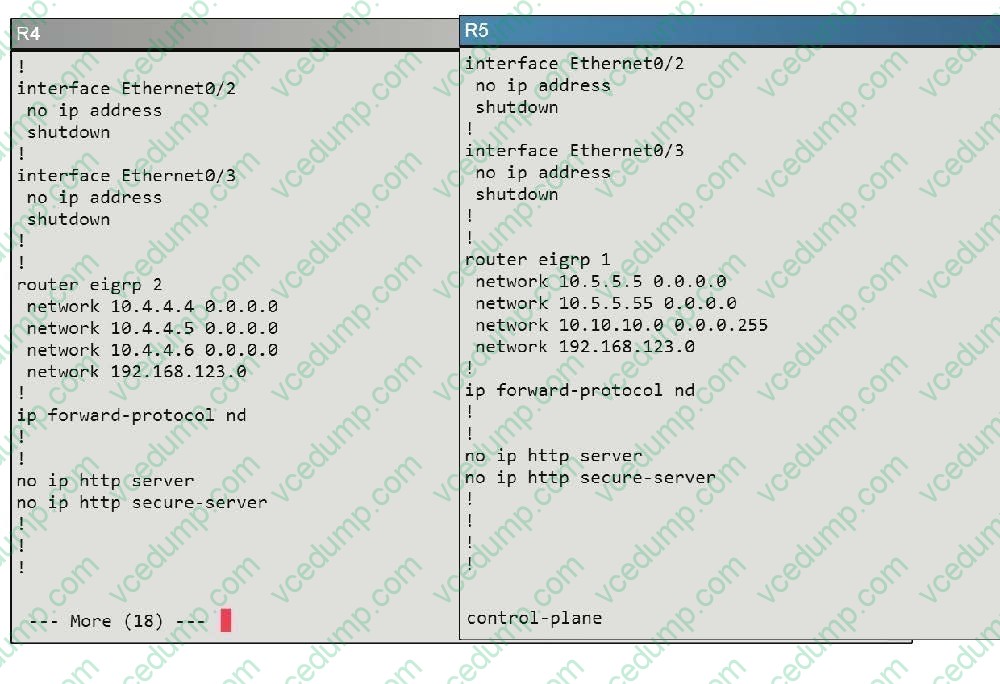
Refer to the topology. Your company has connected the routers R1. R2. and R3 with serial links. R2 and R3 are connected to the switches SW1 and SW2, respectively. SW1 and SW2 are also connected to the routers R4 and R5.
The EIGRP routing protocol is configured.
You are required to troubleshoot and resolve the EIGRP issues between the various routers.
Use the appropriate show commands to troubleshoot the issues.
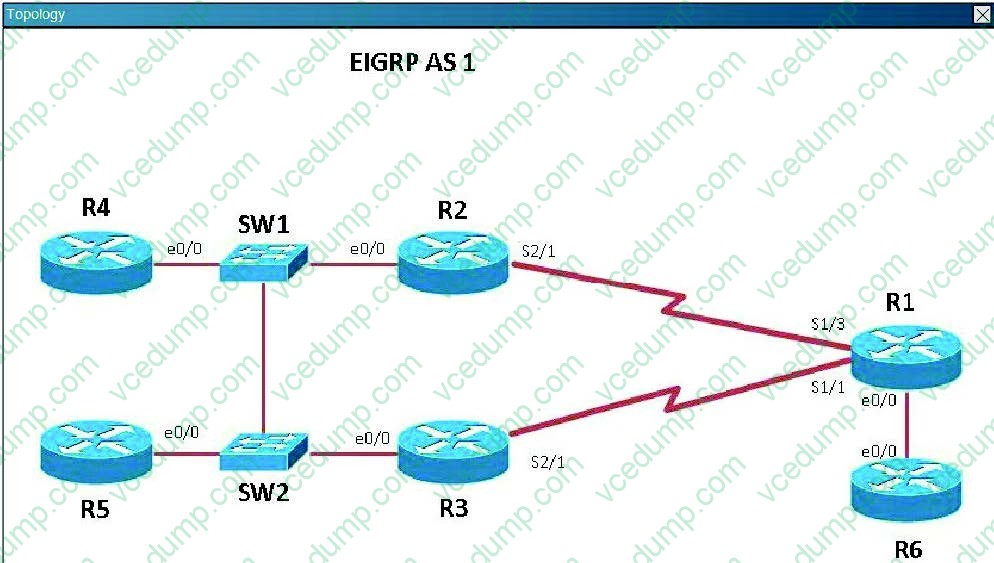
The loopback interfaces on R4 with the IP addresses of 10.4.4.4 /32, 10.4.4.5/32. and 10.4.4.6/32 are not appearing in the routing table of R5 Why are the interfaces missing?
A. The interfaces are shutdown, so they are not being advertised.
B. R4 has been incorrectly configured to be in another AS, so it does not peer with R5.
C. Automatic summarization is enabled, so only the 10.0.0.0 network is displayed.
D. The loopback addresses haven't been advertised, and the network command is missing on R4. -
Question 43:
Refer to the exhibit.
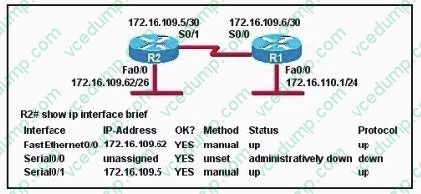
Assuming that the entire network topology is shown, what is the operational status of the interfaces of R2 as indicated by the command output shown?
A. One interface has a problem.
B. Two interfaces have problems.
C. The interfaces are functioning correctly.
D. The operational status of the interfaces cannot be determined from the output shown. -
Question 44:
Refer to the exhibit.
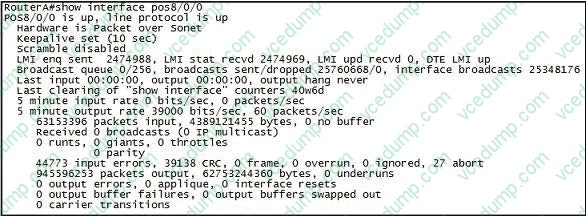
Which WAN protocol is being used?
A. ATM
B. HDLC
C. Frame Relay
D. PPP -
Question 45:
What is the purpose of LCP?
A. to perform authentication
B. to negotiate control options
C. to encapsulate multiple protocols
D. to specify asynchronous versus synchronous -
Question 46:
Which type of EIGRP route entry describes a feasible successor?
A. a backup route, stored in the routing table
B. a primary route, stored in the routing table
C. a backup route, stored in the topology table
D. a primary route, stored in the topology table -
Question 47:
Which two options are valid WAN connectivity methods? (Choose two.)
A. PPP
B. WAP
C. DSL
D. L2TPv3
E. Ethernet -
Question 48:
Which statement describes an EIGRP feasible successor route?
A. A primary route, added to the routing table
B. A backup route, added to the routing table
C. A primary route, added to the topology table
D. A backup route, added to the topology table -
Question 49:
What does a router do if it has no EIGRP feasible successor route to a destination network and the successor route to that destination network is in active status?
A. It routes all traffic that is addressed to the destination network to the interface indicated in the routing table.
B. It sends a copy of its neighbor table to all adjacent routers.
C. It sends a multicast query packet to all adjacent neighbors requesting available routing paths to the destination network.
D. It broadcasts Hello packets to all routers in the network to re-establish neighbor adjacencies. -
Question 50:
Which statement is true, as relates to classful or classless routing?
A. Classful routing protocols send the subnet mask in routing updates.
B. RIPv1 and OSPF are classless routing protocols.
C. Automatic summarization at classful boundaries can cause problems on discontiguous subnets.
D. EIGRP and OSPF are classful routing protocols and summarize routes by default.
Related Exams:
-
300-745
Designing Cisco Security Infrastructure (300-745 SDSI) v1.0 -
350-101
Implementing and Operating Cisco Wireless Core Technologies (350-101 WLCOR)v1.0 -
352-011
Cisco Certified Design Expert Practical -
500-052
Cisco Unified Contact Center Express -
500-173
Designing the FlexPod Solution (FPDESIGN) -
500-201
Deploying Cisco Service Provider Mobile Backhaul Solutions -
500-210
SP Optical Technology Field Engineer Representative -
500-220
Engineering Cisco Meraki Solutions (ECMS) v2.2 -
500-230
Cisco Service Provider Routing Field Engineer -
500-240
Cisco Mobile Backhaul for Field Engineers
Tips on How to Prepare for the Exams
Nowadays, the certification exams become more and more important and required by more and more enterprises when applying for a job. But how to prepare for the exam effectively? How to prepare for the exam in a short time with less efforts? How to get a ideal result and how to find the most reliable resources? Here on Vcedump.com, you will find all the answers. Vcedump.com provide not only Cisco exam questions, answers and explanations but also complete assistance on your exam preparation and certification application. If you are confused on your 200-101 exam preparations and Cisco certification application, do not hesitate to visit our Vcedump.com to find your solutions here.