1Z0-997 Exam Details
-
Exam Code
:1Z0-997 -
Exam Name
:Oracle Cloud Infrastructure 2019 Architect Professional -
Certification
:Oracle Certifications -
Vendor
:Oracle -
Total Questions
:76 Q&As -
Last Updated
:Jul 08, 2026
Oracle 1Z0-997 Online Questions & Answers
-
Question 61:
Your customer has gone through a recent departmental re structure. As part of this change, they are organizing their Oracle Cloud Infrastructure (OCI) compartment structure to align with the company's new organizational structure.
They have made the following change:
Compartment x Is moved, and its parent compartment is now compartment c.
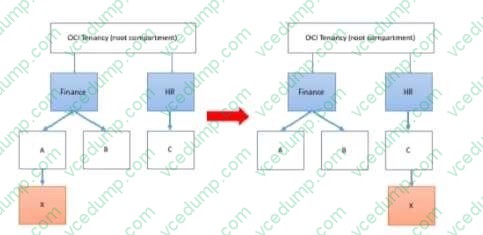
Policy defined in compartment A: Allow group networkadmins to manage subnets in compartment X Policy defined in root compartment: Allow group admins to read subnets in compartment Finance:A:X After the compartment move, which action will provide users of group networkadmins and admins with similar privileges as before the move?
A. Define a policy in Compartment C as follows: Allow group network admins to manage subnets in compartment X.
B. No change in any policy statement is required as compartments move automatically moves alt the policy statements associated with compartments as well.
C. Define a policy in compartment C as follows: Allow group admins to read subnets in compartment HR:C:X
D. Define a policy in compartment HR as follows: Allow group network admins to manage subnets in compartment X.
E. Define a policy in compartment C as follows Allow group admins to read subnets in compartment HR:C:X -
Question 62:
Which three scenarios are suitable for the Oracle Infrastructure (OCI) Autonomous transaction Processing Server less (ATP-S) deployment?
A. well established, online auction marketplace is running an application where there is database usage 24? but also has peaks of activity that the hard to predict when the peaks happen, the total activities may reach 3 times the normal activity level
B. A small startup is deploying a new application fen eCommerce and it requires database to store customers' transactions the team b of what the load will look like since it is a new application.
C. A midsize company is considering migrating its legacy on premises MongoDB database to Oracle Cloud Infrastructure (OCI). The database has significantly higher workloads on weekends than weekdays
D. A developer working on an Internal project needs to use a database during work hours but doesn't need It during nights or weekends. the project budget requires her to keep costs low.
E. A manufacturing company is running Oracle E-Business Suite application on premises. They are looking to move this application to OCI and they want to use a managed database offering for their database tier. -
Question 63:
You are working as a solutions architect for an online retail store In Frankfurt which uses multiple compute instance VMs spread among three availability domains In the eu-frankfurt-1 region.
You noticed the website Is having very high traffic, so you enabled autoscaling to sun tee me no f your application but, you observed that one of the availability domains is not receiving any traffic. What could be wrong In this situation?
A. Autoscaling only works with single availability domains.
B. You have to manually acid all three availability domains to your load balancer configuration.
C. Autoscaling can be enabled for multiple availability domains only in uk-london t region.
D. Autoscaling is using an Instance Pool configured to create instances in two availability Domains.
E. You forgot to attach a load balancer to your instance pool configuration. -
Question 64:
You are working as a solution architect with a global automotive provider who is looking to create a multi-cloud solution
They want to run their application tier in Microsoft Azure while utilizing the Oracle DB Systems In the Oracle Cloud Infrastructure (OCI).
What is the most fault tolerant and secure solution for this customer?
A. Create an Oracle database in OCI Virtual Cloud Network (VCN) and connect to the application tier running In Microsoft Azure over the Internet.
B. Create a FastConnect virtual circuit and choose Microsoft Azure from the list of providers available to setup Network connectivity between application tier running in Microsoft Azure Virtual Network and Oracle Databases running In OCI Virtual Cloud (VCN)
C. Use OCI Virtual Cloud Network remote peering connection to create connectivity among application tier running in Microsoft Azure Virtual Network and Oracle Databases running in OCI Virtual Cloud Network(VCN).
D. Create a VPN connection between the application tie, running in Azure Virtual Network and Oracle Databases running In OCI Virtual Cloud Network (VCN). -
Question 65:
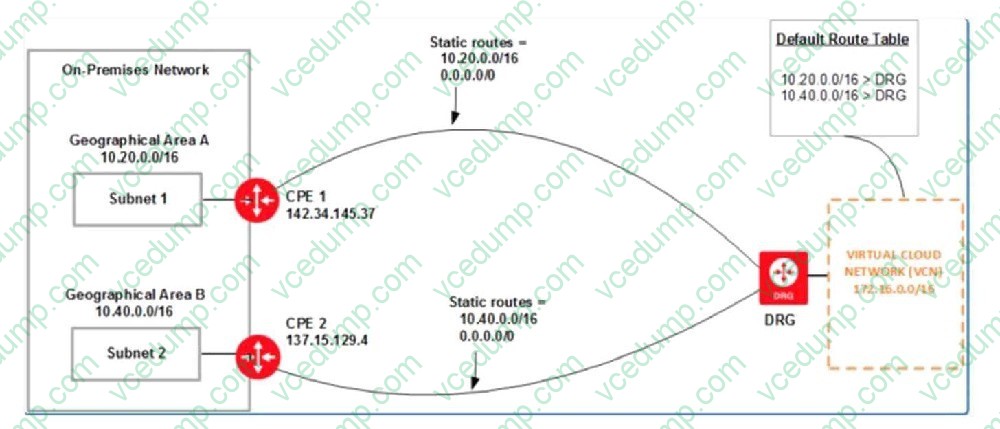
A retail company has several on-premises data centers which span multiple geographical locations. They plan to move some of their applications from on-premises data centers to Oracle Cloud Infrastructure (OCI). For these applications
running in OCI, they still need to interact with applications running on their on-premises data centers to Oracle Cloud Infrastructure (OCI). for these applications running in OCI. they still need to interact with applications running on their on-
premises data centers. These applications require highly available, fault-tolerant network connections between on premises data centers and OCI.
Which option should you recommend to provide the highest level of redundancy?
A. Oracle cloud Infrastructure provides network redundancy by default so that no other operations are required
B. If your data centers span multiple, geographical locations, use only the specific IP address as a static route for the specific geographical location
C. Set up both IPSec VPN and FastConnect to connect your on premises data centers to Oracle Cloud Infrastructure.
D. Use FastConnect private peering only to ensure secure access from your data center to Oracle Cloud Infrastructure
E. Set up a single IPSec VPN connection (rom your data center to Oracle Cloud Infrastructure since It is cost effective -
Question 66:
An online Stock trading application is deployed to multiple Availability Domains in the us phoenix-1 region. Considering the high volume of transactions that the trading application handles, the company has hired you to ensure that the data
stored by the application available, and disaster resilient. In the event of failure, the Recovery lime Objective (UK)) must be less than 2 hours to meet regulator requirements.
Which Disaster Recovery strategy should be used to achieve the RTO requirement In the event of system failure?
A. Configure hourly block volumes backups through the Storage Gateway service.
B. Configure hourly block volumes backups using the Oracle Cloud Infrastructure (OCI) Command Line Interface (CLI)
C. Store hourly block volumes backup to NVMe device under a compute instance and generate a custom Image every 5 minutes.
D. Configure your application to use synchronous master slave data replication between Availability Domains. -
Question 67:
You want to automate the processing of new Image files to generate thumbnails. the expected rate is 10 new files every hour. Which of the following is the most cost effective option to meet this requirement in Oracle Cloud Infrastructure (OCI)?
A. Upload files to an OCI Object storage bucket. Every time a file is uploaded, an event is emitted. Write a rule to filter these events with an action to trigger a function in Oracle Functions. The function processes the image in the file and stores the thumbnails back in an Object storage bucket.
B. Upload files to an OCI Object storage bucket. Every time a file is uploaded, trigger an event with an action to provision a compute instance with a cloud-init script to access the file, process it and store it back in an Object storage bucket. Terminate the instance using Autoscaling policy after the processing is finished.
C. Build a web application to ingest the files and save them to a NoSQL Database. Configure OCI Events service to trigger a notification using Oracle Notification Service (ONS). ONS invokes a custom application to process the image files to generate thumbnails. Store thumbnails in a NoSQL Database table.
D. Upload all files to an Oracle Streaming Service (OSS) stream. Set up a cron job to invoke a function in Oracle Functions to fetch data from the stream. Invoke another function to process the image files and generate thumbnails. Store thumbnails in another OSS stream. -
Question 68:
An organization has its IT infrastructure in a hybrid setup with an on-premises environment and an Oracle Cloud Infrastructure (OCI) Virtual Cloud Network (VCN) in the us-phonix-1 region. The on- premise applications communications with
compute instances inside the VPN over a hardware VPN connection. They are looking to implement an Intrusion detected and Prevention (IDS/IPS) system for their OCI environment. This platform should have the ability to scale to thousands
of compute of instances running inside the VCN.
How should they architect their solution on OCI to achieve this goal?
A. Set up an OCI Private Load Balance! and configure IDS/IPS related health checks at TCP and/or HTTP level to inspect traffic
B. Configure each host with an agent that collects all network traffic and sends that traffic to the IDS/IPS platform to inspection
C. There Is no need to implement an IPS/IDS system as traffic coming over IPSec VPN tunnels Is already encrypt
D. Configure autoscaling on a compute Instance pool and set vNIC to promiscuous mode to called traffic across the vcn and send it IDS/IPS platform for inspection. -
Question 69:
Which three options are available to migrate an Oracle database 12.x from an on-premises environment to Oracle Cloud Infrastructure (OCI)?
A. Leverage OCI Storage Gateway asynchronous database migration option.
B. Use Oracle Data Pump Export/Import to migrate the database.
C. Configure RMAN cross-platform transportable tablespace backup sets.
D. Setup OCI schema and data transfer tool with Bare Metal DB Systems as the target.
E. Create a backup of your on-premises database In OCI DB Systems. -
Question 70:
You are running a legacy application In a compute Instance on Oracle Cloud Infrastructure (OCI). To provide enough space for it to store internal data, a block volume is attached to the instance in paravirtualized mode. Your application is not resilient to crash-consistent backup. What should you do to securely backup the block volume?
A. Create a volume group, add the block volume and boot volume and then run the volume group backup.
B. Before creating a backup, save your application data and detach the block volume.
C. Create a backup, detach the block volume and save your application data.
D. Use the block volume clone feature to save cost and speed up the backup process.
Related Exams:
-
1Z0-020
Oracle8i: New Features for Administrators -
1Z0-023
Architecture and Administration -
1Z0-024
Performance Tuning -
1Z0-025
Backup and Recovery -
1Z0-026
Network Administration -
1Z0-034
Upgrade Oracle9i/10g OCA to Oracle Database OCP -
1Z0-036
Managing Oracle9i on Linux -
1Z0-041
Oracle Database 10g: DBA Assessment -
1Z0-052
Oracle Database 11g: Administration Workshop I -
1Z0-053
Oracle Database 11g: Administration II
Tips on How to Prepare for the Exams
Nowadays, the certification exams become more and more important and required by more and more enterprises when applying for a job. But how to prepare for the exam effectively? How to prepare for the exam in a short time with less efforts? How to get a ideal result and how to find the most reliable resources? Here on Vcedump.com, you will find all the answers. Vcedump.com provide not only Oracle exam questions, answers and explanations but also complete assistance on your exam preparation and certification application. If you are confused on your 1Z0-997 exam preparations and Oracle certification application, do not hesitate to visit our Vcedump.com to find your solutions here.