1Z0-997 Exam Details
-
Exam Code
:1Z0-997 -
Exam Name
:Oracle Cloud Infrastructure 2019 Architect Professional -
Certification
:Oracle Certifications -
Vendor
:Oracle -
Total Questions
:76 Q&As -
Last Updated
:Jul 08, 2026
Oracle 1Z0-997 Online Questions & Answers
-
Question 51:
You have deployed a web application targeting a global audience across multiple Oracle Cloud Infrastructure (OCI) regions.
You decide to use Traffic Management Geo-Location based Steering Policy to serve web requests to users from the region closets to the user. Within each region you have deployed a public load balancer with 4 servers in a backend set.
During a DR test disable all web servers in one of the regions however, traffic Management does not automatically direct all users to the other region.
Which two are possible causes?
A. You did not setup a Route Table associated with load Balancer's subnet
B. You did not setup an HTTP Health Check associated with Load Balancer public IP in the disabled region.
C. Rather than using Geo-Location based Steering Policy, you should use Failover Policy Type to serve traffic.
D. One of the two working web servers In the other region did not pass Its HTTP health check
E. You did not correctly setup the Load Balancer HTTP health check policy associated with backend set -
Question 52:
You have deployed a multi-tier application with multiple compute instances in Oracle Cloud Infrastructure. You want to back up these volumes and have decided to use Volume Group's feature. The Block volume and Compute instances exist
in different compartments within your tenancy. Periodically. a few child compartments are moved under different parent compartments, and you notice that sometimes volume group backup fails.
What could be the cause?
A. You are exceeding your volume group backup quota configured.
B. You have the same block volume attached to multiple compute instances; if these compute instances are in different compartments then all concerned compartments must be moved at the same time.
C. Compute instance with multiple block volumes attached cannot move when a compartment is moved.
D. The Identity and Access Management policy allowing backup failed to move when the compartment was moved. -
Question 53:
A large financial services company has used 2 types of Oracle DB Systems. In Oracle Cloud Infrastructure (OCI) to store user dat.
One is running on a VM.Standard2.8 shape and the other on a VM.Standard 2.4 shape.
As business grows, data is growing rapidly on both the databases and performance is also degrading.
The company wants to address this problem with a viable and economical solution.
As the solution architect for that company you have suggested that they move their databases to Autonomous Transaction Processing Serverless (ATP-S) database.
Which two factors should you consider before you arrived at that recommendation?
A. You verified that ATP S supports the database features and options currently being used by the 2 databases.
B. Validate that ATP-S will support the storage and processing requirements for the 2 databases over the life cycle of the business applications.
C. Confirm that ATP-S allows customers to compress tablespaces to reduce storage costs
D. Upon provisioning, ATP-S automatically scales up CPU to meet the application's processing requirements. -
Question 54:
You are currently working for a public health care company based in the United Stats. Their existing patient records runs in an on-premises data center and the customer is sending tape backups offsite as part of their recovery planning. You have developed an alternative archival solution using Oracle Cloud Infrastructure (OCI) that will save the company a significant amount of mom on a yearly basis. The solution involves storing data in an OCI Object Storage bucket After reviewing your solution with the customer global Compliance (GRC) team they have highlighted the following security requirements: All data less than 1 year old must be accessible within 2 hour. All data must be retained for at least 10 years and be accessible within 48 hours AH data must be encrypted at rest No data may be transmitted across the public Internet
Which two options meet the requirements outlined by the customer GRC team?
A. Provision a FastConnect link to the closest OCI region and configure a private peering virtual circuit.
B. Create an OCI Object Storage Standard tier bucket Configure a lifecycle policy to archive any object that Is older than 365 days
C. Create a VPN connection between your on premises data center and OCI. Create a Virtual Cloud Network (VCN) along with an OCI Service Gateway for OCI Object Storage.
D. Provision a FastConnect link to the closest OCI region and configure a public peering virtual circuit
E. Create an OCI Object Storage Standard tier bucket. Configure a lifecycle policy to delete any object that is older than 7 years -
Question 55:
A large financial company has a web application hosted in their on-premises data center. They are migrating their application to Oracle Cloud Infrastructure (OCI) and require no downtime while the migration is on-going. In order to achieve this, they have decided to divert only 30% of the application works fine, they divert all traffic to OCI. As a solution architect working with this customer, which suggestion should you provide them?
A. Use OCI Traffic management with failover steering policy and distribute the traffic between OC1 and on premises infrastructure.
B. Use OCI Traffic management with Load Balancing steering policy and distribute the traffic between OCI and on premises infrastructure.
C. Use an OCI load Balancer and distribute the traffic between OCI and on premises infrastructure.
D. Use VPN connectivity between on premises Infrastructure and OCI, and create routing tables to distribute the traffic between them. -
Question 56:
A company has an urgent requirement to migrate 300 TB of data to Oracle Cloud Infrastructure (OCI) In two weeks. Their data center has been recently struck by a massive hurricane and the building has been badly damaged, although still operational. They have a 100 Mbps Internet line but the connection is Intermittent due to the damages caused to the electrical grid in this scenario, what is the most effective service to use to migrate the data to OCI given the time constraints?
A. Setup a OCI Storage Gateway to connect your data center and your VCN. Once the connection has been established, upload all data to OCI using OCI Storage Gateway Cloud Sync tool.
B. Setup a hybrid network by launching aIGbpsFastConnect virtual circuit between your data center and OCI. Use OCI Object storage multipart upload tool to automate the migration of your data to OCI.
C. Use multiple OCI Data Transfer Appliances to transfer data to OCI.
D. Upload the data to OCI using OCI Object Storage multipart upload tool.
E. Storage Gateway to connect your data center and your VCN. Once the connection has been established, upload all data to OCI. -
Question 57:
You are tasked with migrating an online shopping website to Oracle Cloud Infrastructure (OCI) and decide to use a Load Balancer. You have configured the backend set with the round robin policy. During the testing phase, you noticed that
users are losing items from their shopping carts when they navigate to different pages.
How should you implement a solution to this problem?
A. Set up a Traffic Management Steering Policy to redirect traffic to a different backend set that is deployed exclusively for the purpose of holding all Items placed in the shopping cart.
B. Configure a set of path route rules that will route to different backend sets based on the URI requested by the customer's browser.
C. Replace the round robin policy with least connections policy at the backend set.
D. Set up session persistence at the Load Balancer backend set. -
Question 58:
An upcoming e-commerce company has deployed their online shopping application on OCI. The application was deployed on compute instances with autoscaling configuration for application servers fronted by a load balancer and OCI Autonomous Transaction Processing (ATP) in the backend. In order to promote their e-commerce platform 50% discount was announced on all the products for a limited period. During the day 1 of promotional period it was observed that the application is running slow and company's hotline is flooded with complaints. What could be two possible reasons for this situation?
A. The health check on some of the backend servers has failed and the load balancer has taken those servers temporarily out of rotation
B. As part of autoscaling, the load balancer shape has dynamically changed to a larger shape to handle more incoming traffic and the system was slow for a short time during this change
C. The health check on some of the backend servers has failed and the load balancer was rebooting these servers.
D. The autoscaling has already scaled to the maximum number of instances specified in the configuration and there is no room of scaling -
Question 59:
You are working with a social media company as a solution architect. The media company wants to collect and analyze large amounts of data being generated from their websites and social media feeds to gain insights and continuously
improve the user experience. In order to meet this requirement, you have developed a microservices application hosted on Oracle Container Engine for Kubernetes. The application will process the data and store the result to an Autonomous
Data Warehouse (ADW) instance.
Which Oracle Cloud Infrastructure (OCI) service can you use to collect and process a large volume of unstructured data in real time?
A. OCI Events
B. OCI Streaming
C. OCI Resource Manager
D. OCI Notifications -
Question 60:
You are the Solution Architect that designed this Oracle Cloud Infrastructure (OCI) compartment layout for your organization:
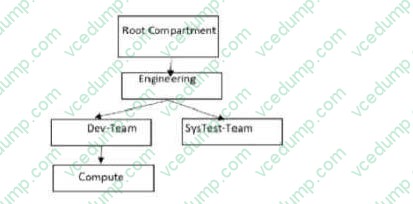
The development team has deployed quite a few instances under 'Compute' Compartment and the operations team needs to list the Instances under the same compartment for their testing. Both teams, development and operations are part of a group called 'Eng-group' You have been looking for an option to allow the operations team to list the instances without access any confidential information or metadata of resources. Which IAM policy should you write based on these requirements?
A. Allow group Eng-group to inspect instance-family in compartment Dev-Team:Compute and attach the policy to `Engineering' Compartment
B. Allow group Eng-group to inspect instance-family in compartment Dev-Team: Compute and attach the policy to 'SysTest Team' Compartment
C. Allow group Eng-group to read instance-family in compartment Compute and attach the policy to 'Engineering' Compartment.
D. Allow group Eng-group to read instance-family in compartment Dev-Team-.Compute and attach the policy to'Dev-Team'
Related Exams:
-
1Z0-020
Oracle8i: New Features for Administrators -
1Z0-023
Architecture and Administration -
1Z0-024
Performance Tuning -
1Z0-025
Backup and Recovery -
1Z0-026
Network Administration -
1Z0-034
Upgrade Oracle9i/10g OCA to Oracle Database OCP -
1Z0-036
Managing Oracle9i on Linux -
1Z0-041
Oracle Database 10g: DBA Assessment -
1Z0-052
Oracle Database 11g: Administration Workshop I -
1Z0-053
Oracle Database 11g: Administration II
Tips on How to Prepare for the Exams
Nowadays, the certification exams become more and more important and required by more and more enterprises when applying for a job. But how to prepare for the exam effectively? How to prepare for the exam in a short time with less efforts? How to get a ideal result and how to find the most reliable resources? Here on Vcedump.com, you will find all the answers. Vcedump.com provide not only Oracle exam questions, answers and explanations but also complete assistance on your exam preparation and certification application. If you are confused on your 1Z0-997 exam preparations and Oracle certification application, do not hesitate to visit our Vcedump.com to find your solutions here.