1Z0-997 Exam Details
-
Exam Code
:1Z0-997 -
Exam Name
:Oracle Cloud Infrastructure 2019 Architect Professional -
Certification
:Oracle Certifications -
Vendor
:Oracle -
Total Questions
:76 Q&As -
Last Updated
:Jul 08, 2026
Oracle 1Z0-997 Online Questions & Answers
-
Question 31:
A retailer bank is currently hosting their mission critical customer application on-premises. The application has a standard 3 tier architecture -4 application servers process the incoming traffic and store application data in an Oracle Exadata
Database Server. The bank has recently has service disruption to other inter applications to they are looking to avoid this issue for their mission critical Customer Application.
Which Oracle Cloud Infrastructure services should you recommend as part of the DR solution?
A. OCI DNS Service' Public Load Balancer, Oracle Database Cloud Backup Service, Object Storage Service, Oracle Bare Metal Cloud Service, Oracle Bare Metal Cloud Service with GoldenGate, OCI Container Engines for Kubernetes, Oracle IPSec VPN
B. OCI Traffic Management, Private Load Balancer, Compute instances distributed across multiple Availability Domains and/or Fault Domains, Exadata Cloud Service with Data Guard, Oracle FastConnect, Object Storage, Database Cloud backup module
C. OCI Traffic Management, Public toad Balancer, Compute Instances distributed across multiple
D. OCI DNS Service, Load Balancer as a service using Public Load Balancer distributing traffic Compute Instance across multiple regions, Oracle RAC Database using Virtual Machines, Remote Peering connecting two VCNs in different regions. Exadata Cloud Service with GoldenGate FastConnect, Object Storage, Database Cloud backup module. -
Question 32:
A manufacturing company is planning to migrate their on-premises database to OCI and has hired you for the migration. Customer has provided following information regarding their existing onpremises database:
Database version, host operating system and version, database character set, storage for data staging, acceptable length of system outage.
What additional information do you need from customer in order to recommend a suitable migration method? Choose two
A. Elapsed time since database was last patched
B. On-premises host operating system and version
C. Number of active connections
D. Data types used in the on-premises database
E. Top 5 longest running queries -
Question 33:
You have designed and deployed your Autonomous Data Warehouse (ADW) such that it is accessible from your on-premises data center and servers running on both private and public networks in Oracle Cloud Infrastructure (OCI).
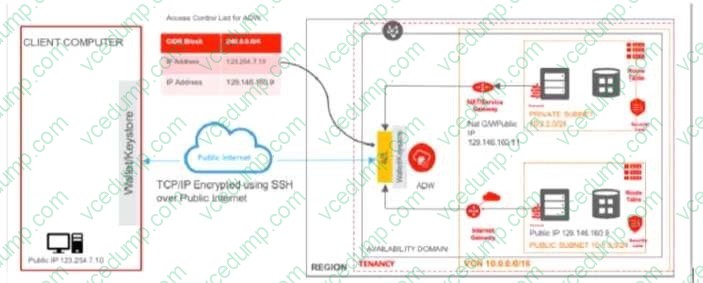
As you are testing the connectivity to your ADW database from the different access paths, you notice that the sewer lunninq on the private network is unable to connect to ADW. Which two steps do you need to take to enable connectivity from the server on the private network to ADW?
A. Add an entry in the Security List of the ADW allowing ingress traffic for C10R block 10.2.2.0/24
B. Add an entry in the route table (associated with the private subnet) with destination of 0.0.0.0/; target type of NAT Gateway, add a stateful egress rule to the security list (associated with the private subnet) with destination of 0.0.0.0./0 and for all IP protocols.
C. Add an entry in the access table list of ASW for CIDR block 10.2.2.0/24.
D. Add an entry in the route table (associated with the private subnet) with destination of 0.0.0.0./0; target type of internet Gateway, add a stateful egress in the security list (associated with the private subnet) with destination of 0.0.0.0/0 and for all IP protocols.
E. Add an entry in the access control list of ADW for IP address 129.146.160.11 -
Question 34:
Your organization is planning on using Oracle Cloud Infrastructure (OCI) File Storage Service (FSS). You will be deploying multiple compute instance in Oracle Cloud Infrastructure (OCI) and mounting the file system to these compute
instances. The file system will hold payment data processed by a Database instance and utilized by compute instances to create a overall inventory report. You need to restrict access to this data for specific compute instances and must be
allowed/blocked per compute instance's CIDR block.
Which option can you use to secure access?
A. Use stateless Security List rule to restrict access from known IP addresses only.
B. Create a new VCN security list, choose SOURCE TYPE as Service and SOURCE SERVICE as FSS. Add stateless ingress and egress rules for specific P address and CIDR blocks.
C. Use 'Export option' feature of FSS to restrict access to the mounted file systems.
D. Create and configure OCI Web Application Firewall service with built in DNS based intelligent routing. -
Question 35:
You are working as a solution architect for an online retail store to create a portal to allow the users to pay for their groceries using credit cards. Since the application is not fully compliant with the Payment Card Industry Data Security Standard (PCI DSS), your company is looking to use a third party payment service to process credit card payments. The third party service allows a maximum of Spelunk IP addresses 5 public IP addresses at a time However, your website is using Oracle Cloud Infrastructure (OCI) Instance Pool Auto Scaling policy to create up to create up to 15 Instances during peak traffic demand, which are launched In VCN private in VCN private subnets and attached to an OCI public Load Balancer. Upon user payment, the portal connects to the payment service over the Interne! to complete the transaction What solution can you implement to make sure that all compute Instances can connect to the third party system to process the payments aw peak traffic demand?
A. Route credit card payment request from the compute instances through the NAT Gateway. On the third-party services, whitest the public IP associated with the NAT Gateway.
B. Whitelist the Internet Gateway Public IP on the third party service and route all payment requests through the Internet Gateway.
C. Create an OCI Command Line Interface (CLI) script to automatically reserve public IP address for the compute instances. On the third services, whitelist the Reserved public IP.
D. Route payment request from the compute instances through the OCI Load Balancer, which will then be routed to the third party service. -
Question 36:
To serve web traffic for a popular product, your cloud engineer has provisioned four BM.Standard2.52 instances, event spread across two availability domains in the us-asburn-1 region:
LoadBalancer is used to deliver the traffic across instances. After several months, the product grows even more popular and you need additional compute capacity. As a result, an engineer provisioned two additional VM.Standard2.8
instances. You register the two VM. Standard2. 8 Instances with your load Balancer Backend sot and quickly find that the VM Standard2.8 Instances running at 100% of CPU utilization but the BM.Standard2 .52 instances have significant
CPU capacity that's unused. Which option is the most cost effective and uses instances capacity most effectively?
A. Configure your Load Balance, with weighted round robin policy to distribute traffic to the compute instances, with more weight assigned to bare metal instances.
B. Configure Autoscaling instance pool with LoadBalancer to add up to 3 more BM.Standard2.52 Instances when triggered. Shut off VM.Standard2.8 instances.
C. Route traffic to BM.Standard2.52 and VM Standard2.8 instances directly using DNS and Health Checks. Shut off the load Balances.
D. Configure LoadBalancer with two VM Standard2.8 instances and use Autoscalling Instant pool to add up to two additional VM instances. Shut off BM.Standard2.52 instances. -
Question 37:
Multiple departments In your company use a shared Oracle Cloud Infrastructure (OCI) tenancy to Implement their projects. You are in charge of managing the cost of OCI resources in the tenancy and need to obtain better Insights Into department's usage. Which three options can you implement together to accomplish this?
A. Create a budget that matches your commitment amount and an alert at 100 percent of the forecast
B. Set up a consolidated budget tracking lags to analyze costs in ,1 granular manner
C. Set up different compartments for each department then track and analyze cost per compartment
D. Use the billing cost tracking report to analyze costs
E. Set up a tag default that automatically applies tags to all specified resources created In a compartment then use these tags for cost analysis. -
Question 38:
An Oracle Cloud Infrastructure (OCI) Public Load Balancer's SSL certificate is expiring soon. You noticed the Load Balancer is configured with SSL Termination only. When the certificate expires, data traffic can be interrupted and security
compromised.
What steps do you need to take to prevent this situation?
A. Add the new SSL certificate to the Load Balancer, update backend servers to work with a new certificate and edit listeners so they can use the new certificate bundle.
B. Add the new SSL certificate to the Load Balancer, update listeners and backend sets so they can use the new certificate bundle.
C. Add the new SSL certificate to the Load Balancer and implement end to end SSL so it can encrypt the traffic from clients all the way to the backend servers.
D. Add the new SSL certificate to the Load Balancer and update backend servers to use the new certificate bundle.
E. Add the new SSL certificate to the Load Balancer and update listeners to use the new certificate bundle. -
Question 39:
Your team is conducting a root analysis (RCA) following a recent, unplanned outage. One of the block volumes attached to your production WebLogic server was deleted and you have tasked with identifying the source of the action. You search the Audit logs and find several Delete actions that occurred in the previous 24 hours. Given the sample of this event.
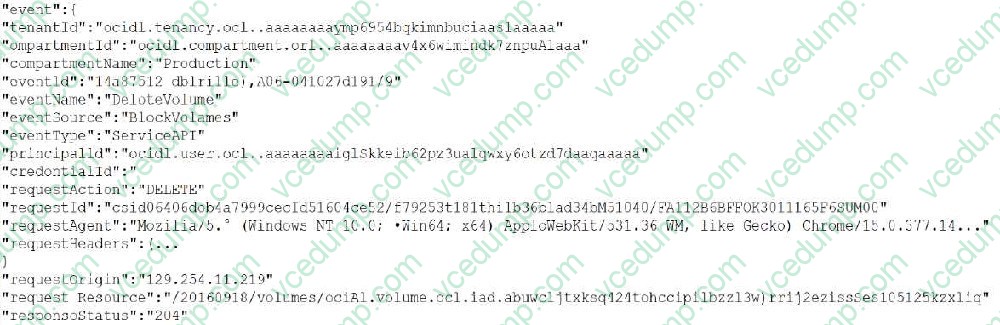
Which item from the event log helps you identify the individual or service that initiated the DeleteVolume API call?
A. requestAgent
B. eventource
C. principalld
D. requestOrigin
E. eventId -
Question 40:
A retail company runs their online shopping platform entirely on Oracle cloud Infrastructure (OCI). This is a 3-tier web application that Includes a Mbps Load Balancer. Virtual Machine Instances for web and an Oracle DB Systems Virtual
Machine Due to unprecedented growth, they noticed an Increase in the Incoming traffic to their website and all users start getting 503 (Service Unavailable) errors.
What is the potential problem in this scenario?
A. The Load Balancer health check status Indicates critical situation for half of the backend webservers
B. All the web servers are too busy and not able to answer any request from users.
C. The Database Is down hence users can not access the web site
D. The Traffic Management Policy is not set to load Balancer the traffic to the web servers.
E. You did not configure a Service Gateway to allow connection between web servers and load Balance
Related Exams:
-
1Z0-020
Oracle8i: New Features for Administrators -
1Z0-023
Architecture and Administration -
1Z0-024
Performance Tuning -
1Z0-025
Backup and Recovery -
1Z0-026
Network Administration -
1Z0-034
Upgrade Oracle9i/10g OCA to Oracle Database OCP -
1Z0-036
Managing Oracle9i on Linux -
1Z0-041
Oracle Database 10g: DBA Assessment -
1Z0-052
Oracle Database 11g: Administration Workshop I -
1Z0-053
Oracle Database 11g: Administration II
Tips on How to Prepare for the Exams
Nowadays, the certification exams become more and more important and required by more and more enterprises when applying for a job. But how to prepare for the exam effectively? How to prepare for the exam in a short time with less efforts? How to get a ideal result and how to find the most reliable resources? Here on Vcedump.com, you will find all the answers. Vcedump.com provide not only Oracle exam questions, answers and explanations but also complete assistance on your exam preparation and certification application. If you are confused on your 1Z0-997 exam preparations and Oracle certification application, do not hesitate to visit our Vcedump.com to find your solutions here.