1Z0-574 Real Exam Questions

Oracle IT Architecture Release 3 Essentials

176 questions available · Page 1 of 18

Updated Exam DumpsVerified AnswersPass Guarantee

Get Complete Exam Dumps
Question 1 Single choice

Much as in modular programming, there are two ways that federation applies to user interface design: as either consumer or producer of federated Interface elements.

Which statement is true?

  1. A

    As a consumer, the end user is responsible for incorporating existing Interface elements into the user interface.

  2. B

    As a consumer, the device is responsible for incorporating existing Interface elements into the user interface.

  3. C

    As a consumer, the developer is responsible for incorporating existing Interface elements into the user interface.

  4. D

    As a producer, the developer is responsible for building separate and independent interface elements that can be incorporated into another user interface.

  5. E

    As a producer, the developer is responsible for incorporating existing interface elements into the user interface.

Show answer and explanation

Correct answer: C

Explanation

Explanation:
As a consumer the developer is responsible for incorporating existing interface elements into the user interface.

References:

Question 2 Single choice

Oracle Web Services Manager uses an agent-based approach to providing Web Services security.

Where are these agents deployed?

  1. A

    In any IPv4 of Later network firewall

  2. B

    In the Oracle WebLogic Server Web Service request Interceptors

  3. C

    In the Oracle Service Bus proxy pipeline

  4. D

    In the Oracle Access Manager web gate

  5. E

    In the Oracle WebLogic Server access gate

Show answer and explanation

Correct answer: D

Explanation

Explanation:
You use the Web Services Manager Control Console to define Oracle Web Services Manager components such as server agents. The server agent acts as an enforcement point for security policies.

Point your browser to the Web Services Manager Control Console and log in using your single sign-on user name and password.
The Web Services Manager Control Console is accessed with a URL of the form:
http://<hostname>:port_number/ccore

Question 3 Single choice

Which statement best describes the relationship between the Service-Oriented Integration (SOI) architecture and the Application Integration Architecture (AIA) product from Oracle?

  1. A

    AIA is a product specific Implementation of the SOI architecture.

  2. B

    AIA is a traditional Enterprise Application Integration (EAI) architecture; therefore AIA does not follow
    the SOI architecture.

  3. C

    AIA is an Oracle product that maps to some of the layers and capabilities defined by the SOI architecture.

  4. D

    AIAis an Oracle product and the SOI architecture is a product-agnostic architecture; therefore there is
    no relationship between the two.

  5. E

    AIA is one of many Oracle products that maps onto SOI architecture.

Show answer and explanation

Correct answer: E

Explanation

Explanation:
There are two categories of Oracle products that map into the service-oriented integration architecture, Fusion Middleware products and the Application Integration Architecture (AIA) products.

References:

Question 4 Single choice

Oracle Reference Architecture uses multiple views (as defined by standard IEEE 1471) to describe the architecture.

Which statement best describes the use of views within ORA?

  1. A

    Each view within ORA focuses on a particular set of Oracle products.

  2. B

    ORA provides multiple views (for example, Conceptual, Logical, Deployment) to describe the architecture to various stakeholders.

  3. C

    Each view within ORA focuses on a particular set of industry standards.

  4. D

    ORA provides multiple views (for example, Product Mapping, Deployment) to illustrate how Oracle products must be installed and configured.

  5. E

    ORS uses views to illustrate industry standards and document architecture guidelines.

Show answer and explanation

Correct answer: B

Explanation

Explanation:
It is important that the service-oriented reference architecture documents the architecture from multiple views. Each view might include multiple models to illustrate the concepts, capabilities, etc. important for that view. The particular choice of views depends on what material is being covered and which views best convey the information. Example views include conceptual, logical, product mapping, and deployment views.

References:

Question 5 Single choice

You are designing a mission-critical application that requires high performance. Your analysis concludes that Oracle Exadata would enable you to meet the performance goals.

What characteristics of Oracle Exadata make it possible to provide such superior performance?

  1. A

    Oracle Exadata uses massively parallel architecture to speed up Oracle data warehouses by offloading data-intensive query processing from the databases.

  2. B

    By pushing SQL processing to the Oracle Exadata Storage Server, all the disks can operate in parallel, reducing database server CPU consumption while consuming much less bandwidth to move data between storage and database servers.

  3. C

    The Oracle Exadata Storage Server returns a query result set rather than entire tables, eliminates network bottlenecks, and frees up database server resources.

  4. D

    Oracle Exadata uses direct data placement to ensure very low CPU overhead by directly moving data from the wire to database buffers with no extra data copies being made.

Show answer and explanation

Correct answer: A

Explanation

Explanation:
To overcome the limitations of conventional storage, Oracle Exadata Storage Servers use a massively parallel architecture to dramatically increase data bandwidth between the database server and storage.
Innovative technologies such as Exadata Smart Scan, Exadata Smart Flash Cache, and Hybrid Columnar Compression enable Exadata to deliver extreme performance for everything from data warehousing to online transaction processing to mixed workloads.

Question 6 Single choice

Which of the following standards states that every reusable asset must contain a minimum of one manifest file and at least one artifact to be considered a valid reusable asset?

  1. A

    OMG Reusable Asset Specification (RAS)

  2. B

    OMG Meta Object Facility (MOF)

  3. C

    OMG XML Metadata Interchange (XMI)

  4. D

    OMG Systems Modeling Language (SysML)

Show answer and explanation

Correct answer: A

Explanation

Explanation:
A: The OMG RAS specification is a set of guidelines and recommendations about the structure, content, and descriptions of reusable software assets. It identifies some categories, or rather types or profiles and provides general guidelines on these profiles. RAS addresses the engineering elements of reuse. It attempts to reduce the friction associated with reuse transactions through consistent, standard packaging.

References:

Question 7 Single choice

Which of the following statements about asset-centric engineering is true?

  1. A

    Project assets are maintained at each individual project level in an asset-centric engineering.

  2. B

    Asset-centric engineering promotes an integrated asset management approach in which assets are shared across the enterprise.

  3. C

    Asset-centric engineering uses multiple enterprise repositories to store and maintain the assets.

  4. D

    Asset-centric engineering requires that everything related to the assets,including metadata and payload, should be stored in the same repository.

Show answer and explanation

Correct answer: D

Explanation

Explanation:
The underlying core principle of ORA Engineering is asset sharing and enterprise development through an integrated asset management approach. Most organizations use a Software Configuration Management (SCM) or Version Control System (VCS) for managing the code and configuration assets. These tools are great for managing the versioning of assets produced but they don't maintain the metadata of the assets.
Without metadata assets are not organized in context and it is hard to discover them. ORA recommends an asset-centric engineering process, where an Asset Manager is used to address the challenges posed by the traditional approaches. The Asset Manager is typically an enterprise-scoped Metadata Repository working in concert with SCMs and other types of asset repositories.

References:

Question 8 Multiple choice

Which of the following statements are true about perimeter security?

  1. A

    Though it is often associated with network security, it also applies to physical security measures as fences and locked doors.

  2. B

    It is most effective when there is only one perimeter. For example, when inner perimetersare established, they reduce the effectiveness of outer perimeters.

  3. C

    The Demilitarized Zone (DMZ) is the most protected zone of the network, which should be reserved for only the most sensitive data.

  4. D

    Connections should not be permitted to span more than one perimeter or firewall.

  5. E

    Perimeter security can be a component of a defense-in-depth strategy.

  6. F

    Perimeter security is most effective for protection against insider threats.

Show answer and explanation

Correct answers: A, D, E

Explanation

Explanation:
A: Your inner perimeter consists of the doors, windows and walls of your building(s). Protecting your inner perimeter is usually accomplished with locks, keys and alarm systems.
D:
E: Defense in depth is a security strategy in which multiple, independent, and mutually reinforcing security controls are leveraged to secure an IT environment. Defense in depth should be applied so that a combination of firewalls, intrusion detection and prevention, user management, authentication, authorization, and encryption mechanisms are employed across tiers and network zones. Defense in depth is compatible with perimeter security in that network perimeters (or more generically, protection zones) can make up part of the defense in depth strategy.

References:

Question 9 Multiple choice

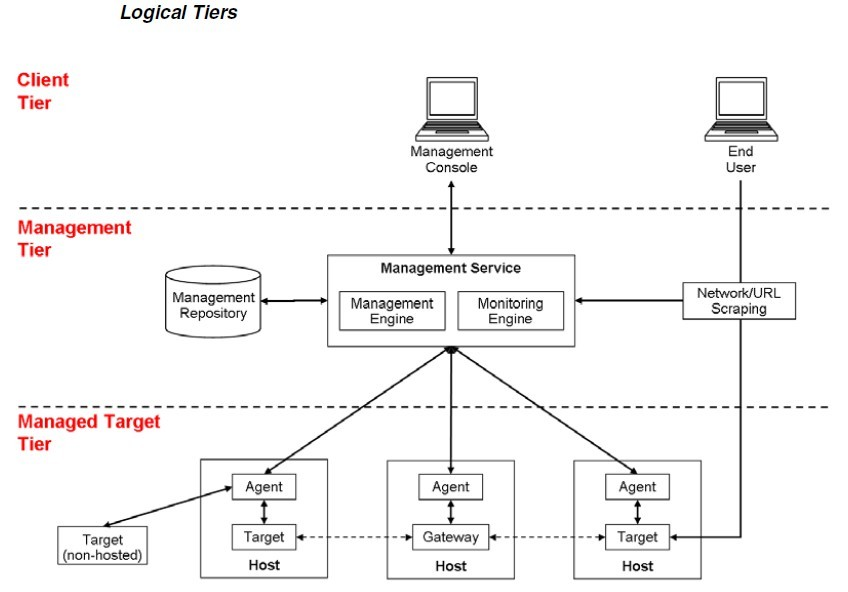
Which of the following are the three major tiers of the Logical view of the Oracle Management Reference Architecture?

  1. A

    Administrative Tier

  2. B

    Client Tier

  3. C

    Management Tier

  4. D

    Managed Services Tier

  5. E

    Managed Target Tier

Show answer and explanation

Correct answers: B, C, E

Explanation

Explanation:
* The Client Tier represents access to management content and operations as well as end users accessing the appropriate business solution. Administrators utilize a browser based console to perform their management tasks using a standard browser interface. The management console which is lightweight, easy to access and firewall friendly, enables administrators to centrally manage their entire environment.
* The Management Tier renders the content and interface for the management console that gives access to management operations such as monitoring, administration, configuration, central policy setting, and security. The Management Tier controls the accessing and uploading of management information.
* The Managed Target Tier contains the named infrastructure components that are required to be managed and monitored. It is common to utilize a combination of agent based and gateway (a.k.a. proxy) patterns to monitor and manage hosted and non-hosted targets.

Question 10 Multiple choice

Which of the following statements are true about defense-in-depth strategy?

  1. A

    It saves money by allowing organizations to remove costly perimeter security Infrastructure.

  2. B

    It is a strategy designed to win the battle by attrition. It consists of multiple security measures at various levels as opposed to a single barrier.

  3. C

    It includes security measures for the network, the operating system, the application, and data.

  4. D

    Due to network overhead issues, it should not be used in a distributed computing environment such as SOA or cloud computing.

  5. E

    It is a good strategy to protect an organization from insider threats.

Show answer and explanation

Correct answers: B, C, E

Explanation

Explanation:
Defense in depth is a security strategy in which multiple, independent, and mutually reinforcing security controls are leveraged to secure an IT environment.

The basic premise is that a combination of mechanisms, procedures and policies at different layers within a system are harder to bypass than a single or small number security mechanisms. An attacker may penetrate the outer layers but will be stopped before reaching the target, which is usually the data or content stored in the 'innermost' layers of the environment. Defense in depth is also adopted from military defense strategy, where the enemy is defeated by attrition as it battles its way against several layers of defense.

Defense in depth should be applied so that a combination of firewalls, intrusion detection and prevention, user management, authentication, authorization, and encryption mechanisms are employed across tiers and network zones.

The strategy also includes protection of data persisted in the form of backups and transportable/mobile devices. Defense in depth should take into account OS and VM hardening as well as configuration control as means of preventing attackers from thwarting the system by entering via the OS or by tampering with application files.

References: