1Z0-146 Exam Details
-
Exam Code
:1Z0-146 -
Exam Name
:Oracle Database 11g: Advanced PL/SQL -
Certification
:Oracle Certifications -
Vendor
:Oracle -
Total Questions
:136 Q&As -
Last Updated
:Dec 09, 2021
Oracle 1Z0-146 Online Questions & Answers
-
Question 61:
You have an external C procedure stored in a dynamic-link library (DLL).
The C procedure takes an integer as argument and returns an integer. You want to invoke the C procedure through a PL/SQL program.
View the Exhibit.
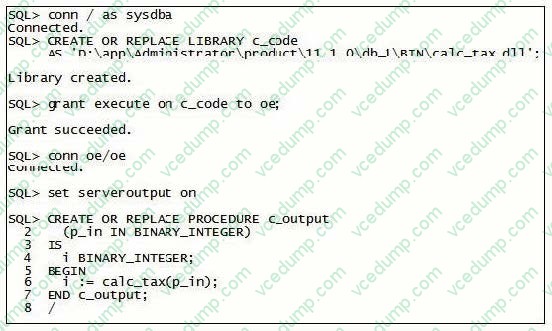
Which statement is true about the C_OUTPUT PL/SQL program?
A. It invokes the external C procedure.
B. It only publishes the external C procedure.
C. It fails because the external C procedure is not published.
D. It fails because the input data type is BINARY_INTEGER and the external C procedure expects an integer. -
Question 62:
Which two statements are true about cursor variables? (Choose two.)
A. A cursor variable points to the current row in the result set of a multirow query stored in a work area.
B. A cursor variable is an explicitly named work area in which the results of different multirow queries can be stored.
C. A cursor variable can be used only if a query is performed and its results are processed in the same subprogram.
D. A cursor variable can be used to perform a query in one subprogram, and process the results in a different subprogram. -
Question 63:
To examine the dependencies between all PL/SQL objects and the tables and views they reference, you executed the following query as the user OE:
SQL> SELECT owner || '.' || NAME refs_table
, referenced_owner || '.' || referenced_name AS table_referenced
FROM all_dependencies
WHERE owner = USER
AND TYPE IN ('PACKAGE', 'PACKAGE BODY','PROCEDURE', 'FUNCTION')
AND referenced_type IN ('TABLE', 'VIEW')
AND referenced_owner NOT IN ('SYS', 'SYSTEM')
ORDER BY owner, NAME, referenced_owner, referenced_name;
Which statement is true about the output of the query?
A. It displays all PL/SQL code objects created by user OE that reference any table or view owned by other users except SYS and SYSTEM..
B. It displays no rows because this query needs to be executed as the user SYS for required results.
C. It displays all PL/SQL code objects that reference a table or view directly for all the users in the database.
D. It displays only those PL/SQL code objects created by the user OE that reference a table or view created by the user SYS. -
Question 64:
When do you use static SQL as a technique for avoiding SQL injection?
A. when the WHERE clause values are unknown
B. when the code contains data definition language (DDL) statements
C. when all Oracle identifiers are known at the time of code compilation
D. when the SET clause values are unknown at the time of code compilation -
Question 65:
You created a PL/SQL function with the RESULT_CACHE and RELIES_ON clauses. In which scenarios is the cached result bypassed? (Choose all that apply.)
A. when the size for the memory allocated for the result cache is increased
B. when the function is executed in a session frequently with the same parameter value
C. when the database administrator has disabled the use of the result cache during application patching
D. when a data manipulation language (DML) statement is executed in a session on a table or view that was specified in the RELIES_ON clause of a result-cached function -
Question 66:
You issue the following command to create the PRINT_MEDIA table.
CREATE TABLE print_media
(product_id NUMBER(3),
ad_sourcetext CLOB,
ad_photo BLOB);
Evaluate the following INSERT statements:
INSERT INTO print_media VALUES (1, empty_clob(),empty_blob());
INSERT INTO print_media VALUES (2,'This is a One Line Story',null);
INSERT INTO print_media VALUES (3,'This is another One Line Story',empty_blob());
INSERT INTO print_media VALUES (4,empty_clob(),to_blob('This is new Story'));
Which of the above INSERT statements are valid?
A. Only the first statement is valid.
B. All the statements are valid.
C. Only the first and fourth statements are valid.
D. Only the first and second statements are valid.
E. Only the first, second and third statements are valid. -
Question 67:
Examine the following line of code that is part of a PL/SQL application: stmt:='SELECT session_id FROM sessions WHERE ' || p_where_stmt; Identify a solution for preventing SQL injection in the above code.
A. Replace P_WHERE_STMT with a bind variable.
B. Do not use APIs that allow arbitrary query parameters to be exposed.
C. Use the RESTRICT_REFERENCES clause in the PL/SQL subprogram that contains the code.
D. Use DBMS_SQL to detect that the expression provided for P_WHERE_STMT is free from SQL injection. -
Question 68:
View the Exhibit and examine the PL/SQL code.
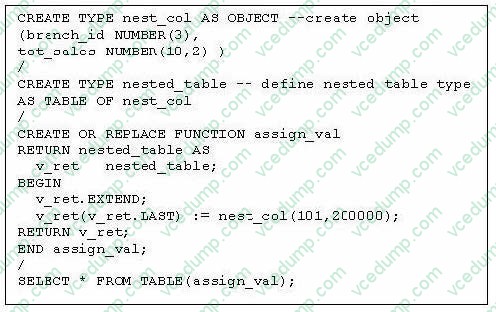
Which statement is true about the execution of the PL/SQL code?
A. It executes successfully and displays 101 and 200000 values.
B. The ASSIGN_VAL function generates an error during compilation because nested tables cannot be returned by functions.
C. The SELECT statement generates an error because the nested table has not been initialized in the ASSIGN_VAL function.
D. The ASSIGN_VAL function generates an error during compilation because the EXTEND method cannot be used with nested tables. -
Question 69:
View the Exhibit and examine the PL/SQL code.
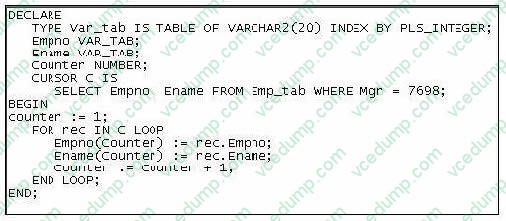
The code takes a long time to execute. What would you recommend to improve performance?
A. using NOT NULL constraint when declaring the variables
B. using the BULK COLLECT option for query instead of cursor
C. using WHILE.. END LOOP instead of FOR .. END LOOP
D. using the SIMPLE_INTEGER data type instead of the NUMBER data type -
Question 70:
View the Exhibit and examine the output.
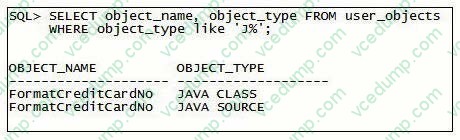
Which statement is an inference from the output?
A. The class file is pinned into the Java pool.
B. The class file has been loaded into the shared library.
C. Java class methods in the Java class file have been published.
D. The loadjava command has been executed to load the Java source and class files.
Related Exams:
-
1Z0-020
Oracle8i: New Features for Administrators -
1Z0-023
Architecture and Administration -
1Z0-024
Performance Tuning -
1Z0-025
Backup and Recovery -
1Z0-026
Network Administration -
1Z0-034
Upgrade Oracle9i/10g OCA to Oracle Database OCP -
1Z0-036
Managing Oracle9i on Linux -
1Z0-041
Oracle Database 10g: DBA Assessment -
1Z0-052
Oracle Database 11g: Administration Workshop I -
1Z0-053
Oracle Database 11g: Administration II
Tips on How to Prepare for the Exams
Nowadays, the certification exams become more and more important and required by more and more enterprises when applying for a job. But how to prepare for the exam effectively? How to prepare for the exam in a short time with less efforts? How to get a ideal result and how to find the most reliable resources? Here on Vcedump.com, you will find all the answers. Vcedump.com provide not only Oracle exam questions, answers and explanations but also complete assistance on your exam preparation and certification application. If you are confused on your 1Z0-146 exam preparations and Oracle certification application, do not hesitate to visit our Vcedump.com to find your solutions here.