1Z0-146 Exam Details
-
Exam Code
:1Z0-146 -
Exam Name
:Oracle Database 11g: Advanced PL/SQL -
Certification
:Oracle Certifications -
Vendor
:Oracle -
Total Questions
:136 Q&As -
Last Updated
:Dec 09, 2021
Oracle 1Z0-146 Online Questions & Answers
-
Question 121:
Which two statements are true about the extproc process? (Choose two.)
A. It loads the dynamic library.
B. It is started by the server process.
C. It converts the C output back to PL/SQL.
D. A single extproc process serves all user sessions. -
Question 122:
There is a Java class file in your system and you publish it using the following command:
CREATE OR REPLACE PROCEDURE ccformat
(x IN OUT VARCHAR2)
AS LANGUAGE JAVA
NAME 'FormatCreditCardNo.formatCard(java.lang.String[])';
However, you receive the following error when executing the CCFORMAT procedure:
ERROR at line 1:
ORA-29540: class FormatCreditCardNo does not exist
ORA-06512: at "SH.CCFORMAT", line 1
ORA-06512: at line 1
What would you do to execute the procedure successfully?
A. Change the listener configuration.
B. Create a directory object and link it to the Java class file.
C. Rebuild the Java class file when the database instance is running.
D. Use the loadjava utility to load the Java class file into the database. -
Question 123:
You executed the following command to alter the session parameter:
SQL> ALTER SESSION SET PLSCOPE_SETTINGS = 'IDENTIFIERS:ALL';
Which two statements are true in this scenario? (Choose two.)
A. If the SYSAUX tablespace is unavailable, and you compile a program unit, PL/Scope does not collect data for the compiled object.
B. All the identifiers declared in compiled program units before altering the parameter settings appear in the *_IDENTIFIER static data dictionary views.
C. All the identifiers declared in compiled program units before altering the parameter settings do not appear in the *_IDENTIFIER static data dictionary views.
D. If the SYSAUX tablespace is unavailable, and you compile a program unit, PL/Scope collects data for the compiled object and stores it in the SYSTEM tablespace. -
Question 124:
Identify the two types of PL/SQL programs for which you consider setting the compilation method to native mode. (Choose two.)
A. PL/SQL programs that are still in the debugging phase of development
B. PL/SQL programs that have computation-intensive procedural operations
C. A PL/SQL program, which is called with the same parameters by multiple sessions
D. PL/SQL programs that spend most of their execution time in executing SQL statements -
Question 125:
Examine the structure of the LOB_STORE table.
Name Null? Type
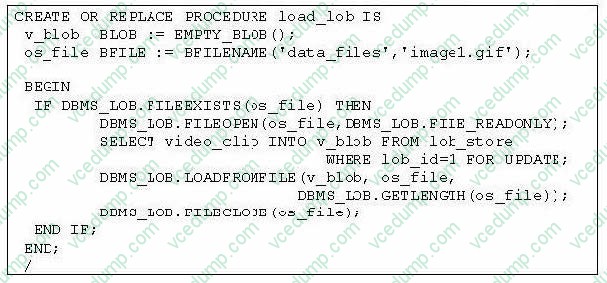
LOB_ID NUMBER VIDEO_CLIP BLOB You create a 'DATA_FILES' directory object that contains the 'IMAGE1.GIF'operating system (OS) file. View the Exhibit and examine the LOAD_LOB procedure code that you execute for reading data from the OS file into the BLOB column.
It is created with compilation errors. What is the reason?
A. V_BLOB should be initialized to EMPTY_BLOB().
B. The WRITE routine of DBMS_LOB should be used instead of LOADFROMFILE.
C. The return type of DBMS_LOB.FILEEXISTS is not compatible with the IF statement.
D. OPEN, CLOSE, and READONLY routines of DBMS_LOB should be used instead of FILEOPEN, FILECLOSE, and FILE_READONLY. -
Question 126:
Which two statements are true about SecureFile LOB options? (Choose two.)
A. The DECRYPT option can be used to remove the encryption only if the LOB column is empty.
B. The KEEP_DUPLICATES option removes the deduplication effect only on new data in a LOB column.
C. The KEEP_DUPLICATES option removes the deduplication effect on existing and new data in a LOB column.
D. The DECRYPT option can be used to remove the encryption from LOB columns that are empty or contain data. -
Question 127:
You enabled PL/SQL tracing in a user session using the following command:
SQL> EXECUTE DBMS_TRACE.SET_PLSQL_TRACE(DBMS_TRACE.TRACE_ALL_CALLS);
View Exhibit1 to examine the output. After some time, the query produces a different result as shown in Exhibit2.
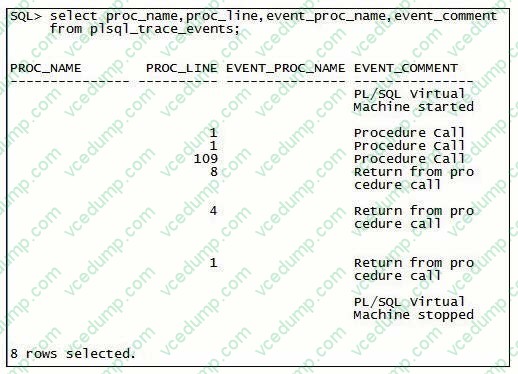
What is the cause for the change?
A. The FOO procedure has been executed more than once.
B. The PLSQL_DEBUG parameter is set to FALSE for the user session.
C. The FOO procedure has been compiled with the DEBUG option, and executed.
D. Schema level statistics have been gathered by the database administrator (DBA). -
Question 128:
View the Exhibit and examine the settings for the PLSQL_CODE_TYPE parameter.
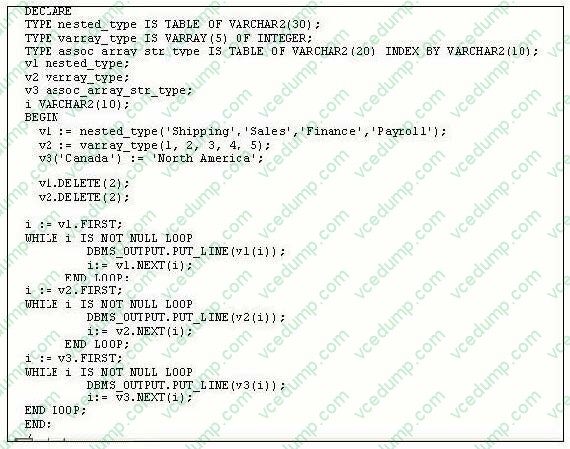
After sometime, the user recompiles the procedure DISPLAY_SAL_INFO by issuing the following command:
SQL> ALTER PROCEDURE display_sal_info COMPILE;
Which statement would be true in this scenario?
A. The procedure would be invalidated.
B. The procedure would remain as NATIVE code type.
C. The procedure would be changed to INTERPRETED code type.
D. The command would produce an error and the procedure must be compiled using the PLSQL_CODE_TYPE attribute with value INTERPRETED. -
Question 129:
Which two statements are true about the migration of BasicFile to the SecureFile format by using the DBMS_REDEFINITION package? (Choose two.)
A. It can be performed only on tables with a single LOB column.
B. It automatically creates an interim table during the migration process.
C. It allows the table that is migrated to be accessed throughout the migration process.
D. It requires free space that is at least equal to the space used by the table that is migrated.
E. It requires all constraints defined on the original table to be re-created manually after the migration. -
Question 130:
Examine the structure of the PRINT_MEDIA table: Name Null? Type
ADVT_ID NUMBER
ADVT_SOURCE CLOB
Examine the following PL/SQL block:
DECLARE
lobloc CLOB;
buffer VARCHAR2(100);
amount NUMBER;
offset NUMBER :=1;
BEGIN
buffer :='This is the second line of a new document';
amount := LENGTH(buffer);
SELECT advt_source INTO lobloc FROM print_media WHERE advt_id=2 FOR UPDATE;
DBMS_LOB.WRITE(lobloc,amount,offset,buffer);
COMMIT;
END;
/
What must be the value in the ADVT_SOURCE column for the above code to execute successfully?
A. null
B. an empty locator
C. a non-NULL value
D. either null or any non-NULL values
Related Exams:
-
1Z0-020
Oracle8i: New Features for Administrators -
1Z0-023
Architecture and Administration -
1Z0-024
Performance Tuning -
1Z0-025
Backup and Recovery -
1Z0-026
Network Administration -
1Z0-034
Upgrade Oracle9i/10g OCA to Oracle Database OCP -
1Z0-036
Managing Oracle9i on Linux -
1Z0-041
Oracle Database 10g: DBA Assessment -
1Z0-052
Oracle Database 11g: Administration Workshop I -
1Z0-053
Oracle Database 11g: Administration II
Tips on How to Prepare for the Exams
Nowadays, the certification exams become more and more important and required by more and more enterprises when applying for a job. But how to prepare for the exam effectively? How to prepare for the exam in a short time with less efforts? How to get a ideal result and how to find the most reliable resources? Here on Vcedump.com, you will find all the answers. Vcedump.com provide not only Oracle exam questions, answers and explanations but also complete assistance on your exam preparation and certification application. If you are confused on your 1Z0-146 exam preparations and Oracle certification application, do not hesitate to visit our Vcedump.com to find your solutions here.