1Z0-146 Exam Details
-
Exam Code
:1Z0-146 -
Exam Name
:Oracle Database 11g: Advanced PL/SQL -
Certification
:Oracle Certifications -
Vendor
:Oracle -
Total Questions
:136 Q&As -
Last Updated
:Dec 09, 2021
Oracle 1Z0-146 Online Questions & Answers
-
Question 51:
Which two statements are true about the migration of BasicFile to the SecureFile format by using the DBMS_REDEFINITION package? (Choose two.)
A. It can be performed only on tables with a single LOB column.
B. It automatically creates an interim table during the migration process.
C. It allows the table that is migrated to be accessed throughout the migration process.
D. It requires free space that is at least equal to the space used by the table that is migrated.
E. It requires all constraints defined on the original table to be re-created manually after the migration. -
Question 52:
Which two types of query results cannot be stored in the query result cache? (Choose two.)
A. subquery results
B. results of a query having the SYSDATE function
C. results of a query having the GROUP BY clause
D. results of a query having the DATE data type in the WHERE clause -
Question 53:
Examine the structure of the EMPLOYEES table in the SCOTT schema. Name Null? Type
EMPLOYEE_ID NOT NULL NUMBER(6) FIRST_NAME VARCHAR2(20)
LAST_NAME NOT NULL VARCHAR2(25)
SALARY NOT NULL NUMBER(8,2)
COMMISSION_PCT NUMBER(2,2)
DEPARTMENT_ID NUMBER(4)
View the Exhibit and examine the code for the EMP_TOTSAL procedure created by user SCOTT.
Which statement is true regarding the EMP_TOTSAL procedure?
A. It is created successfully, but displays the correct output message only for existent employee IDs.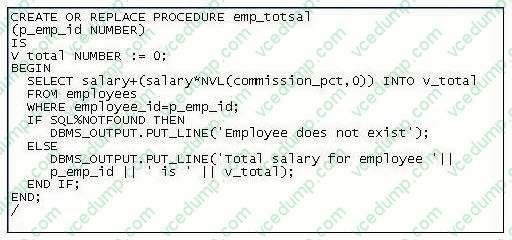
B. It is created successfully and displays the correct output message for both existent and nonexistent employee IDs.
C. It generates an error because the %NOTFOUND attribute cannot be used in combination with a SELECT INTO statement.
D. It generates an error because a user-defined exception has to be included whenever the % NOTFOUND attribute is used in combination with a SELECT INTO statement. -
Question 54:
Which two statements are true about SecureFile LOB options? (Choose two.)
A. The COMPRESSION HIGH option can be enabled only for CLOBs.
B. The COMPRESSION HIGH option can be enabled for all internal LOBs.
C. The DECRYPT option can be used to remove encryption only if the LOB column is empty.
D. The DECRYPT option can be used to remove encryption from LOB columns that are empty or contain data. -
Question 55:
Examine the following settings for a session:
PLSQL_CODE_TYPE = NATIVE
PLSQL_OPTIMIZE_LEVEL = 3
Which statement would be true in this scenario?
A. The compiler would automatically inline subprograms.
B. The compiler would inline the code for external subroutines.
C. The compiler would inline the code even if the INLINE pragma is set to NO.
D. The compiler would not inline the code unless the INLINE pragma is set to YES. -
Question 56:
Which two statements are true about the inlining of PL/SQL subprograms? (Choose two.)
A. Only local subroutines can be inlined.
B. Inlining always reduces the execution time for a PL/SQL program unit.
C. PLSQL_OPTIMIZE_LEVEL must be set to a value greater than or equal to 2.
D. The PL/SQL programs that make use of relatively large helper subroutines are good candidates for inlining. -
Question 57:
Examine the commands:
CREATE TYPE typ_course_tab IS VARRAY(5) OF VARCHAR2(20)
/
CREATE TYPE typ_course_nst
AS TABLE OF typ_course_tab
/
CREATE TABLE faculty
(faculty_id NUMBER(5),
faculty_name VARCHAR2(30),
courses typ_course_nst)
NESTED TABLE courses STORE AS course_stor_tab
/
INSERT INTO faculty
VALUES (101, 'Jones', NULL);
UPDATE (SELECT courses FROM faculty WHERE faculty_id=101) SET courses =
typ_course_nst(11,'Oracle');
Which statement is true about the execution of these commands?
A. All the commands execute successfully.
B. Only the first two commands execute successfully.
C. Only the first four commands execute successfully.
D. Only the first three commands execute successfully. -
Question 58:
Which two statements are true about the usage of the DBMS_DESCRIBE.DESCRIBE_PROCEDURE procedure? (Choose two.)
A. You can describe remote objects.
B. You can describe anonymous PL/SQL blocks.
C. You can describe a stored procedure, stored function, packaged procedure, or packaged function.
D. You can obtain information about the position, name, and data type of the arguments of a procedure. -
Question 59:
Which two statements are true about the DBMS_LOB.CREATETEMPORARY procedure that is used to create a temporary LOB? (Choose two.)
A. It can be used for transforming data in permanent internal LOBs.
B. It is used only for the migration of BasicFile to the SecureFile format.
C. It is used only for the migration of the LONG column to the LOB column.
D. It creates a LOB variable that is not associated with any table and is stored in the user's temporary tablespace.
E. It creates a LOB variable that is associated with a specific table and is temporarily stored in the user's default tablespace. -
Question 60:
In which two situations is the body of a result-cached function executed? (Choose two.)
A. if the memory allocated for the result cache is increased
B. if a session on this database instance invokes the function with the same parameter values
C. if the first time a session on this database instance invokes the function with a parameter value
D. if a session executes a data manipulation language (DML) statement on a table or view that was specified in the RELIES_ON clause of a result-cached function
Related Exams:
-
1Z0-020
Oracle8i: New Features for Administrators -
1Z0-023
Architecture and Administration -
1Z0-024
Performance Tuning -
1Z0-025
Backup and Recovery -
1Z0-026
Network Administration -
1Z0-034
Upgrade Oracle9i/10g OCA to Oracle Database OCP -
1Z0-036
Managing Oracle9i on Linux -
1Z0-041
Oracle Database 10g: DBA Assessment -
1Z0-052
Oracle Database 11g: Administration Workshop I -
1Z0-053
Oracle Database 11g: Administration II
Tips on How to Prepare for the Exams
Nowadays, the certification exams become more and more important and required by more and more enterprises when applying for a job. But how to prepare for the exam effectively? How to prepare for the exam in a short time with less efforts? How to get a ideal result and how to find the most reliable resources? Here on Vcedump.com, you will find all the answers. Vcedump.com provide not only Oracle exam questions, answers and explanations but also complete assistance on your exam preparation and certification application. If you are confused on your 1Z0-146 exam preparations and Oracle certification application, do not hesitate to visit our Vcedump.com to find your solutions here.