1Z0-061 Exam Details
-
Exam Code
:1Z0-061 -
Exam Name
:Oracle Database 12c: SQL Fundamentals -
Certification
:Oracle Certifications -
Vendor
:Oracle -
Total Questions
:339 Q&As -
Last Updated
:Oct 10, 2022
Oracle 1Z0-061 Online Questions & Answers
-
Question 71:
Which statement is true about Enterprise Manager (EM) express in Oracle Database 12c?
A. By default, EM express is available for a database after database creation.
B. You can use EM express to manage multiple databases running on the same server.
C. You can perform basic administrative tasks for pluggable databases by using the EM express interface.
D. You cannot start up or shut down a database Instance by using EM express.
E. You can create and configure pluggable databases by using EM express. -
Question 72:
Which two statements are true regarding indexes? (Choose two.)
A. They can be created on tables and clusters.
B. They can be created on tables and simple views.
C. You can create only one index by using the same columns.
D. You can create more than one index by using the same columns if you specify distinctly different combinations of the columns. -
Question 73:
You issue the following command to alter the country column in the departments table:

Which statement is true?
A. It produces an error because column definitions cannot be altered to add default values.
B. It executes successfully and all the rows that have a null value for the country column will be updated with the value 'USA'.
C. It executes successfully. The modification to add the default value takes effect only from subsequent insertions to the table.
D. It produces an error because the data type for the column is not specified. -
Question 74:
Examine the structure of the EMPLOYEES table:
EMPLOYEE_ID NUMBER NOT NULL, Primary Key
EMP_NAME VARCHAR2(30)
JOB_ID NUMBER\
SAL NUMBER
MGR_ID NUMBER . References EMPLOYEE_ID column
DEPARTMENT_ID NUMBER . Foreign key to DEPARTMENT_ID column of the. .
DEPARTMENTS table
You created a sequence called EMP_ID_SEQ in order to populate sequential values for the EMPLOYEE_ID column of the EMPLOYEES table.
Which two statements regarding the EMP_ID_SEQ sequence are true? (Choose two.)
A. You cannot use the EMP_ID_SEQ sequence to populate the JOB_ID column.
B. The EMP_ID_SEQ sequence is invalidated when you modify the EMPLOYEE_ID column.
C. The EMP_ID_SEQ sequence is not affected by modifications to the EMPLOYEES table.
D. Any other column of NUMBER data type in your schema can use the EMP_ID_SEQ sequence.
E. The EMP_ID_SEQ sequence is dropped automatically when you drop the EMPLOYEES table.
F. The EMP_ID_SEQ sequence is dropped automatically when you drop the EMPLOYEE_ID column. -
Question 75:
The following data exists in the PRODUCTS table: PROD_ID PROD_LIST_PRICE
123456 152525.99
You issue the following query:
SQL> SELECT RPAD(( ROUND(prod_list_price)), 10, '*')
FROM products
WHERE prod_id = 123456;
What would be the outcome?
A. 152526****
B. **152525.99
C. 152525**
D. an error message -
Question 76:
Evaluate the following two queries:
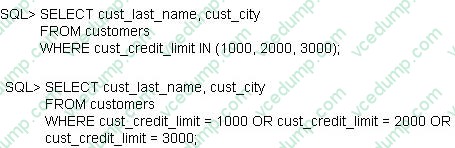
Which statement is true regarding the above two queries?
A. Performance would improve in query 2 only if there are null values in the CUST_CREDIT_LIMIT column.
B. Performance would degrade in query 2.
C. There would be no change in performance.
D. Performance would improve in query 2. -
Question 77:
You want to write a query that accepts user input for columns and conditions every time it is executed.
The user needs to be promoted only once for the table input.
Which query provides the required result?
A. SELECT andcol1, col2FROM andandtableWHERE andcondition = andcond;
B. SELECT andcol1, col2FROM "andandtable"WHERE andcondition = andcond;
C. SELECT andcol1, col2FROM andandtableWHERE andcondition = andandcond;
D. SELECT andcol1, `col2'FROM andtableWHERE andandcondition = `andcond'; -
Question 78:
A UNIQUE constraint on a column requires an index.
Which of the following scenarios is correct? (Choose one or more correct answers.)
A. If a UNIQUE index already exists on the column, it will be used.
B. If a NONUNIQUE index already exists it will be used.
C. If a NONUNIQUE index already exists on the column, a UNIQUE index will be created implicitly.
D. If any index exists on the column, there will be an error as Oracle attempts to create another index implicitly. -
Question 79:
You want to create a table employees in which the values of columns EMPLOYEES_ID and LOGIN_ID must be unique and not null. Which two SQL statements would create the required table?
A. Option A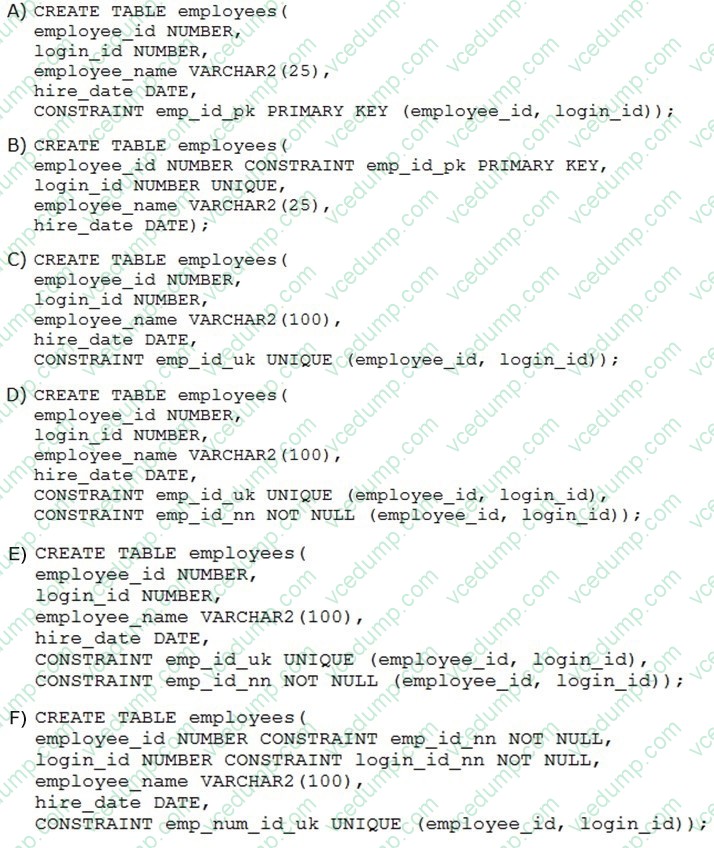
B. Option B
C. Option C
D. Option D
E. Option E
F. Option F -
Question 80:
Which two statements are true regarding constraints? (Choose two.)
A. A foreign key cannot contain NULL values.
B. The column with a UNIQUE constraint can store NULLS.
C. A constraint is enforced only for an INSERT operation on a table.
D. You can have more than one column in a table as part of a primary key.
Related Exams:
-
1Z0-020
Oracle8i: New Features for Administrators -
1Z0-023
Architecture and Administration -
1Z0-024
Performance Tuning -
1Z0-025
Backup and Recovery -
1Z0-026
Network Administration -
1Z0-034
Upgrade Oracle9i/10g OCA to Oracle Database OCP -
1Z0-036
Managing Oracle9i on Linux -
1Z0-041
Oracle Database 10g: DBA Assessment -
1Z0-052
Oracle Database 11g: Administration Workshop I -
1Z0-053
Oracle Database 11g: Administration II
Tips on How to Prepare for the Exams
Nowadays, the certification exams become more and more important and required by more and more enterprises when applying for a job. But how to prepare for the exam effectively? How to prepare for the exam in a short time with less efforts? How to get a ideal result and how to find the most reliable resources? Here on Vcedump.com, you will find all the answers. Vcedump.com provide not only Oracle exam questions, answers and explanations but also complete assistance on your exam preparation and certification application. If you are confused on your 1Z0-061 exam preparations and Oracle certification application, do not hesitate to visit our Vcedump.com to find your solutions here.