1Z0-061 Exam Details
-
Exam Code
:1Z0-061 -
Exam Name
:Oracle Database 12c: SQL Fundamentals -
Certification
:Oracle Certifications -
Vendor
:Oracle -
Total Questions
:339 Q&As -
Last Updated
:Oct 10, 2022
Oracle 1Z0-061 Online Questions & Answers
-
Question 91:
You work as a database administrator at ABC.com. You study the exhibit carefully.
Exhibit
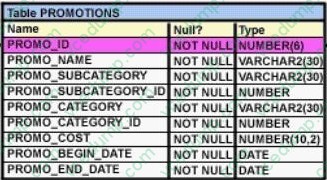
Using the PROMOTIONS table, you need to display the names of all promos done after January 1, 2001 starting with the latest promo. Which query would give the required result? (Choose all that apply.)
A. . SELECT promo_name, promo_begin_dateFROM promotionsWHERE promo_begin_date > '01-JAN-01'ORDER BY 1 DESC;
B. SELECT promo_name, promo_begin_date "START DATE"FROM promotionsWHERE promo_begin_date > '01-JAN-01'ORDER BY "START DATE" DESC;
C. . SELECT promo_name, promo_begin_dateFROM promotionsWHERE promo_begin_date > '01-JAN-01'ORDER BY 2 DESC;
D. . SELECT promo_name, promo_begin_dateFROM promotionsWHERE promo_begin_date > '01-JAN-01'ORDER BY promo_name DESC; -
Question 92:
Examine the structure of the EMPLOYEES and DEPARTMENTS tables:
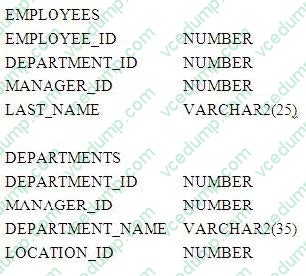
You want to create a report displaying employee last names, department names, and locations. Which query should you use to create an equi-join?
A. SELECT last_name, department_name, location_id FROM employees , departments ;
B. SELECT employees.last_name, departments.department_name, departments.location_id FROM employees e, departments D WHERE e.department_id =d.department_id;
C. SELECT e.last_name, d.department_name, d.location_id FROM employees e, departments D WHERE manager_id =manager_id;
D. SELECT e.last_name, d.department_name, d.location_id FROM employees e, departments D WHERE e.department_id =d.department_id; -
Question 93:
See the Exhibits and examine the structures of PRODUCTS, SALES and CUSTOMERS table:
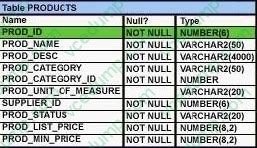
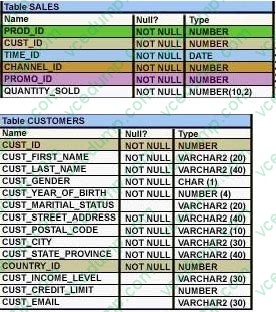
You issue the following query:

Which statement is true regarding the outcome of this query?
A. It produces an error because the NATURAL join can be used only with two tables
B. It produces an error because a column used in the NATURAL join cannot have a qualifier
C. It produces an error because all columns used in the NATURAL join should have a qualifier
D. It executes successfully -
Question 94:
View the Exhibit and examine the data in the promotions table.

PROMO_BEGIN_DATE is stored in the default date format, dd-mon-rr.
You need to produce a report that provides the name, cost, and start date of all promos in the post category that were launched before January 1, 2000.
Which SQL statement would you use?
A. Option A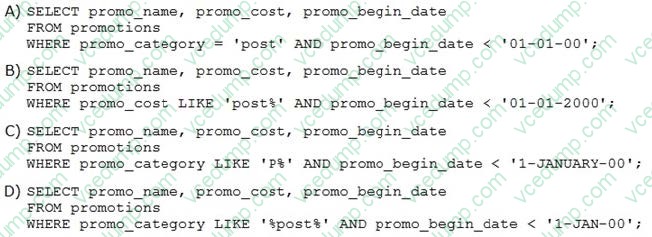
B. Option B
C. Option C
D. Option D -
Question 95:
Evaluate these two SQL statements:
SELECT last_name, salary, hire_date FROM EMPLOYEES ORDER BY salary DESC;
SELECT last_name, salary, hire_date FROM EMPLOYEES ORDER BY 2 DESC;
What is true about them?
A. The two statements produce identical results.
B. The second statement returns a syntax error.
C. There is no need to specify DESC because the results are sorted in descending order by default.
D. The two statements can be made to produce identical results by adding a column alias for the salary column in the second SQL statement. -
Question 96:
Which two statements complete a transaction? (Choose two)
A. DELETE employees;
B. DESCRIBE employees;
C. ROLLBACK TO SAVEPOINT C;
D. GRANT SELECT ON employees TO SCOTT;
E. ALTER TABLE employeesSET UNUSED COLUMN sal;
F. Select MAX(sal)FROM employeesWHERE department_id = 20; -
Question 97:
You need to generate a list of all customer last names with their credit limits from the customers table.
Those customers who do not have a credit limit should appear last in the list.
Which two queries would achieve the required result? (Choose two.)
A. Option A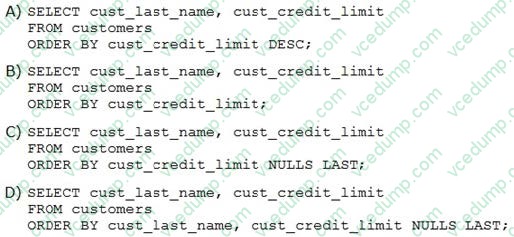
B. Option B
C. Option C
D. Option D -
Question 98:
Examine the structure of the PROMOS table:
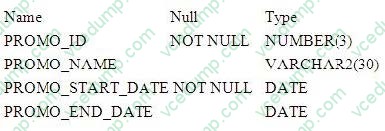
You want to generate a report showing promo names and their duration (number of days).
If the PROMO_END_DATE has not been entered, the message 'ONGOING' should be displayed. Which queries give the correct output? (Choose all that apply.)
A. SELECT promo_name, TO_CHAR(NVL(promo_end_date -promo_start_date, 'ONGOING')) FROM promos;
B. SELECT promo_name, COALESCE(TO_CHAR(promo_end_date - promo_start_date), 'ONGOING') FROM promos;
C. SELECT promo_name, NVL(TO_CHAR(promo_end_date -promo_start_date), 'ONGOING') FROM promos;
D. SELECT promo_name, DECODE(promo_end_date-promo_start_date, NULL, 'ONGOING', promo_end_date - promo_start_date) FROM promos;
E. SELECT promo_name, ecode(coalesce(promo_end_date, promo_start_date), null, 'ONGOING', promo_end_date - promo_start_date)FROM promos; -
Question 99:
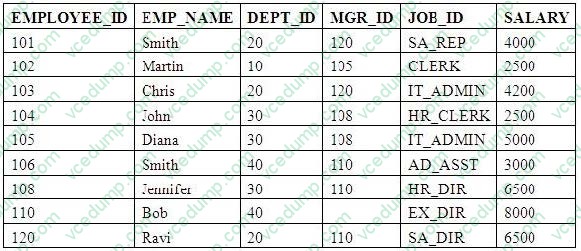
EMPLOYEES and DEPARTMENTS data:
EMPLOYEES
DEPARTMENTS
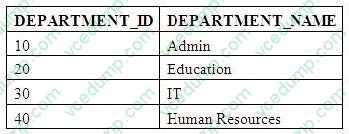
On the EMPLOYEES table, EMPLOYEE_ID is the primary key. MGR_ID is the ID managers and refers to the EMPLOYEE_ID.
On the DEPARTMENTS table DEPARTMENT_ID is the primary key.
Evaluate this UPDATE statement.
UPDATE employees
SET mgr_id =
. (SELECT mgr_id
. FROM. employees
. WHERE dept_id=
. (SELECT department_id
. FROM departments
. WHERE department_name = 'Administration')),
. Salary = (SELECT salary
. . FROM employees
. . WHERE emp_name = 'Smith')
WHERE job_id = 'IT_ADMIN';
What happens when the statement is executed?
A. The statement executes successfully, leaves the manager ID as the existing value, and changes the salary to 4000 for the employees with ID 103 and 105.
B. The statement executes successfully, changes the manager ID to NULL, and changes the salary to 4000 for the employees with ID 103 and 105.
C. The statement executes successfully, changes the manager ID to NULL, and changes the salary to 3000 for the employees with ID 103 and 105.
D. The statement fails because there is more than one row matching the employee name Smith.
E. The statement fails because there is more than one row matching the IT_ADMIN job ID in the EMPLOYEES table.
F. The statement fails because there is no 'Administration' department in the DEPARTMENTS table. -
Question 100:
Which three statements are true regarding views? (Choose three.)
A. Views can be created only from tables.
B. Views can be created from tables or other views.
C. Only simple views can use indexes existing on the underlying tables.
D. Both simple and complex views can use indexes existing on the underlying tables.
E. Complex views can be created only on multiple tables that exist in the same schema.
F. Complex views can be created on multiple tables that exist in the same or different schemas.
Related Exams:
-
1Z0-020
Oracle8i: New Features for Administrators -
1Z0-023
Architecture and Administration -
1Z0-024
Performance Tuning -
1Z0-025
Backup and Recovery -
1Z0-026
Network Administration -
1Z0-034
Upgrade Oracle9i/10g OCA to Oracle Database OCP -
1Z0-036
Managing Oracle9i on Linux -
1Z0-041
Oracle Database 10g: DBA Assessment -
1Z0-052
Oracle Database 11g: Administration Workshop I -
1Z0-053
Oracle Database 11g: Administration II
Tips on How to Prepare for the Exams
Nowadays, the certification exams become more and more important and required by more and more enterprises when applying for a job. But how to prepare for the exam effectively? How to prepare for the exam in a short time with less efforts? How to get a ideal result and how to find the most reliable resources? Here on Vcedump.com, you will find all the answers. Vcedump.com provide not only Oracle exam questions, answers and explanations but also complete assistance on your exam preparation and certification application. If you are confused on your 1Z0-061 exam preparations and Oracle certification application, do not hesitate to visit our Vcedump.com to find your solutions here.