1Z0-060 Exam Details
-
Exam Code
:1Z0-060 -
Exam Name
:Upgrade to Oracle Database 12c -
Certification
:Oracle Certifications -
Vendor
:Oracle -
Total Questions
:217 Q&As -
Last Updated
:May 25, 2026
Oracle 1Z0-060 Online Questions & Answers
-
Question 121:
You support Oracle Database 12c Oracle Database 11g, and Oracle Database log on the same server.
All databases of all versions use Automatic Storage Management (ASM).
Which three statements are true about the ASM disk group compatibility attributes that are set for a disk group?
A. The ASM compatibility attribute controls the format of the disk group metadata.
B. RDBMS compatibility together with the database version determines whether a database Instance can mount the ASM disk group.
C. The RDBMS compatibility setting allows only databases set to the same version as the compatibility value, to mount the ASM disk group.
D. The ASM compatibility attribute determines some of the ASM features that may be used by the Oracle disk group.
E. The ADVM compatibility attribute determines the ACFS features that may be used by the Oracle 10 g database. -
Question 122:
Identify two valid options for adding a pluggable database (PDB) to an existing multitenant container database (CDB). (Choose two.)
A. Use the CREATE PLUGGABLE DATABASE statement to create a PDB using the files from the SEED.
B. Use the CREATE DATABASE ... ENABLE PLUGGABLE DATABASE statement to provision a PDB by copying file from the SEED.
C. Use the DBMS_PDB package to clone an existing PDB.
D. Use the DBMS_PDB package to plug an Oracle 12c non-CDB database into an existing CDB.
E. Use the DBMS_PDB package to plug an Oracle 11g Release 2 (11.2.0.3.0) non-CDB database into an existing CDB. -
Question 123:
Which two statements are true about the RMAN VALIDATE DATABASE command? (Choose two.)
A. It checks the database for intrablock corruptions.
B. It can detect corrupt pfiles.
C. It can detect corrupt spfiles.
D. It checks the database for interblock corruptions.
E. It can detect corrupt block change tracking files. -
Question 124:
Examine the following command:

Which three statements are true about using an invisible column in the PRODUCTS table?
A. The %ROWTYPE attribute declarations in PL/SQL to access a row will not display the invisible column in the output.
B. The DESCRIBE commands in SQL *Plus will not display the invisible column in the output.
C. Referential integrity constraint cannot be set on the invisible column.
D. The invisible column cannot be made visible and can only be marked as unused.
E. A primary key constraint can be added on the invisible column. -
Question 125:
You are about to plug a multi-terabyte non-CDB into an existing multitenant container database (CDB).
The characteristics of the non-CDB are as follows: Version: Oracle Database 11g Release 2 (11.2.0.2.0) 64-bit Character Set: AL32UTF8 National Character Set: AL16UTF16 O/S: Oracle Linux 6 64-bit
The characteristics of the CDB are as follows: Version: Oracle Database 12c Release 1 64-bit Character Set: AL32UTF8 National Character Set: AL16UTF16 O/S: Oracle Linux 6 64-bit
Which technique should you use to minimize down time while plugging this non-CDB into the CDB?
A. Transportable database
B. Transportable tablespace
C. Data Pump full export/import
D. The DBMS_PDB package
E. RMAN -
Question 126:
You notice a performance change in your production Oracle database and you want to know which change has made this performance difference.
You generate the Compare Period Automatic Database Diagnostic Monitor (ADDM) report to further investigation.
Which three findings would you get from the report?
A. It detects any configuration change that caused a performance difference in both time periods.
B. It identifies any workload change that caused a performance difference in both time periods.
C. It detects the top wait events causing performance degradation.
D. It shows the resource usage for CPU, memory, and I/O in both time periods.
E. It shows the difference in the size of memory pools in both time periods.
F. It gives information about statistics collection in both time periods. -
Question 127:
In your database, the TBS PERCENT USED parameter is set to 60 and the TBS PERCENT FREE parameter is set to 20.
Which two storage-tiering actions might be automated when using information Lifecycle Management (ILM) to automate data movement?
A. The movement of all segments to a target tablespace with a higher degree of compression, on a different storage tier, when the source tablespace exceeds TBS PERCENT USED
B. The movement of some blocks to a target tablespace with a lower degree of compression, on a different storage tier, when the source tablespace exceeds TBS PERCENT USED
C. The movement of some segments to a target tablespace with a higher degree of compression, on a different storage tier, when the source tablespace exceeds TBS PERCENT USED
D. Setting the target tablespace to read-only after the segments are moved
E. Taking the target tablespace offline after the segments are moved -
Question 128:
You use RMAN to back up a database which uses Automatic Storage Management (ASM) and you use the MD_BACKUP command to back up the ASM metadata regularly.
You lose an ASM disk group DG1 due to a hardware failure.
In which two ways can you re-create the lost disk group and restore the data? (Choose two.)
A. Use RMAN to restore both the metadata and the data.
B. Use the MKDG command to add a new disk group DG1 with the same or different specifications as those from the lost disk group and use RMAN to restore the data.
C. Use the MD_RESTORE command to restore both the metadata and data for the failed disk group.
D. Use the MD_RESTORE command to restore the disk group metadata and use RMAN to restore the data. -
Question 129:
Your multitenant container database (CDB) contains two pluggable databases (PDBs).
Which three tools can be used to add a new PDB to the CDB? (Choose three.)
A. Enterprise Manager Cloud Control
B. SQL Developer
C. Database Upgrade Assistant (DBUA)
D. Database Configuration Assistant (DBCA)
E. Oracle Universal Installer (OUI) -
Question 130:
Examine the contents of SQL loader control file:
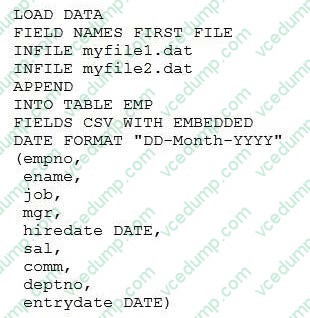
Which three statements are true regarding the SQL* Loader operation performed using the control file?
A. An EMP table is created if a table does not exist. Otherwise, if the EMP table is appended with the loaded data.
B. The SQL* Loader data file myfile1.dat has the column names for the EMP table.
C. The SQL* Loader operation fails because no record terminators are specified.
D. Field names should be the first line in the both the SQL* Loader data files.
E. The SQL* Loader operation assumes that the file must be a stream record format file with the normal carriage return string as the record terminator.
Related Exams:
-
1Z0-020
Oracle8i: New Features for Administrators -
1Z0-023
Architecture and Administration -
1Z0-024
Performance Tuning -
1Z0-025
Backup and Recovery -
1Z0-026
Network Administration -
1Z0-034
Upgrade Oracle9i/10g OCA to Oracle Database OCP -
1Z0-036
Managing Oracle9i on Linux -
1Z0-041
Oracle Database 10g: DBA Assessment -
1Z0-052
Oracle Database 11g: Administration Workshop I -
1Z0-053
Oracle Database 11g: Administration II
Tips on How to Prepare for the Exams
Nowadays, the certification exams become more and more important and required by more and more enterprises when applying for a job. But how to prepare for the exam effectively? How to prepare for the exam in a short time with less efforts? How to get a ideal result and how to find the most reliable resources? Here on Vcedump.com, you will find all the answers. Vcedump.com provide not only Oracle exam questions, answers and explanations but also complete assistance on your exam preparation and certification application. If you are confused on your 1Z0-060 exam preparations and Oracle certification application, do not hesitate to visit our Vcedump.com to find your solutions here.