1Z0-060 Exam Details
-
Exam Code
:1Z0-060 -
Exam Name
:Upgrade to Oracle Database 12c -
Certification
:Oracle Certifications -
Vendor
:Oracle -
Total Questions
:217 Q&As -
Last Updated
:May 25, 2026
Oracle 1Z0-060 Online Questions & Answers
-
Question 141:
An administrator account is granted the CREATE SESSION and SET CONTAINER system privileges.
A multitenant container database (CDB) instant has the following parameter set:
THREADED_EXECUTION = FALSE
Which four statements are true about this administrator establishing connections to root in a CDB that has been opened in read only mode? (Choose four.)
A. You can connect as a common user by using the CONNECT statement.
B. You can connect as a local user by using the CONNECT statement.
C. You can connect by using easy connect.
D. You can connect by using OS authentication.
E. You can connect by using a Net Service name.
F. You can connect as a local user by using the SET CONTAINER statement. -
Question 142:
You are the DBA for an Oracle Database 11g Release 1 data warehouse database running on Oracle Linux with little endianness.
You want to plug in a transportable tablespace with a 16K blocksize from an Oracle Database 10g database that is running on a SPARC-based Oracle Solaris system with big endianness.
The data warehouse database has the following parameters set:
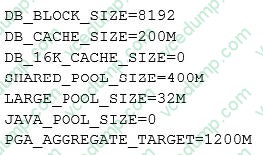
The following parameters are not explicitly set:
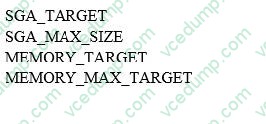
What action must you perform on the data warehouse database to prepare it for the transportable tablespace plug in operation?
A. Do nothing, because Automatic Memory Management will size DB_16K_CACHE_SIZE automatically
B. Set ALTER SYSTEM SET DB_CACHE_SIZE=192M followed by ALTER SYSTEM SET DB_16K_CACHE_SIZE=8M;
C. Do nothing, because you cannot transport a tablespace between databases with different endian formats.
D. Do nothing, because Automatic Shared Memory Management will size DB_16K_CACHE_SIZE automatically.
E. Set ALTER SYSTEM SET DB_16K_CACHE_SIZE=8M and leave other parameters set to their current settings. -
Question 143:
You plan to use the Flashback Drop feature to recover the SALES_EMP table that was dropped in error.
No other table with the same name exists in the SH schema, which owns the table.
You query the RECYCLEBIN and find multiple entries for the SALES_EMP table:
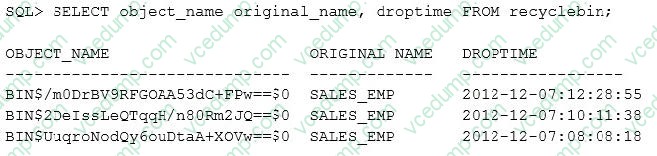
You then issue this statement to recover the table:

What would be the best?
A. It retrieves the least recently dropped version of the table from the recycle bin for which undo is still available.
B. It retrieves the most recently dropped version of the table.
C. It retrieves the most recently dropped version of the table from the recycle bin for which indo is still available.
D. It returns an error because the table name in the OBJECT_NAME column is not specified.
E. It retrieves the least recently dropped version of the table. -
Question 144:
An application accesses a small lookup table frequently. You notice that the required data blocks are getting aged out of the default buffer cache. How would you guarantee that the blocks for the table never age out?
A. Configure the KEEP buffer pool and alter the table with the corresponding storage clause.
B. Increase the database buffer cache size.
C. Configure the RECYCLE buffer pool and alter the table with the corresponding storage clause.
D. Configure Automata Shared Memory Management.
E. Configure Automatic Memory Management- -
Question 145:
You notice a performance change in your production Oracle 12c database and you want to know what change caused this performance difference. You generate the compare period Automatic Database Diagnostic Monitor (ADDM) report to further investigation.
Which three findings would you get from the report?
A. It shows the resource usage for CPU, memory, and I/O in both time periods.
B. It identifies any workload change that caused a performance difference in both time periods
C. It detects any configuration change that caused a performance difference in both time periods.
D. It gives information about statistics collection in both time periods.
E. It detects the top wait events causing performance degradation. -
Question 146:
Which four actions are possible during an Online Data file Move operation?
A. Creating and dropping tables in the data file being moved
B. Performing file shrink of the data file being moved
C. Querying tables in the data file being moved
D. Performing Block Media Recovery for a data block in the data file being moved
E. Flashing back the database
F. Executing DML statements on objects stored in the data file being moved -
Question 147:
You issue the following commands:

The directories '/u0l/app/oracle/oradata/orcl' and '/u0l/app/oracle/mydata' exist. Which statement describes the outcome?
A. The AUGUST_SALES tablespace is created with its data file in the DB_CREATE_FILE_DEST location and the TEMP101 tablespace is created with its temp file in the '/u01/app/oracle/mydata' location.
B. The TEMP101 tablespace is created with its temp file in the DB_CREATE_FILE_DEST location and the AUGUST_SALES tablespace is created with its data file in the '/u01/app/oracle/mydata/mysales.dbf' location.
C. The two tablespaces are created with the data file and temp file in their respective locations as specified in the CREATE commands.
D. Tablespace creation ignores the data file and temp file locations specified in the CREATE commands, and creates both the tablespaces in the DB_CREATE_FILE_DEST location. -
Question 148:
Examine the memory-related parameters of an Oracle database instance:
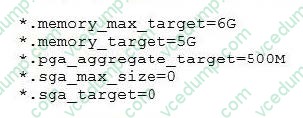
Which statement is true?
A. The value of the memory_target parameter cannot be changed dynamically.
B. PGA size can grow automatically beyond 500 MB.
C. Only the components of SGA are managed automatically.
D. Memory is dynamically re-allocated between SGA and PGA as needed. -
Question 149:
Your multitenant container database (CDB) is running in ARCHIVELOG mode. You connect to the CDB RMAN.
Examine the following command and its output:
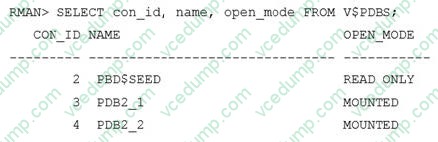
You execute the following command:
RMAN > BACKUP DATABASE PLUS ARCHIVELOG;
Which data files will be backed up?
A. Data files that belong to only the root container
B. Data files that belong to the root container and all the pluggable databases (PDBs)
C. Data files that belong to only the root container and PDB$SEED
D. Data files that belong to the root container and all the PDBs excluding PDB$SEED -
Question 150:
Which two statements are true regarding SQL*Loader Express Mode in an Oracle 12c database? (Choose two.)
A. You cannot have multiple SQL*Loader data files.
B. The DEGREE_OF_PARALLELISM parameter is set to AUTO.
C. If no data file is specified, it uses table-name.dat and assumes it is in the current directory.
D. A new table is created and data is inserted into the table if it does not exist in a schema.
Related Exams:
-
1Z0-020
Oracle8i: New Features for Administrators -
1Z0-023
Architecture and Administration -
1Z0-024
Performance Tuning -
1Z0-025
Backup and Recovery -
1Z0-026
Network Administration -
1Z0-034
Upgrade Oracle9i/10g OCA to Oracle Database OCP -
1Z0-036
Managing Oracle9i on Linux -
1Z0-041
Oracle Database 10g: DBA Assessment -
1Z0-052
Oracle Database 11g: Administration Workshop I -
1Z0-053
Oracle Database 11g: Administration II
Tips on How to Prepare for the Exams
Nowadays, the certification exams become more and more important and required by more and more enterprises when applying for a job. But how to prepare for the exam effectively? How to prepare for the exam in a short time with less efforts? How to get a ideal result and how to find the most reliable resources? Here on Vcedump.com, you will find all the answers. Vcedump.com provide not only Oracle exam questions, answers and explanations but also complete assistance on your exam preparation and certification application. If you are confused on your 1Z0-060 exam preparations and Oracle certification application, do not hesitate to visit our Vcedump.com to find your solutions here.