Which three statements are true about RMAN compressed backups?
Show answer and explanation
Correct answers: B, C, E
1Z0-060 Real Exam Questions
217 questions available · Page 1 of 22
Updated Exam DumpsVerified AnswersPass Guarantee
Which three statements are true about RMAN compressed backups?
Correct answers: B, C, E
Which three statements are true about Automatic Workload Repository (AWR)?
Correct answers: B, C, D
5.2 Overview of the Automatic Workload Repository
The Automatic Workload Repository (AWR) collects, processes, and maintains performance statistics for problem detection and self-tuning purposes. This data is both in memory and stored in the database. The gathered data can be displayed in both reports and views.
The statistics collected and processed by AWR include:
Object statistics that determine both access and usage statistics of database segments Time model statistics based on time usage for activities, displayed in the V$SYS_TIME_MODEL and V$SESS_TIME_MODEL views
References:
http://docs.oracle.com/cd/B28359_01/server.111/b28274/autostat.htm#PFGRF02601
You find this query being used in your Oracle 12c database:
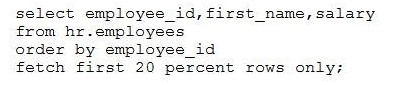
Which method a used by the optimizer to limit the rows being returned?
Correct answer: C
Which action takes place when an incremental checkpoint occurs?
Correct answer: C
References:
http://www.dba-oracle.com/t_incremental_checkpoint.htm
Examine the parameters for your database instance:
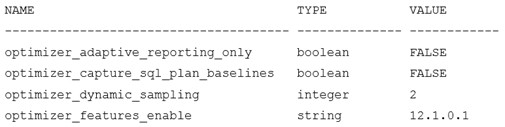
Which three statements are true about the process of automatic optimization by using cardinality feedback?
Correct answers: A, C, D
C: During the first execution of a SQL statement, an execution plan is generated as usual.
D: if multi-column statistics are not present for the relevant combination of columns, the optimizer can fall back on cardinality feedback.
(not B)* Cardinality feedback. This feature, enabled by default in 11.2, is intended to improve plans for repeated executions.
optimizer_dynamic_sampling
optimizer_features_enable
* dynamic sampling or multi-column statistics allow the optimizer to more accurately estimate selectivity of
conjunctive predicates.
Note:
* OPTIMIZER_DYNAMIC_SAMPLING controls the level of dynamic sampling performed by the optimizer.
Range of values. 0 to 10
* Cardinality feedback was introduced in Oracle Database 11gR2. The purpose of this feature is to automatically improve plans for queries that are executed repeatedly, for which the optimizer does not estimate cardinalities in the plan properly. The optimizer may misestimate cardinalities for a variety of reasons, such as missing or inaccurate statistics, or complex predicates. Whatever the reason for the misestimate, cardinality feedback may be able to help.
Which three statements are true concerning the multitenant architecture? (Choose three.)
Correct answers: B, D, G
B:
* A PDB would have its SYSTEM, SYSAUX, TEMP tablespaces. It can also contains other user created
tablespaces in it.
* There is one default temporary tablespace for the entire CDB. However, you can create additional temporary tablespaces in individual PDBs.
D:
* There is a single redo log and a single control file for an entire CDB
* A log switch is the point at which the database stops writing to one redo log file and begins writing to another. Normally, a log switch occurs when the current redo log file is completely filled and writing must continue to the next redo log file.
G: instance recovery
The automatic application of redo log records to uncommitted data blocks when an database instance is restarted after a failure.
Incorrect Answers:
A:
* There is one set of background processes shared by the root and all PDBs. ?
* High consolidation density. The many pluggable databases in a single container database share its memory and background processes, letting you operate many more pluggable databases on a particular platform than you can single databases that use the old architecture.
C: There is a separate SYSAUX tablespace for the root and for each PDB.
F: There is a separate SYSTEM tablespace for the root and for each PDB. -
Examine the contents of SQL loader control file:
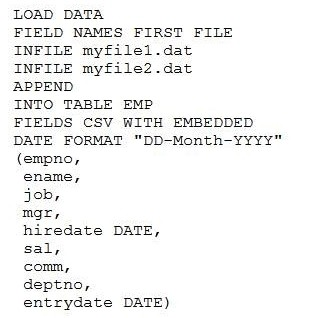
Which three statements are true regarding the SQL* Loader operation performed using the control file?
Correct answers: A, B, E
A: The APPEND keyword tells SQL*Loader to preserve any preexisting data in the table. Other options allow you to delete preexisting data, or to fail with an error if the table is not empty to begin with.
B (not D):
Note:
* SQL*Loader-00210: first data file is empty, cannot process the FIELD NAMES record
Cause: The data file listed in the next message was empty. Therefore, the FIELD NAMES FIRST FILE directive could not be processed.
Action: Check the listed data file and fix it. Then retry the operation
E:
* A comma-separated values (CSV) (also sometimes called character-separated values, because the separator character does not have to be a comma) file stores tabular data (numbers and text) in plain-text form. Plain text means that the file is a sequence of characters, with no data that has to be interpreted instead, as binary numbers. A CSV file consists of any number of records, separated by line breaks of
some kind; each record consists of fields, separated by some other character or string, most commonly a literal comma or tab. Usually, all records have an identical sequence of fields.
* Fields with embedded commas must be quoted.
Example:
1997,Ford,E350,"Super, luxurious truck"
Note:
* SQL*Loader is a bulk loader utility used for moving data from external files into the Oracle database.
Which three statements are true about using flashback database in a multitenant container database (CDB)?
Correct answers: B, D, E
An Automatic Database Diagnostic Monitor (ADDM) finding in your production database reports that the shared pool is inadequately sized. You diagnose that this is due to the different kinds of workloads and this occurs only during peak hours. The following are the parameter settings for the database instance:
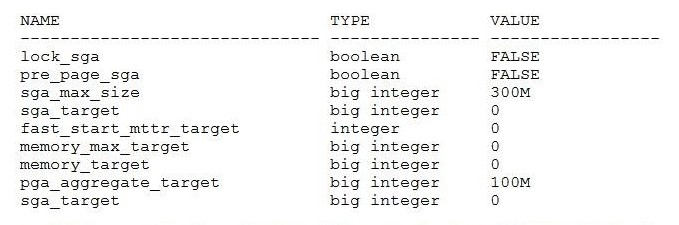
You want to balance the memory between the System Global Area (SGA) components depending on the workload.
Which option would solve this problem?
Correct answer: C
Your database runs in NOARCHIVELOG mode.
Whole database backups are taken daily.
A media failure damages data files belonging to the USERS tablespace and the online redo log files.
The hardware that is causing this damage is not repairable.
You issue the SHUTDOWN ABORT command.
Examine these steps:
1. Restore only the damaged files from the whole database backup to a new location.
2. Restore the whole database backup to a new location.
3. Edit the restored initialization parameter file to indicate the new location of the control files.
4. Issue the STARTUP MOUNT command.
5. Issue the STARTUP NOMOUNT command.
6. Issue the RECOVER DATABASE command.
7. Update the control file to reflect the new data file locations by using the ALTER DATABASE RENAME
FILE command.
8. Specify a new location for each affected online log by issuing the command:
RECOVER DATABASE UNTIL CANCEL
9. Open the database in RESETLOGS mode.
Identify the minimum steps required in the correct sequence to recover your database.
Correct answer: B