1Z0-054 Exam Details
-
Exam Code
:1Z0-054 -
Exam Name
:Oracle Database 11g: Performance Tuning -
Certification
:Oracle Certifications -
Vendor
:Oracle -
Total Questions
:192 Q&As -
Last Updated
:Dec 09, 2021
Oracle 1Z0-054 Online Questions & Answers
-
Question 171:
The Service-Level Agreement for the production database includes a clause that the database down time should not be more than 15 minutes.Which two details would you examine in the alert log to diagnose whether your database meets this requirement? (Choose two.)
A. log switch frequency
B. data file recovery time
C. instance recovery time
D. deadlock and timeout errors
E. the FAST_START_MTTR_TARGET parameter setting -
Question 172:
View the Exhibit and examine the content of the V$MEMORY_RESIZE_OPS view.Which two conclusions can you draw? (Choose two.)
A. Automatic Memory Management (AMM) is enabled.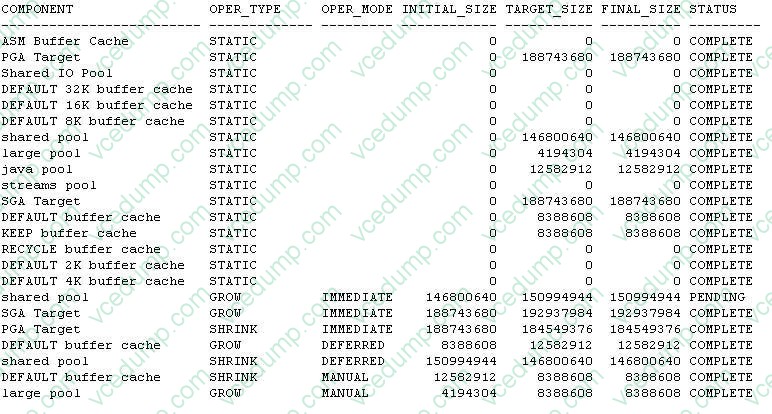
B. Automatic Shared Memory Management (ASMM) is enabled but not AMM.
C. The Shared Pool grew in IMMEDIATE mode to avoid an out-of-memory error.
D. The Default Buffer Cache grew in DEFERRED mode to avoid an out-of-memory error.
E. The memory is transferred in IMMEDIATE mode only if there are entirely empty granules available in other components. -
Question 173:
Identify the situation in which you would use the Automatic Workload Repository (AWR) baseline template.
A. when creating AWR snapshots based on a repeating time schedule
B. when creating and dropping AWR baselines based on a repeating time schedule
C. when computing statistics for all moving window baselines based on a repeating time schedule in the future
D. when resetting the threshold values for the SYSTEM_MOVING_WINDOW baseline based on a repeating time schedule in the future -
Question 174:
Your database has the HR and Reporting applications. The HR application does most of the transactions on the database and the Reporting application does most of the batch processing operations.The Reporting application has more workload during nonpeak hours. Both the HR and Reporting applications run on the middle tier using connection pooling for connecting to database.You want to statistically measure the workload generated by both the applications and set priority for the workload generated by the applications. Which option would help you achieve this?
A. Assigning individual sessions created by the applications to consumer groups and setting relative priority
B. Assigning profiles to individual sessions created by the applications to set the relative priority for the resource usage
C. Creating services for the applications and setting the relative priority of services within an instance by binding the services directly to consumer groups
D. Creating services for the applications and assigning different profiles to the sessions created by the sessions to set the relative priority for the resource usage -
Question 175:
View the Exhibit.You want to set the threshold for the number of transactions (per second)metric with the threshold type as significance level. Which baseline would you choose to make the threshold adaptive?
A. LAST_NIGHT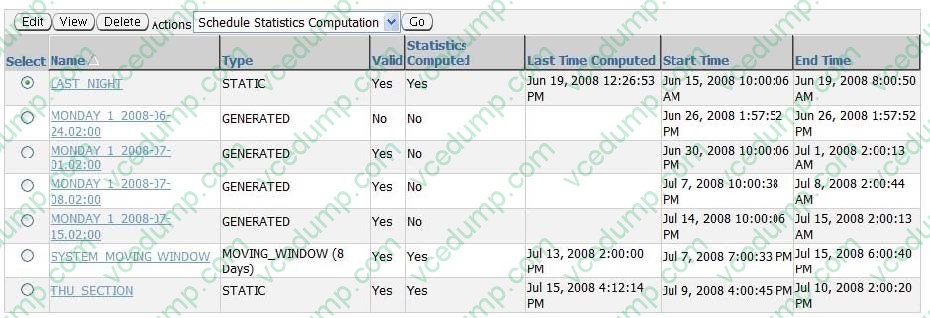
B. THU_SECTION
C. SYSTEM_MOVING_WINDOW
D. MONDAY_1_2008-07-15.02:00 -
Question 176:
For which two systems would you recommend configuring DBWR I/O slaves instead of multiple database writer processes? (Choose two.)
A. for systems where you have a single CPU
B. for systems where asynchronous I/O is not available
C. for systems with multiple CPUs or multiple processor groups
D. for systems where asynchronous I/O is available and configured
E. for systems where throughput is an important performance consideration -
Question 177:
View the Exhibit and examine the result of Automatic SQL Tuning for a period. None of the recommended SQL profiles are implemented. What would you do to allow the Automatic SQL Tuning implement the SQL profiles automatically?
A. Set the OPTIMIZER_MODE parameter to ALL_ROWS for the database instance.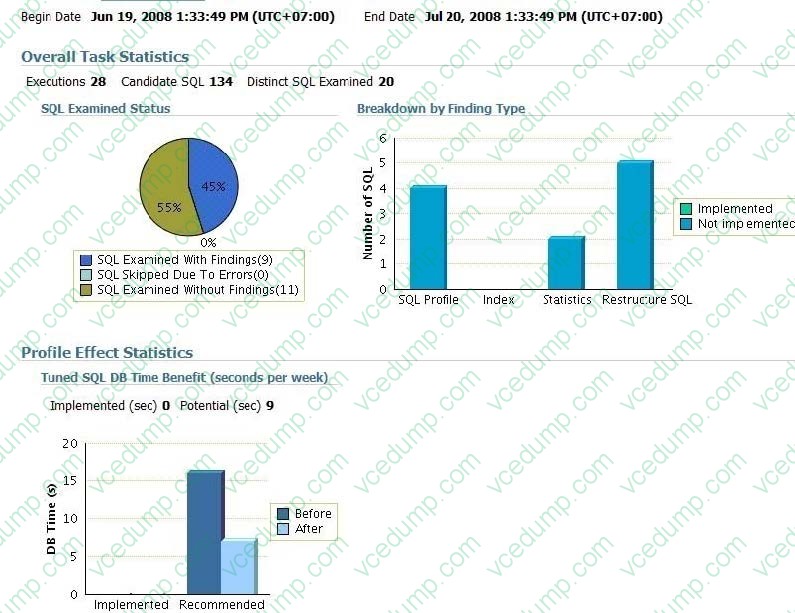
B. Set the SQLTUNE_CATEGORY parameter to DEFAULT for the database instance.
C. Set the OPTIMIZER_CAPTURE_SQL_PLAN_BASELINES parameter to TRUE for the database instance.
D. Use the DBMS_SQLTUNE.SET_TUNING_TASK_PARAMETERS procedure to set ACCEPT_SQL_PROFILES to TRUE. -
Question 178:
You work on an online transaction processing (OLTP) database in which the SALES table has 10,000 rows but only four distinct products are sold. View the Exhibit named HIST to check data distribution in the table and the histograms on the table.
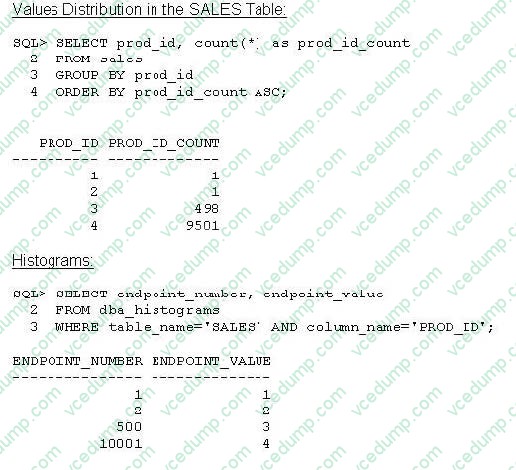
View the Exhibit named QUERY-1 that shows details in the V$SQL view for the query executed on the SALES table having product id 1.
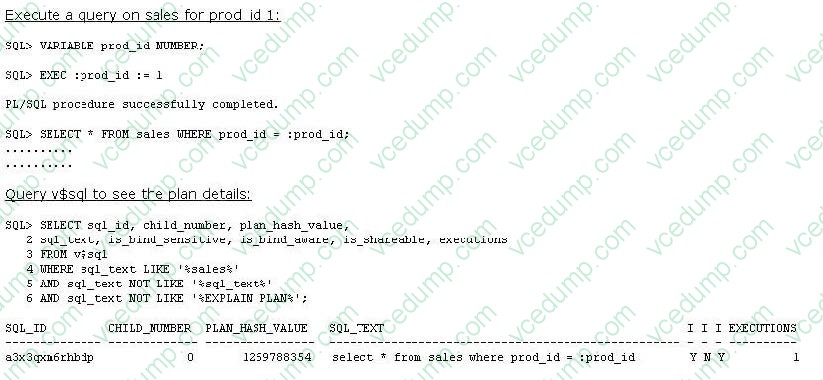
Further, you query the SALES table thrice more in the following order:
-
query rows having product ID 4
-
query rows having product ID 2
-
query rows having product ID 4
View the Exhibit named QUERY-n to see the details about these queries.
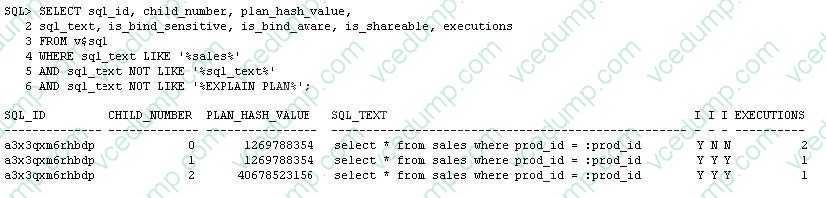
What do you infer from this?
A. The second plan was created because the first plan was aged out.
B. The CURSOR_SHARING parameter value was changed to EXACT after the second query was executed.
C. The third plan was created because the first plan was aged out and the second plan had different selectivity.
D. The first two executions used the same plan because at parse time the optimizer did not consider selectivity as the cursor was not yet considered bind-aware. -
Question 179:
You are managing an online transaction processing (OLTP) application database. Some users on the system are reporting degradation in the performance of SQL statements. To diagnose the problem, you want to identify the SQL statements that are expensive on system resources.What would you recommend to accomplish the task? (Choose all that apply.)
A. running SQL Access Advisor
B. running SQL Performance Analyzer
C. querying the V$SQLSTATS and V$SQL_PLAN views to get the information
D. creating an Automatic Workload Repository (AWR) report for the problematic period -
Question 180:
View the Exhibit and examine the content of the V$SGA_RESIZE_OPS view.
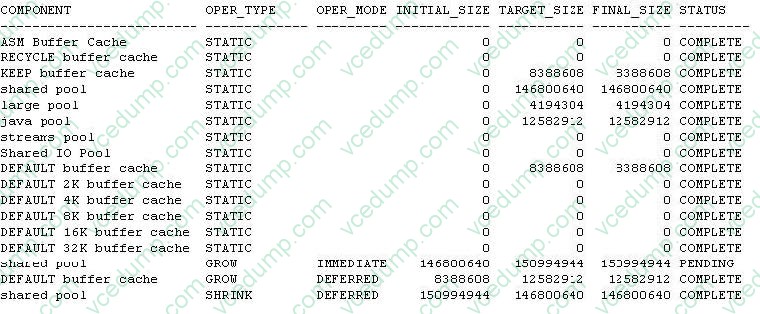
The Shared Pool was shrunk when the Default Buffer Cache required more memory. Why did the Java Pool not shrink when the Default Buffer Cache grew?
A. because it is not an auto-tuned component
B. because it uses memory available outside the total SGA size
C. because it always requires three granules and cannot be reduced
D. because it has less free memory than the Database Buffer Cache
E. because it cannot be shrunk below the value set to the JAVA_POOL_SIZE parameter
Related Exams:
-
1Z0-020
Oracle8i: New Features for Administrators -
1Z0-023
Architecture and Administration -
1Z0-024
Performance Tuning -
1Z0-025
Backup and Recovery -
1Z0-026
Network Administration -
1Z0-034
Upgrade Oracle9i/10g OCA to Oracle Database OCP -
1Z0-036
Managing Oracle9i on Linux -
1Z0-041
Oracle Database 10g: DBA Assessment -
1Z0-052
Oracle Database 11g: Administration Workshop I -
1Z0-053
Oracle Database 11g: Administration II
Tips on How to Prepare for the Exams
Nowadays, the certification exams become more and more important and required by more and more enterprises when applying for a job. But how to prepare for the exam effectively? How to prepare for the exam in a short time with less efforts? How to get a ideal result and how to find the most reliable resources? Here on Vcedump.com, you will find all the answers. Vcedump.com provide not only Oracle exam questions, answers and explanations but also complete assistance on your exam preparation and certification application. If you are confused on your 1Z0-054 exam preparations and Oracle certification application, do not hesitate to visit our Vcedump.com to find your solutions here.