1Z0-054 Exam Details
-
Exam Code
:1Z0-054 -
Exam Name
:Oracle Database 11g: Performance Tuning -
Certification
:Oracle Certifications -
Vendor
:Oracle -
Total Questions
:192 Q&As -
Last Updated
:Dec 09, 2021
Oracle 1Z0-054 Online Questions & Answers
-
Question 11:
What type of redundancy would you recommend for the Automatic Storage Management (ASM) of a file system based on RAID level 1 for the optimum performance of database using ASM storage?
A. high redundancy
B. normal redundancy
C. external redundancy
D. use both ASM mirroring and hardware mirroring -
Question 12:
On examining the Automatic Workload Repository (AWR) report, you find that log file sync appears among the top 5 wait events.On further investigation, you notice that the average time waited for this event is low, but the number of waits are high.What does this imply?
A. DBWR is slow.
B. LGWR is slow due to slow I/O.
C. Redo log buffer size is insufficient.
D. The application might be committing frequently. -
Question 13:
You used SQL Tuning Advisor for a long-running SQL statement that suggested a SQL profile which can be used by the query subsequently for better execution plan. View the Exhibit. But you want certain user sessions not to use this SQL profile for their queries. How would you implement this?
A. Alter the SQL profile to change the category of the SQL profile.
B. Set the OPTIMIZER_USE_PENDING_STATISTICS to TRUE the desired sessions.
C. Use database resource manager to prevent the use of the SQL profile by these user sessions.
D. Use database resource manager to preUse the resource management feature in profiles of these users to prevent the use of the SQL profile. -
Question 14:
View the Exhibit and examine a portion of the output obtained from the following query:
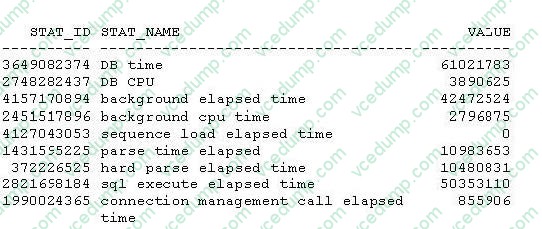
SQL> SELECT * FROM v$sys_time_model;
Select three correct interpretations of the time model statistics. (Choose three.)
A. DB time includes the wait time of all the nonidle and idle user sessions.
B. SQL execute elapsed time includes the time spent in performing fetches of query results.
C. DB CPU includes the CPU time spent on database user-level calls and background CPU time.
D. SQL execute elapsed time includes components of the hard parse elapsed time like bind elapsed time.
E. DB time includes the connection management call elapsed time excluding the background process time. -
Question 15:
Identify the reason why chained or migrated rows in a table cause performance degradation when you access them.
A. because the ROWID changes for these rows
B. because these rows make existing indexes invalid
C. because it is not possible to use indexes to retrieve these rows
D. because retrieving these rows requires more than one data block to be accessed
E. because the rows force queries to use temporary segments while retrieving them -
Question 16:
What indicates that the rate of writing data blocks to the disk is very slow?
A. very high cache-hit ratio
B. increasing number of free buffer waits
C. increasing number of buffer busy waits
D. waits on latch: cache buffers chains event -
Question 17:
Your database has the ACCTG service configured for an accounting application running on a middle tier. These service is used by the middle-tier applications to connect to the database by using connection pools. The application has three modules LEDGER, ACCOUNTS, and BILLING. You asked the developers to invoke the DBMS_APPLICATION_INFO.SET_MODULE procedure to set the module name and action in the code for the application. You enabled tracing at the service level by executing the following command:
SQL> exec DBMS_MONITOR.SERV_MOD_ACT_TRACE_ENABLE('ACCTG');
You want to consolidate the trace output from the trace files created based on module. Which is the appropriate solution for this?
A. Using trace files as input for the tkprof utility to consolidate the tracing of sessions for a module
B. Using the trace file as input for the trcsess utility to consolidate and process the output for a module
C. Using the trcsess utility to consolidate all trace files into a single output file, which can then be processed by the tkprof utility
D. Using the trace file as input for the trcsess utility and creating output files that can directly be used by the users for performance or debugging purposes -
Question 18:
In a database, the values for transactions per second are higher during working hours and lower during nonworking hours. You want to receive alerts in future time periods if the daytime performance varies compared to the captured daytime performance or the nighttime performance varies compared to the captured nighttime performance, over a repeating time period. This would permit the DBA to perform additional performance tuning operations. Which feature would you use to record this variation in performance statistics?
A. SQL tuning set
B. SQL plan baselines
C. the Automatic Workload Repository (AWR) baseline
D. the Automatic Workload Repository (AWR) baseline template -
Question 19:
View the Exhibit and examine the sample Automatic Database Diagnostic Monitor (ADDM) report.Which statement is true about the report?
A. The sum of impacts under recommendations in Finding 2 cannot exceed 100%.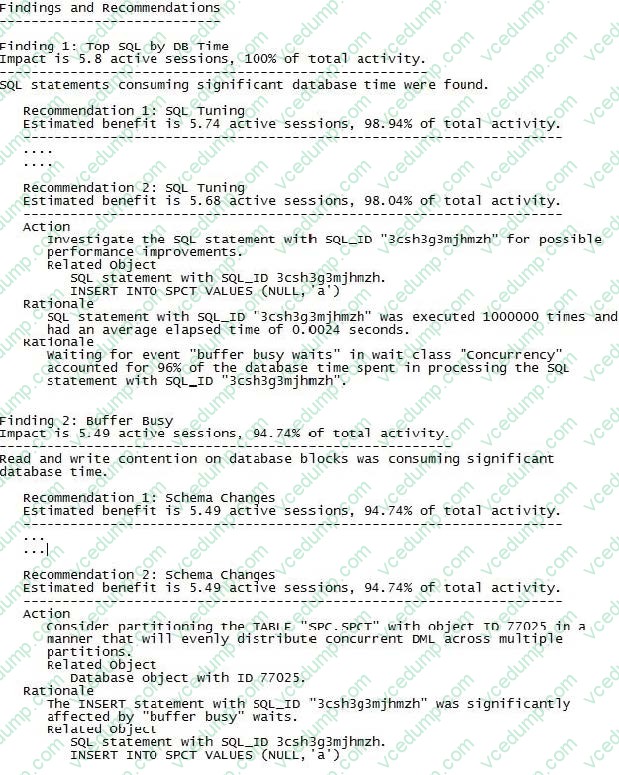
B. It is possible that the sum of impacts under recommendations in Finding 2 can exceed 100%.
C. The recommendations regarding "buffer busy" wait cannot appear more than once in the report.
D. The sum of impacts of recommendation 2 in Finding 1 and recommendation 2 in Finding 2 cannot exceed 100%. -
Question 20:
You generate an AWR Compare Periods Report for two consecutive time periods as a routine activity to monitor your database performance.View the Exhibit and examine the partial details of the Time Model Statistics generated in the report.Which two statements give a correct inference based on the DB Time and DB CPU in the Time Model Statistics? (Choose two.)
A. More CPU time was used for background processes in the first time period.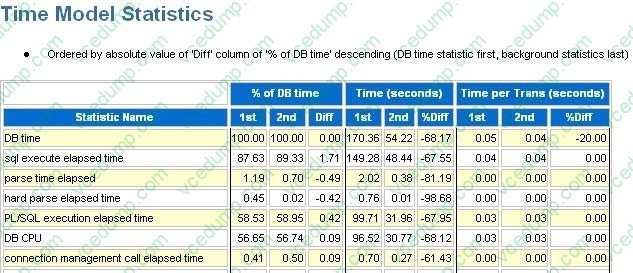
B. A change to the database configuration reduced the % DB time for transactions.
C. More of DB Time was consumed by background processes in the first time period.
D. A reduction in Hard Parse activity resulted in a reduction of DB CPU Time (in seconds).
E. More transactions were processed in the first time period based on the DB Time values.
Related Exams:
-
1Z0-020
Oracle8i: New Features for Administrators -
1Z0-023
Architecture and Administration -
1Z0-024
Performance Tuning -
1Z0-025
Backup and Recovery -
1Z0-026
Network Administration -
1Z0-034
Upgrade Oracle9i/10g OCA to Oracle Database OCP -
1Z0-036
Managing Oracle9i on Linux -
1Z0-041
Oracle Database 10g: DBA Assessment -
1Z0-052
Oracle Database 11g: Administration Workshop I -
1Z0-053
Oracle Database 11g: Administration II
Tips on How to Prepare for the Exams
Nowadays, the certification exams become more and more important and required by more and more enterprises when applying for a job. But how to prepare for the exam effectively? How to prepare for the exam in a short time with less efforts? How to get a ideal result and how to find the most reliable resources? Here on Vcedump.com, you will find all the answers. Vcedump.com provide not only Oracle exam questions, answers and explanations but also complete assistance on your exam preparation and certification application. If you are confused on your 1Z0-054 exam preparations and Oracle certification application, do not hesitate to visit our Vcedump.com to find your solutions here.