100-101 Exam Details
-
Exam Code
:100-101 -
Exam Name
:CCNA Interconnecting Cisco Networking Devices 1 (ICND1) -
Certification
:Cisco Certifications -
Vendor
:Cisco -
Total Questions
:202 Q&As -
Last Updated
:Dec 07, 2021
Cisco 100-101 Online Questions & Answers
-
Question 61:
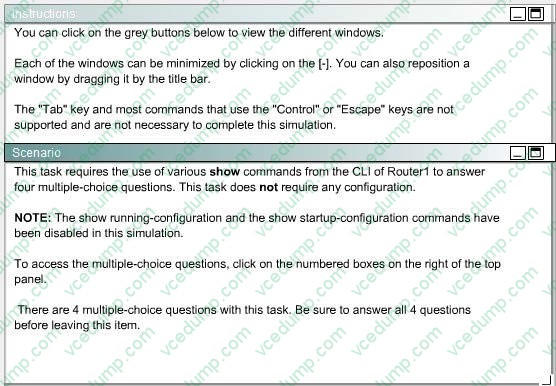
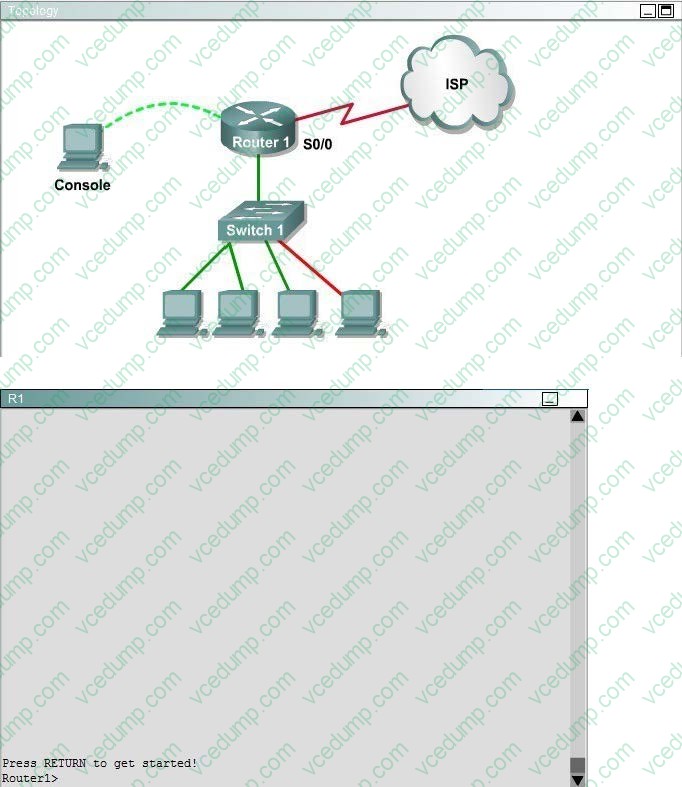
Including the address on the Routed Ethernet interface, how many hosts can have IP addresses on the LAN to which Routed is connected?
A. 6
B. 30
C. 62
D. 126 -
Question 62:
Refer to the exhibit.
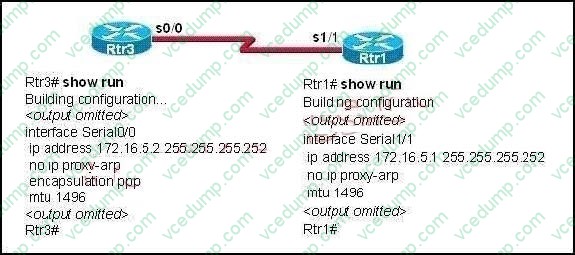
A network administrator is troubleshooting a connectivity problem on the serial interfaces. The output from the show interfaces command on both routers shows that the serial interface is up, line protocol is down. Given the partial output for the show running-config in the exhibit, what is the most likely cause of this problem?
A. The serial cable is bad.
B. The MTU is incorrectly configured.
C. The Layer 2 framing is misconfigured.
D. The IP addresses are not in the same subnet. -
Question 63:
Refer to the exhibit.
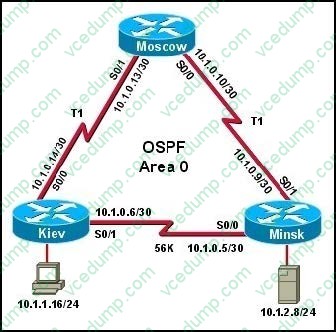
The host in Kiev sends a request for an HTML document to the server in Minsk. What will be the source IP address of the packet as it leaves the Kiev router?
A. 10.1.0.1
B. 10.1.0.5
C. 10.1.0.6
D. 10.1.0.14
E. 10.1.1.16
F. 10.1.2.8 -
Question 64:
Scenario
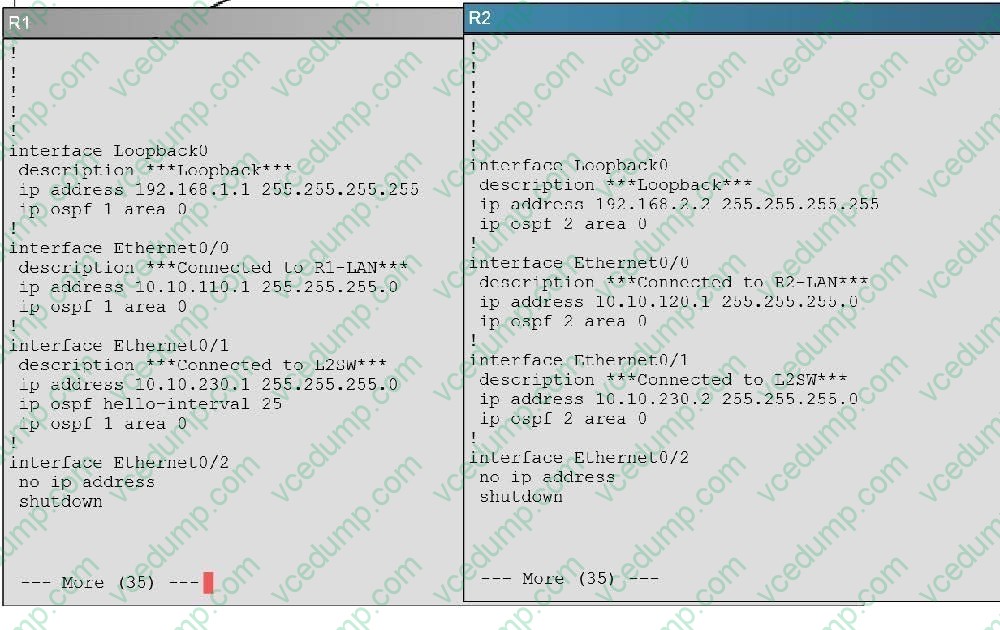
Refer to the topology. Your company has decided to connect the main office with three other remote branch offices using point-to-point serial links.
You are required to troubleshoot and resolve OSPF neighbor adjacency issues between the main office and the routers located in the remote branch offices.
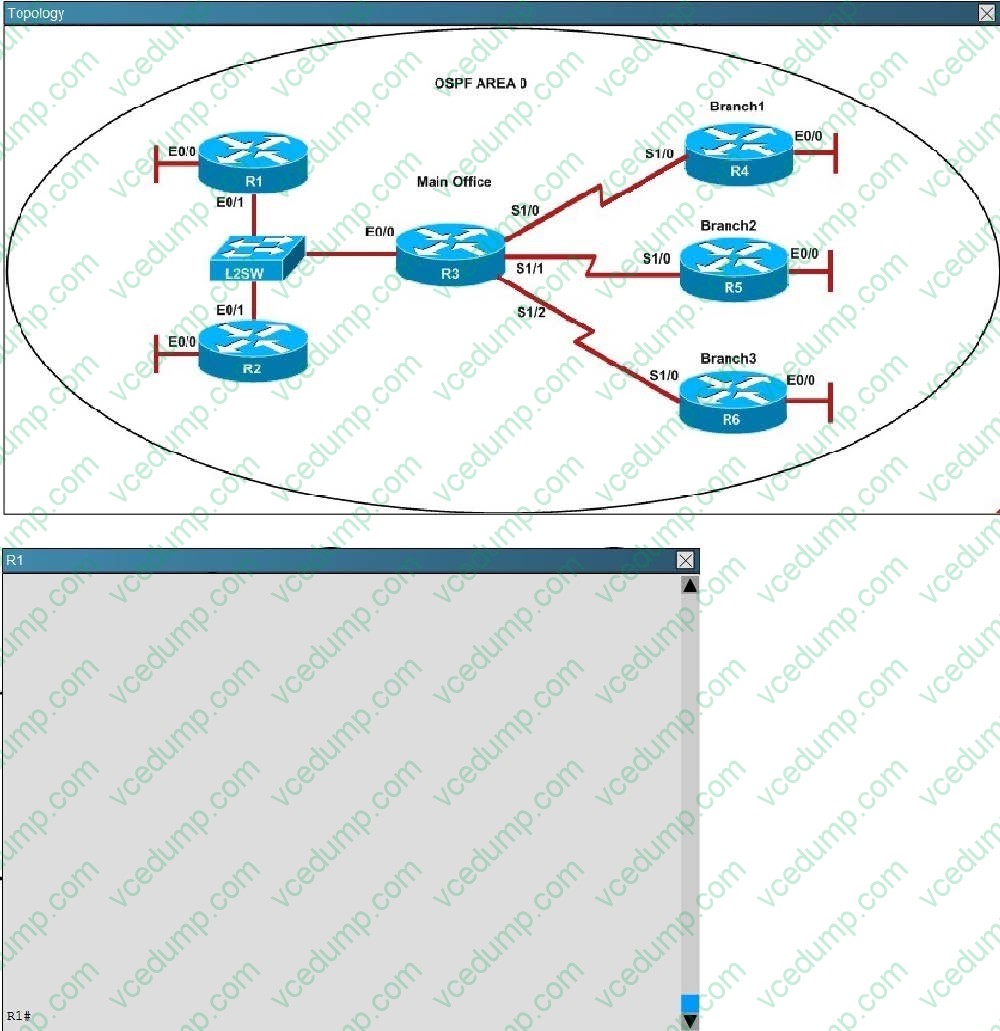

R1 does not form an OSPF neighbor adjacency with R2. Which option would fix the issue?
A. R1 ethernetO/1 is shutdown. Configure no shutdown command.
B. R1 ethernetO/1 configured with a non-default OSPF hello interval of 25: configure no ip ospf hello- interval 25
C. R2 ethernetO/1 and R3 ethernetO/O are configured with a non-default OSPF hello interval of 25; configure no ip ospf hello-interval 25
D. Enable OSPF for R1 ethernetO/1; configure ip ospf 1 area 0 command under ethernetO/1 -
Question 65:
What is the purpose of flow control?
A. To ensure data is retransmitted if an acknowledgement is not received.
B. To reassemble segments in the correct order at the destination device.
C. To provide a means for the receiver to govern the amount of data sent by the sender.
D. To regulate the size of each segment. -
Question 66:
Refer to the exhibit.
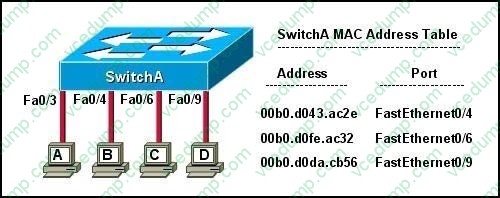
The exhibit is showing the topology and the MAC address table. Host A sends a data frame to host D. What will the switch do when it receives the frame from host A?
A. The switch will add the source address and port to the MAC address table and forward the frame to host D.
B. The switch will discard the frame and send an error message back to host A.
C. The switch will flood the frame out of all ports except for port Fa0/3.
D. The switch will add the destination address of the frame to the MAC address table and forward the frame to host D. -
Question 67:
OSPF is configured using default classful addressing. With all routers and interfaces operational, how many networks will be in the routing table of R1 that are indicated to be learned by OSPF?
A. 2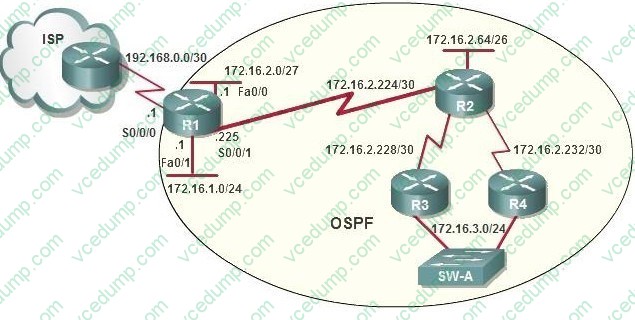
B. 3
C. 4
D. 5
E. 6
F. 7 -
Question 68:
Which commands are required to properly configure a router to run OSPF and to add network 192.168.16.0/24 to OSPF area 0? (Choose two.)
A. Router(config)# router ospf 0
B. Router(config)# router ospf 1
C. Router(config)# router ospf area 0
D. Router(config-router)# network 192.168.16.0 0.0.0.255 0
E. Router(config-router)# network 192.168.16.0 0.0.0.255 area 0
F. Router(config-router)# network 192.168.16.0 255.255.255.0 area 0 -
Question 69:
After the network has converged, what type of messaging, if any, occurs between R3 and R4?
A. No messages are exchanged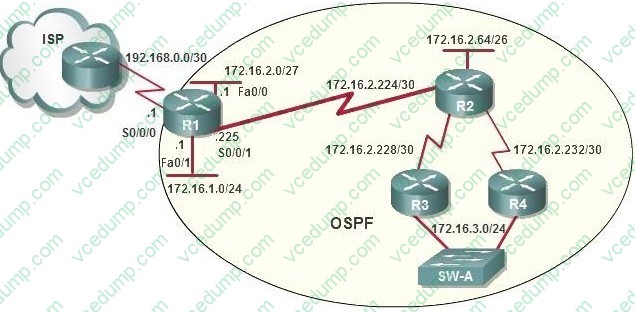
B. Hellos are sent every 10 seconds.
C. The full database from each router is sent every 30 seconds.
D. The routing table from each router is sent every 60 seconds. -
Question 70:
Which two of these functions do routers perform on packets? (Choose two.)
A. Examine the Layer 2 headers of inbound packets and use that information to determine the next hops for the packets
B. Update the Layer 2 headers of outbound packets with the MAC addresses of the next hops
C. Examine the Layer 3 headers of inbound packets and use that information to determine the next hops for the packets
D. Examine the Layer 3 headers of inbound packets and use that information to determine the complete paths along which the packets will be routed to their ultimate destinations
E. Update the Layer 3 headers of outbound packets so that the packets are properly directed to valid next hops
F. Update the Layer 3 headers of outbound packets so that the packets are properly directed to their ultimate destinations
Related Exams:
-
300-745
Designing Cisco Security Infrastructure (300-745 SDSI) v1.0 -
350-101
Implementing and Operating Cisco Wireless Core Technologies (350-101 WLCOR)v1.0 -
352-011
Cisco Certified Design Expert Practical -
500-052
Cisco Unified Contact Center Express -
500-173
Designing the FlexPod Solution (FPDESIGN) -
500-201
Deploying Cisco Service Provider Mobile Backhaul Solutions -
500-210
SP Optical Technology Field Engineer Representative -
500-220
Engineering Cisco Meraki Solutions (ECMS) v2.2 -
500-230
Cisco Service Provider Routing Field Engineer -
500-240
Cisco Mobile Backhaul for Field Engineers
Tips on How to Prepare for the Exams
Nowadays, the certification exams become more and more important and required by more and more enterprises when applying for a job. But how to prepare for the exam effectively? How to prepare for the exam in a short time with less efforts? How to get a ideal result and how to find the most reliable resources? Here on Vcedump.com, you will find all the answers. Vcedump.com provide not only Cisco exam questions, answers and explanations but also complete assistance on your exam preparation and certification application. If you are confused on your 100-101 exam preparations and Cisco certification application, do not hesitate to visit our Vcedump.com to find your solutions here.